


Choosing Your 2 Inch Discharge Hose A Practical Guide
When you need to move a lot of water—and fast—the 2 inch discharge hose is your go-to piece of equipment. Think of it as the heavy-lifter for dewatering a flooded basement, clearing a muddy construction site, or draining an agricultural field. The 2-inch diameter really hits the sweet spot, offering the perfect blend of high flow and manageable weight, which is why it's a staple for contractors, farmers, and industrial maintenance crews.
Your Guide to the 2 Inch Discharge Hose
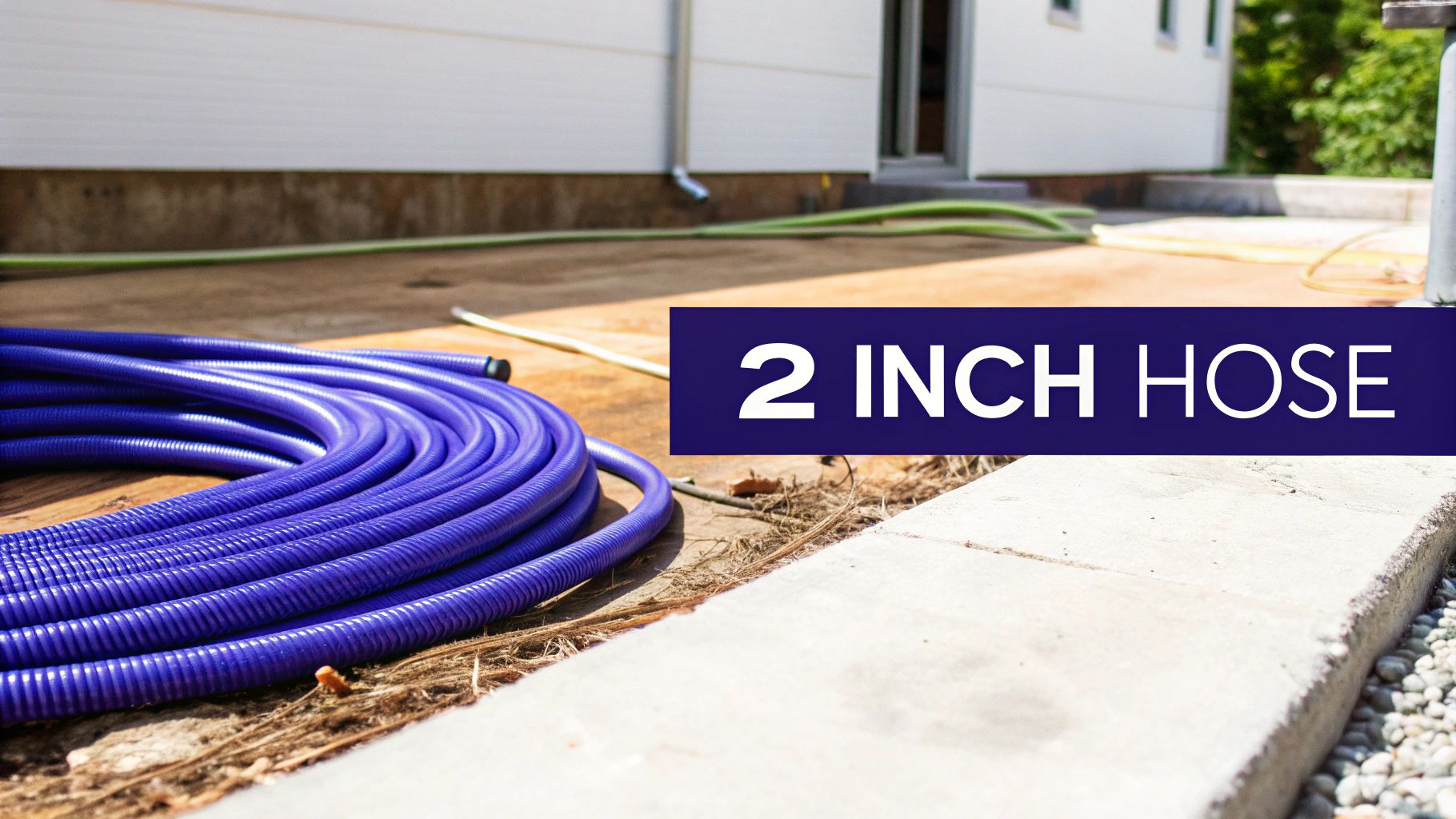
This hose is the true workhorse of fluid transfer. It connects right to your pump's outlet and creates a dedicated channel to guide all that unwanted water to a safe disposal area. It’s not your average garden hose, which is built for high pressure but low volume. A discharge hose is engineered for the opposite: moving huge volumes of water at lower pressures, often hundreds of gallons per minute.
The 2-inch size is so popular because it strikes an ideal balance. Anything smaller would be too slow for serious dewatering jobs. Anything larger, and you're dealing with a hose that's too heavy and awkward for one person to wrestle into place. This diameter lets you move fluid quickly without needing heavy machinery just to position the hose.
2 Inch Discharge Hose At-a-Glance
To give you a clearer picture, here’s a quick rundown of what makes a typical 2-inch discharge hose tick. This table breaks down its key attributes, common materials, and the benefits they bring to the job site.
Attribute | Common Specification | Primary Benefit |
|---|---|---|
Inner Diameter | 2 Inches | Balances high flow rate with manageable weight. |
Common Materials | PVC, Rubber, Polyurethane | Offers flexibility and resistance to abrasion/chemicals. |
Construction | Lay-flat design | Easy to store, transport, and deploy quickly. |
Pressure Rating | 50-80 PSI (Typical) | Optimized for high-volume discharge, not high pressure. |
Typical Use Cases | Construction dewatering, flood control, irrigation | Versatile enough for industrial, municipal, and agricultural jobs. |
This combination of features makes the 2-inch hose an incredibly practical and versatile tool for a wide range of water transfer applications.
Serving San Luis Obispo and Surrounding Areas
For professionals working here on California's Central Coast, having equipment you can count on isn't just a preference—it's a necessity. We are the premier local source for industrial-grade hoses and fittings, proudly serving a wide range of communities from San Luis Obispo and the surrounding areas.
Our team provides expert advice and a deep inventory to clients in:
San Luis Obispo
Paso Robles
Atascadero
Arroyo Grande
Pismo Beach
Grover Beach
Morro Bay
Santa Maria
And other local communities across the Central Coast
We understand the unique challenges of our region, from the dewatering needs of coastal construction projects to the critical irrigation demands of local vineyards. Our focus has always been on providing durable, high-performance solutions that keep your projects moving forward.
Whether you're managing a job site in Paso Robles or running a farm in Santa Maria, having the right 2 inch discharge hose—and the expert support to back it up—is crucial for getting the job done right.
Getting to Know Your Hose: Materials and Construction
A 2 inch discharge hose isn't just a simple tube. Its material and internal structure are what really determine its strength, how flexible it is, and ultimately, how long it will last on the job. Looking past the price tag to understand these core components is how you pick a hose that’s actually built for your world, whether that’s a muddy construction site or a sprawling farm.
The two main players you'll see are PVC (Polyvinyl Chloride) and rubber. PVC is the lightweight, nimble option. It's the go-to for lay-flat hoses, making it a breeze to haul around, stretch across a field for irrigation, and roll up when you're done. It handles water and many chemicals without breaking a sweat.
Rubber, on the other hand, is the heavyweight champ. A rubber hose is all about toughness, built to take a beating from abrasions, cuts, and punctures. This makes it the only real choice for gritty job sites where hoses get dragged over gravel, rebar, and whatever else is lying around.
The Skeleton of the Hose
It’s what’s on the inside that counts, and for a hose, that means its internal reinforcement. This is the "skeleton" that gives it strength and resilience. You'll hear terms like "fabric ply" and "helix reinforcement," and they're simpler than they sound.
Fabric Ply Reinforcement: This is all about layering. High-tensile synthetic fabrics, like polyester or nylon yarn, are embedded right into the hose walls. Each layer, or "ply," adds another level of strength to handle pressure and stop the hose from stretching or ballooning. Think of it like a well-made tire, designed to take stress without blowing out.
Helix Reinforcement: Some hoses have a rigid plastic or even a metal spiral—a helix—running through the wall. While it's more common in suction hoses to keep them from collapsing, in a discharge hose, it’s fantastic for preventing kinks and helping the hose keep its round shape when bent around corners.
A hose’s construction is its promise of performance. A simple PVC lay-flat is perfect for open-field irrigation, but a fabric-reinforced rubber hose provides the grit needed to survive the daily abuse of a dewatering project.
Global Impact and Local Solutions
The humble 2 inch discharge hose is a workhorse in key industries worldwide, especially in North American agriculture and construction. In some farming hubs, these hoses are essential for irrigation, handling over 40% of crop water discharge. Material innovations like reinforced PVC have pushed the average hose lifespan past 10 years, which can slash replacement costs by up to 25% for big operations. You can dive deeper into these trends by checking out the full report on the discharge hose market.
For our customers here on California's Central Coast, these details matter. We know a farmer in Paso Robles has different needs than a construction crew in San Luis Obispo. That’s why we focus on providing the right solutions for our local communities—from Atascadero and Arroyo Grande to Pismo Beach, Grover Beach, Morro Bay, and Santa Maria—to make sure you get a hose truly built for the job you do.
Matching Your Hose to Your Pump
Pairing your pump with the right 2 inch discharge hose is non-negotiable. Trying to force water from a high-power pump through an underrated hose is like shoving a fire truck’s output through a garden hose—it’s not going to end well. You’re setting yourself up for a catastrophic failure.
The most critical spec to match is the pressure rating, measured in Pounds per Square Inch (PSI). Your hose must be rated to handle the maximum pressure your pump can kick out.
Think of it this way: your pump is the engine, and the hose is the road. If you put a race car engine in a vehicle built for a quiet country lane, the road is going to tear apart. In the same way, hooking a pump that generates 100 PSI to a hose only rated for 60 PSI is asking for trouble. The hose will rupture, creating a dangerous burst that can cause injuries, wreck equipment, and bring your project to a screeching halt.
Bottom line: always check the manufacturer’s specs on both your pump and your hose. The hose's PSI rating has to be higher than the pump's maximum output pressure. No exceptions.
Flow Rate and Efficiency
Beyond pressure, you have to think about flow rate, measured in Gallons Per Minute (GPM). Your pump and 2 inch discharge hose need to be in sync to move water efficiently. A mismatch here won't necessarily blow the hose, but it will absolutely tank your productivity.
An undersized hose creates a bottleneck. This chokes the flow and forces your pump to work way harder than it should, burning more fuel and leading to premature wear and tear. That kind of strain can cause the pump to overheat and eventually fail. If you want to dive deeper into keeping your pump running for the long haul, check out these essential tips for pressure washer pump maintenance.
The goal is to build a balanced system. You want a hose that can comfortably handle the volume of water the pump is pushing, ensuring everything runs smoothly and efficiently.
A Practical Selection Guide
So, how do you pick the right hose? A lot of it comes down to where you'll be working. This simple decision tree below can help you nail down the right material for your specific job site.
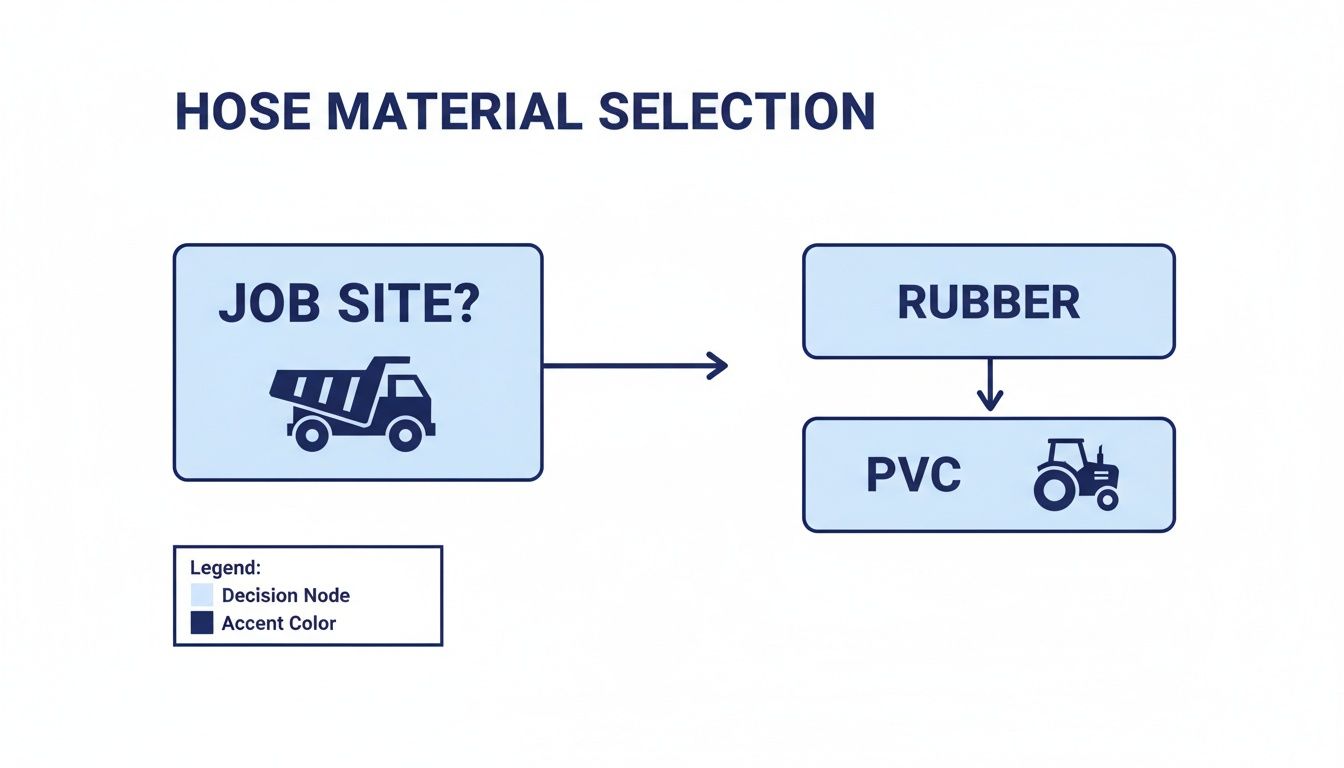
As you can see, rough-and-tumble environments like construction sites almost always call for heavy-duty rubber. On the other hand, agricultural settings often benefit from the lighter weight and flexibility of PVC. For a more detailed look at how different pumps affect your setup, this guide to RV water pumps offers some great insights into overall system efficiency.
We provide reliable hose solutions to professionals across the Central Coast. Whether you're in San Luis Obispo, Paso Robles, Atascadero, or Santa Maria, we have the right hose for your pump. Our local experts serve Arroyo Grande, Pismo Beach, Grover Beach, and Morro Bay with tailored advice for regional needs.
Selecting the Right Couplings and Fittings
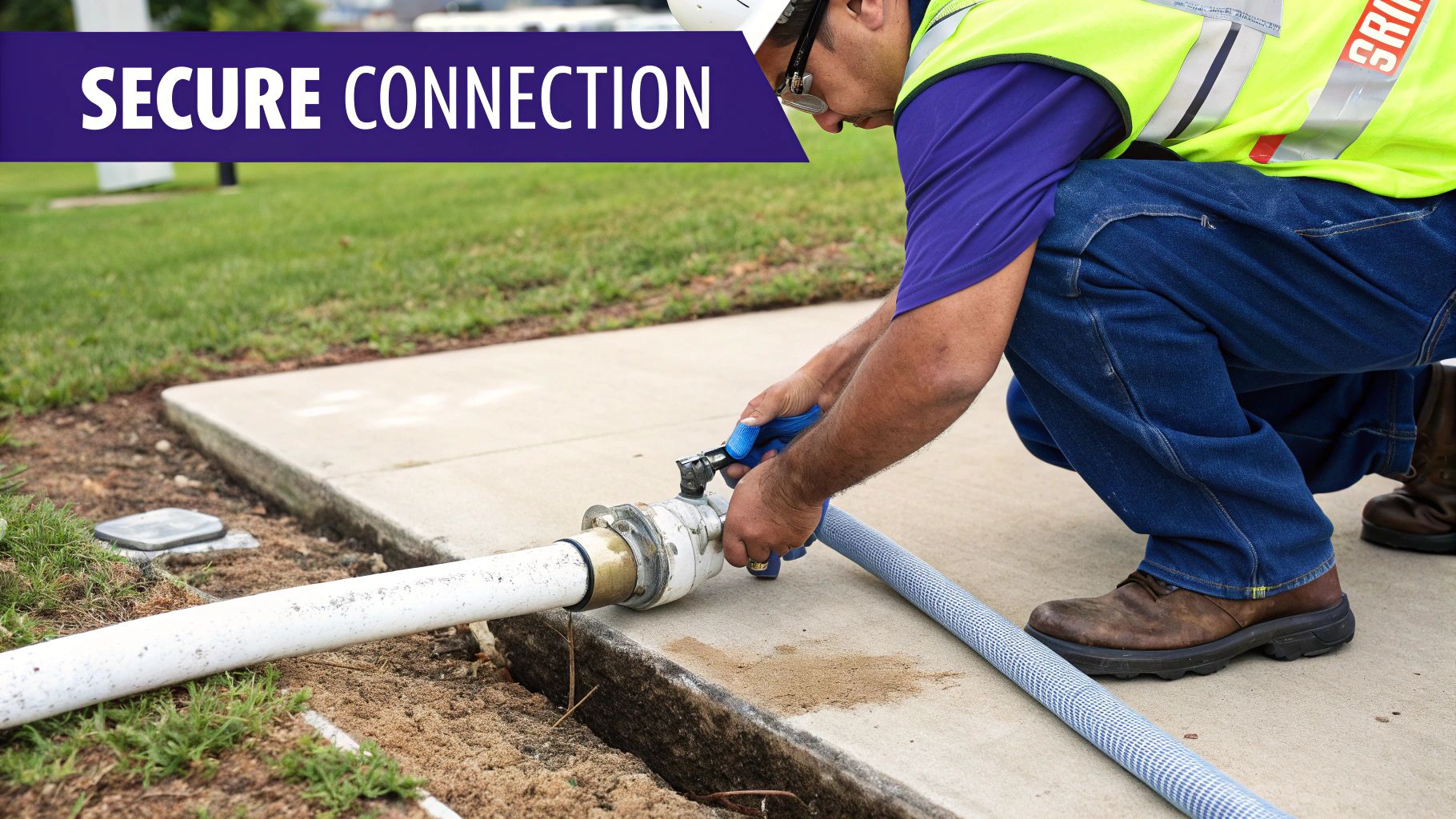
Even the best 2 inch discharge hose is just a long tube without a solid, leak-proof connection to your pump. Couplings are the critical link in the chain, and picking the right one means every drop of water ends up exactly where it’s supposed to go.
Think of them as the handshake between your hose and your equipment. It has to be strong and reliable, or the whole system falls apart.
The most common fittings all have their own specific job to do. Knowing where each one shines will save you from leaks, cut down on frustrating downtime, and keep your job site running like a well-oiled machine. For most contractors, the decision comes down to a trade-off between speed and sheer ruggedness.
Common Couplings for a 2 Inch Discharge Hose
You'll run into three main styles out in the field for a 2 inch discharge hose. Each one is built for different applications and environments.
Cam & Groove (Camlock): These are the undisputed champions of speed. With two levers on the female fitting that clamp down over a male adapter, they let you connect and disconnect in seconds—no tools required. This makes them a go-to for temporary dewatering jobs where you’re setting up and tearing down fast.
Pin Lug: Built for the tough jobs. Pin lug couplings require spanner wrenches to tighten, creating a high-pressure, vibration-resistant seal that won't budge. They’re perfect for demanding work where the hose stays put for a while or is hooked up to a rattling trash pump.
Storz: This is a clever, sexless coupling that connects with a quick quarter-turn. It's the standard in firefighting, where 2-inch hoses are workhorses, used in over 55% of structural fires because they hit the sweet spot for flow rate. You can find more insights on the fire hose market to see just how vital they are.
No matter which coupling you choose, the goal is always the same: a perfect seal. A sloppy connection doesn't just waste water. It can cause pump cavitation, tank your flow efficiency, and turn your work site into a hazardous, slippery mess.
Ensuring a Secure Connection
Getting your couplings attached properly is pretty straightforward. For a Cam & Groove, just slide the male adapter into the female coupler and press the handles down firmly until they click into place.
With a Pin Lug, use a spanner wrench to turn the swivel nut until it's snug, then give it an extra quarter-turn to lock it down tight. And don't forget that proper maintenance of these parts is just as important. To get a better handle on equipment upkeep, take a look at our complete guide to pressure washer parts and repair.
We stock dependable hoses and fittings for professionals all over San Luis Obispo and the surrounding areas. Whether you're working in Paso Robles, Atascadero, Santa Maria, or anywhere on the Central Coast, we’ve got the right connections to get your job done.
Real-World Hose Applications
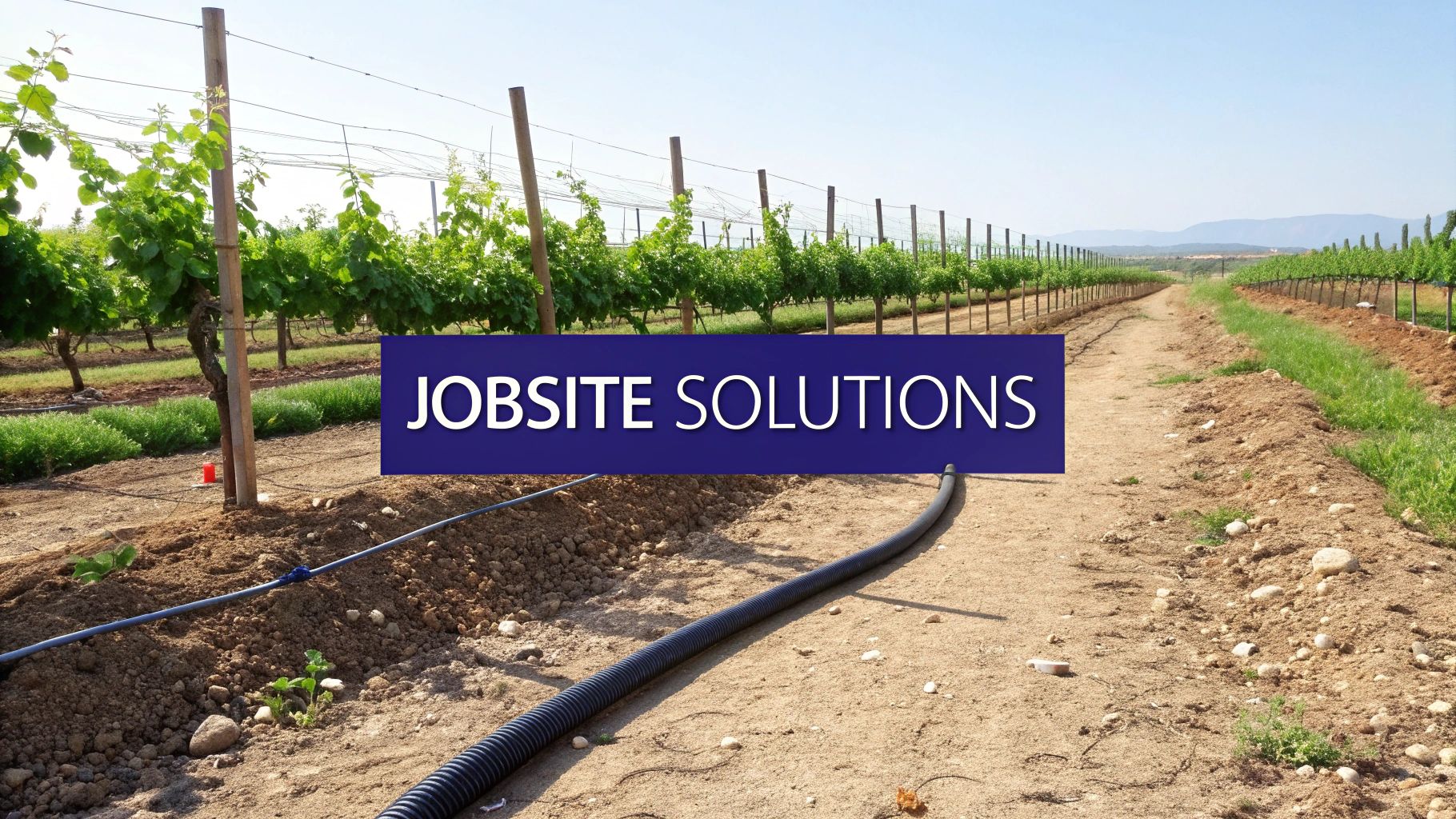
This is where the rubber meets the road—or, in this case, the mud, gravel, and farmland. All the technical specs in the world don't mean much until you see how a 2 inch discharge hose actually performs on the job. It's not just a piece of equipment; it's the tool that keeps projects moving and solves real-world problems.
Think about a construction crew staring down a flooded excavation site after a surprise downpour. Every minute of delay costs money. This is the perfect scenario for a heavy-duty rubber 2 inch discharge hose. You can drag it over sharp rocks and debris without worrying about punctures, and it will keep pumping reliably under pressure.
Versatility in Action
Now, let's head over to a vineyard in Paso Robles during a long, dry summer. A farmer's entire crop is on the line, and efficient irrigation is everything. Here, a lightweight PVC lay-flat hose is the hero. It’s flexible enough to snake through rows of vines with ease, and its UV-resistant material won’t crack or degrade under the intense California sun.
These two scenarios show just how adaptable these hoses are:
Construction: Tough rubber hoses are the go-to for moving water filled with slurry and debris.
Agriculture: Flexible PVC hoses are ideal for large-scale, mobile irrigation systems.
Municipal Work: Durable hoses are essential for clearing flooded streets or managing storm runoff.
No matter the job, the 2-inch diameter hits that sweet spot between flow rate and portability. It’s got enough muscle for serious dewatering but is still light enough for one person to handle and deploy. That’s efficiency.
Industrial and Local Impact
This workhorse hose is just as critical in demanding industrial settings. It plays a vital role in the oil and gas industry and is used in about 30% of all dewatering operations on major infrastructure projects. A quality 2 inch discharge hose that can handle up to 300 PSI and lasts 8-12 years can cut project downtime by as much as 22%. If you're interested in the bigger picture, you can dig into the latest suction and discharge hose market trends.
For professionals right here on the Central Coast—from San Luis Obispo to Atascadero and Santa Maria—we supply hose solutions built for these exact challenges. Whether you’re on a job site in Arroyo Grande or managing crops near Pismo Beach, we have the right hose to get the job done.
Your Local Hose Supplier on The Central Coast
When you're running a job on California's Central Coast, having a local partner for your gear isn't just a nice-to-have—it's what keeps you on schedule. We're the go-to source in San Luis Obispo and the surrounding towns for your next 2 inch discharge hose and all the fittings you need to get it running.
Sourcing your parts locally means you get real, hands-on advice and can grab what you need right away. No more waiting on shipments and dealing with costly downtime. We're proud to support the hardworking contractors and agricultural pros who make our region thrive.
Service Areas We Cover
We get the unique demands of our local industries. From the tough conditions of coastal construction sites to the specific irrigation needs of Central Coast vineyards, we know what you're up against. Our service area is built to support the communities we call home.
We are on the ground providing expert hose solutions for clients throughout San Luis Obispo and its surrounding areas, including:
San Luis Obispo
Paso Robles
Atascadero
Arroyo Grande
Pismo Beach
Grover Beach
Morro Bay
Santa Maria
When you work with a local supplier, you're not just buying a part. You're getting a partner who understands the terrain, the climate, and the challenges you face every single day. We make sure the 2 inch discharge hose you walk away with is a perfect match for your job.
This commitment to the community is something we share with other great businesses in the area. It's why so many people see the value in supporting local and family-owned businesses in Santa Cruz and all along the coast.
We offer more than just parts off a shelf; we provide practical advice and a deep inventory that’s actually tailored to what people here need. Whether you're after a full assembly or just one specific fitting, our team is ready to help you sort it out.
To see everything we have in stock, check out our online catalog of hose kits & paint accessories. Give us a call today and find out why we're the trusted local supplier for all your hose and equipment needs.
Your Top Questions Answered
When you're out on the job, you just need your gear to work. But with something as fundamental as a 2 inch discharge hose, a few questions always seem to come up. Let's get straight to the practical answers for the things we hear most often, so you can keep your projects moving safely and efficiently.
What's the Real Maximum Length for a 2 Inch Discharge Hose?
There’s no hard-and-fast rule here, but there's definitely a practical limit. The enemy of long hose runs is something called friction loss—basically, the drag the inside of the hose puts on the water as it flows.
For a standard 2 inch discharge hose pushing about 100 gallons per minute (GPM), you can expect to lose roughly 5-7 PSI of pressure for every 100 feet of hose. If you’re running a hose out past 300 feet, you'll notice a big drop in pressure and flow at the business end. To overcome this, you'll either need a beefier pump or you might have to jump up to a larger diameter hose to cut down on that friction.
Can I Use a 2 Inch Discharge Hose for Suction?
Never. This is one of the most common and dangerous mistakes we see. A standard discharge hose, especially the lay-flat PVC kind, is only built to handle internal pressure pushing outwards. It has zero structural reinforcement to prevent it from caving in.
The second you try to use it for suction, the vacuum from the pump will suck it flat as a pancake. For any suction job, you absolutely must use a dedicated suction hose. These are built with a rigid internal helix that keeps the hose from collapsing under negative pressure. Using the wrong hose isn't just ineffective—it can wreck your pump.
A few minutes of proper care after each use is the single best thing you can do for your hose. It's the difference between a hose that lasts for seasons and one that cracks and fails when you need it most.
How Should I Store My Discharge Hose?
Proper storage is your best defense against premature failure. It's simple, but it makes a huge difference.
First, always drain the hose completely after you're done. Leaving water inside invites mildew and causes the material to break down over time.
Next, coil it up loosely. Avoid sharp kinks or tight bends, as these create weak spots that are prone to splitting. Find a cool, dry spot for storage, and most importantly, keep it out of the sun. UV radiation is the number one killer of both PVC and rubber, making them brittle and cracked.
When you need expert advice and the right 2 inch discharge hose for your work in San Luis Obispo and the surrounding areas, Contractor's Maintenance Service has you covered. Check out our full inventory and get the solutions you need by visiting our website at https://www.contractorsmaintenanceservice.com.
Comments