


A Complete Guide to Pressure Washer Parts and Repair
When your pressure washer starts acting up—losing pressure, springing a leak, or just refusing to cooperate—it's tempting to jump straight to conclusions. But before you start ordering parts, the real first step is understanding what’s going on under the hood. Knowing your machine's core components turns frustrating guesswork into a clear, confident diagnosis.
Your Pressure Washer Anatomy Guide
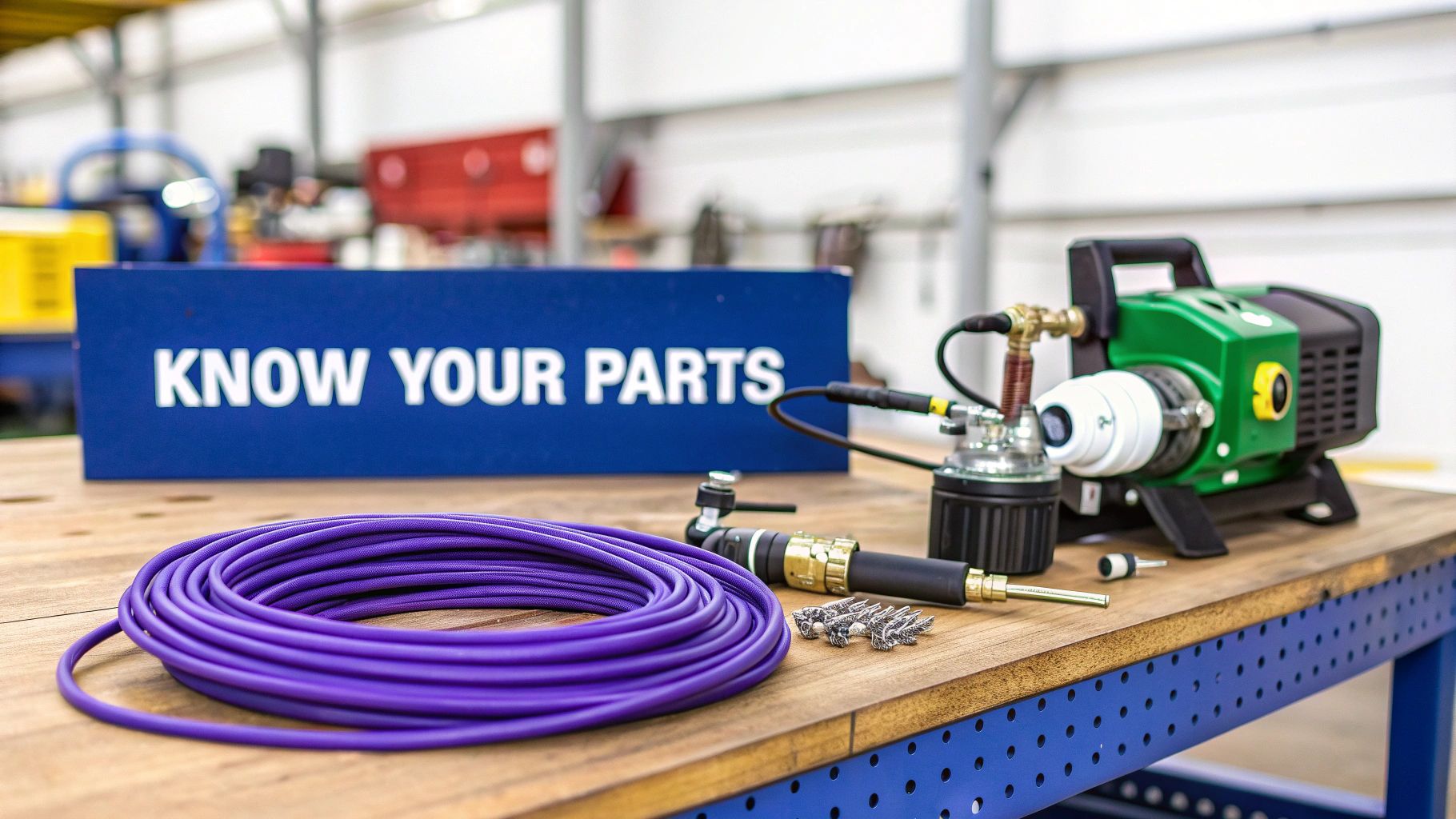
A pressure washer might look like a single, complex machine, but it’s really just a handful of key parts working in harmony. Think of it like a band—if the drummer is off-beat, the whole song sounds wrong. The same goes for your washer. If one component fails, the entire system suffers. Getting familiar with this system is your best tool for both routine maintenance and emergency repairs.
The demand for these machines isn't slowing down, either. The U.S. pressure washer market, valued at USD 390 million, is expected to climb to USD 570 million by 2034. This boom is fueled by their widespread use in home cleaning and property management, where a quick fix for a spray wand or trigger is crucial to keeping the work flowing.
The Engine or Motor: The Powerhouse
Every pressure washer has a power source at its core. On gas models, it’s a small internal combustion engine, not much different from the one on your lawnmower. On electric models, it's an electric motor. Its one and only job is to generate the rotational force that drives the pump.
Engines typically run into trouble with spark plugs, clogged fuel lines, or carburetors. Electric motors, on the other hand, are more likely to suffer from bad wiring or overheating. If the engine or motor won't start or runs rough, nothing else matters—the whole system is dead in the water.
The Pump: The Heart of the Machine
The pump is, without a doubt, the most critical part of a pressure washer. It's an intricate piece of engineering that takes the gentle flow from your garden hose and transforms it into a powerful, high-pressure cleaning jet. The pump is the heart of the operation, pushing water with incredible force.
Most mechanical failures happen right here, in the pump. You'll often find problems stemming from worn-out seals, damaged pistons, or cracked manifolds. The usual culprits are mineral buildup from hard water or, even worse, damage from freezing temperatures.
Taking good care of your pump isn't just a suggestion; it’s essential if you want your machine to last. If you let it go, you're setting yourself up for the most expensive repairs. For a complete breakdown, check out our guide on how to master pressure washer pump maintenance for tips on extending its life.
The Unloader Valve: The Traffic Cop
The unloader valve is a brilliant little device that acts as a traffic cop for water pressure. When you let go of the trigger, the pump doesn't just stop—it keeps running. All that high-pressure water has to go somewhere, and the unloader valve safely diverts it back to the pump's inlet, creating a loop. This prevents a dangerous pressure spike that could blow out your pump or hose.
A faulty unloader is a frequent source of headaches. It's often the reason for that annoying pulsating or surging, where the pressure spikes and drops over and over. If your machine is doing that, the unloader valve should be the first thing you check.
Hoses and Nozzles: The Delivery System
Finally, the high-pressure hose and nozzle deliver the water to whatever you're cleaning. The hose has to be tough enough to handle thousands of PSI without blowing apart, while the nozzle shapes the water stream, controlling both the spray pattern and intensity.
These are your wear-and-tear components:
Hoses are prone to leaks, bulges, and cracks from being dragged around and constantly flexed.
Nozzles wear out over time, causing the opening to widen and your effective pressure to drop.
O-rings are the tiny but vital seals inside the connections that stop leaks at the gun, wand, and hose.
Quick Diagnostics: Matching Symptoms to Parts
When something goes wrong, it helps to have a starting point. This quick reference table can help you match your machine's symptoms to the most likely culprit, saving you time and frustration.
Common Pressure Washer Problems and Their Likely Causes
Symptom | Most Likely Faulty Part | Common Causes |
|---|---|---|
No Pressure or Low Pressure | Nozzle or Pump | Worn-out nozzle, clogged inlet filter, worn pump seals/valves. |
Pulsating or Surging Pressure | Unloader Valve or Nozzle | Clogged nozzle, faulty unloader valve, air in the system. |
Water Leaking | Hoses, Fittings, or Pump Seals | Cracked hose, loose connection, worn O-rings, damaged pump seals. |
Engine/Motor Won't Start | Engine or Motor | No fuel, fouled spark plug (gas), faulty switch, tripped breaker (electric). |
Engine/Motor Runs Rough | Engine (Gas Models) | Clogged fuel filter, dirty carburetor, old or bad gas. |
Excessive Vibration | Pump or Engine Mounts | Worn pump bearings, loose engine mounting bolts. |
This table isn't exhaustive, but it covers the most common issues you're likely to encounter. By starting with the most probable cause, you can get straight to the root of the problem. Whether you're in San Luis Obispo, Paso Robles, Atascadero, Arroyo Grande, Grover Beach, Pismo Beach, Morro Bay, Nipomo, or the surrounding areas, knowing your machine is the first step to a successful fix. We’re proud to serve these communities with the parts and expertise you need to get the job done right.
A Proactive Maintenance Schedule to Prevent Breakdowns
The easiest way to deal with pressure washer repairs? Avoid them in the first place. A solid, proactive maintenance schedule is your best defense against surprise breakdowns and expensive fixes. Think of it as a small investment of time now that pays off big time in your equipment's lifespan and on-the-job reliability.
Just like your truck needs a regular oil change, your pressure washer has its own set of needs. When you meet them, it runs like a top. But if you skip these simple checks, you can set off a domino effect of failures, where one tiny oversight snowballs into a major component failure. This schedule breaks down the essential tasks into simple daily, monthly, and seasonal routines you can actually stick to.
Your Pre-Operation Checklist
Before you even think about pulling that starter cord or flipping the power switch, a quick five-minute inspection can head off the most common reasons a machine dies mid-job. These daily checks are non-negotiable for keeping your equipment healthy.
Check Engine and Pump Oil Levels: Running an engine or pump low on oil is one of the fastest ways to completely destroy it. Make sure the levels are right where they should be.
Inspect the Water Inlet Filter: This little screen is the only thing protecting your pump from sucking in rocks and debris. Check it for gunk, rinse it clean, and make sure water can flow freely. A pump that's starved for water is a pump that's struggling.
Examine Hoses and Connections: Give your high-pressure hose a quick look for any visible cracks, bulges, or leaks. Make sure all your quick-connect fittings are tight and the O-rings are in good shape to prevent pressure loss and dangerous blowouts.
Monthly and Regular-Use Maintenance
If your pressure washer is getting a regular workout, a more thorough check-up every month or after about 50 hours of use is a must. These steps catch wear and tear before it turns into a real problem.
First off, this is when you should change the engine oil. Fresh oil is critical for keeping everything lubricated and cool, especially on gas-powered models. While you're at it, pull the spark plug and check it for corrosion or buildup.
Next, take a hard look at your nozzles. Over time, that high-pressure water literally wears away the orifice, which makes your pressure drop. If your spray pattern looks weak or uneven, it’s a dead giveaway that your nozzle is probably shot and needs replacing.
Finally, give the outside of the unit a good cleaning. Wiping off all the dirt, grime, and oil buildup doesn't just make your machine look professional—it helps the engine cool more efficiently and makes it way easier to spot any potential leaks.
Seasonal Care for Long-Term Protection
Seasonal maintenance is all about prepping your machine for storage, especially before winter hits. This is, without a doubt, the most important step for preventing damage that can't be fixed.
The number one cause of catastrophic pump failure is freeze damage. When water left inside the pump freezes, it expands and can easily crack the pump manifold, resulting in a repair that can cost as much as a new machine.
Winterizing your machine is a simple process that can save you hundreds of dollars. All it involves is flushing all the water out of the system and then running a specialized pump saver or antifreeze solution through it. This not only prevents freezing and cracking but also keeps the seals lubricated during storage.
For a more detailed breakdown, you can use our guide on how to create a comprehensive preventive maintenance schedule template to track these tasks effectively. Sticking to this routine ensures your pressure washer is always ready to perform, job after job.
Step-By-Step Guides for Common DIY Repairs
When your pressure washer starts acting up, your first thought doesn't have to be packing it up for the shop. A surprising number of common issues are pretty straightforward to fix yourself with a few basic tools and a little guidance. Tackling these repairs on your own not only saves you a trip and some money but gets your machine back to work that much faster.
This guide is all about rolling up your sleeves. We'll walk through some of the most frequent fixes, turning what seems like an intimidating job into a manageable weekend project. From annoying drips to frustrating pressure drops, we'll cover the step-by-step process to get your machine running like it should again.
Replacing Worn Seals and O-Rings to Stop Leaks
That tiny drip you've been ignoring can quickly escalate into a leak that kills your pressure. The culprit is almost always a worn-out O-ring or seal. Think of these little rubber rings as the unsung heroes of your pressure washer, creating a perfect seal at every connection. But like any workhorse part, they wear down over time.
Tools and Parts You'll Need:
A set of replacement O-rings that match your model
A small pick or a flathead screwdriver
Silicone grease or lubricant
Step-by-Step Instructions:
Safety First. Shut the machine off, disconnect it from power, and unhook the water supply. Give the trigger a good squeeze to bleed any lingering pressure out of the system.
Find the Leak. Pinpoint exactly where the water is coming from. The most common spots are the high-pressure hose connections, the spray wand fittings, or where your garden hose attaches to the unit.
Yank the Old O-Ring. Use your pick or screwdriver to carefully pry the old, damaged O-ring from its groove. Go easy here—you don't want to scratch the metal fitting.
Clean and Lube. Wipe the groove clean to get rid of any grime or bits of old rubber. Dab a little silicone grease on the new O-ring. This helps it slide in, seal tight, and keeps it from tearing.
Install the New O-Ring. Gently press the new O-ring into the groove. Make sure it's sitting flat and isn't twisted. Reconnect the fitting, tighten it by hand, and then test for leaks.
Fixing a Faulty Unloader Valve
Is your pressure washer pulsating or surging, jumping between high and low pressure? A faulty unloader valve is the prime suspect. This is the part that regulates pressure, and when it starts to stick or fail, you get that erratic, stuttering performance.
This is exactly the kind of problem a little preventative maintenance can help you avoid.
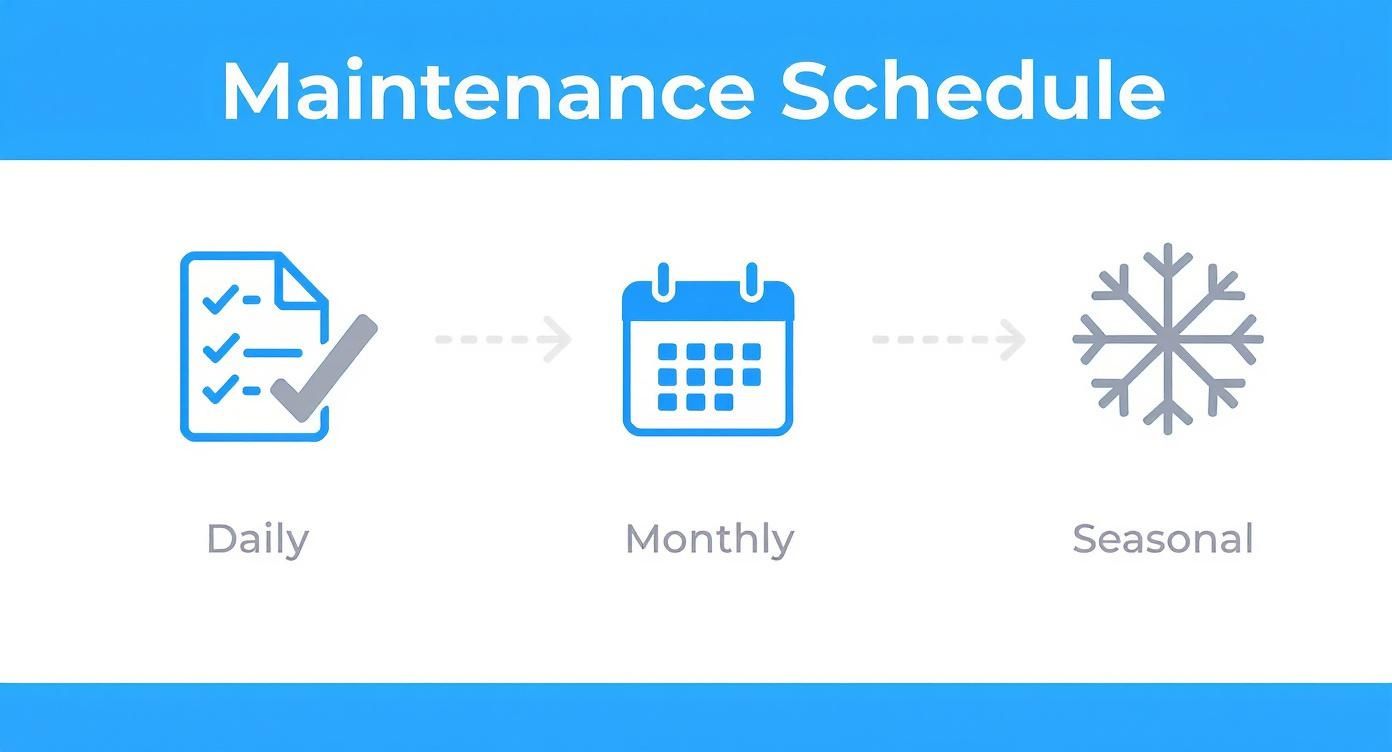
Sticking to a schedule of daily, monthly, and seasonal checks helps prevent the gunk and wear that cause parts like unloader valves to fail in the first place.
Tools and Parts You'll Need:
Replacement unloader valve kit for your specific pump model
Wrenches and a socket set
A few clean rags
Step-by-Step Instructions:
Disconnect Everything. Just like before: machine off, unplugged, water disconnected, and all pressure relieved from the system.
Locate the Unloader Valve. You're looking for a brass or metal assembly on the pump head, usually with an adjustment knob or cap on it. It’s pretty hard to miss.
Take the Valve Apart. Use a wrench to carefully unscrew the main body of the valve from the pump. Pay close attention to how everything comes out—the order and direction of the springs, pistons, and seals are important.
Install the New Parts. Give the valve housing a thorough cleaning. Install the new piston, spring, and seals from your kit, adding a light coat of lubricant as the manufacturer suggests.
Reassemble and Test. Put the valve back together, tightening it to the manufacturer's torque specs. Hook your washer back up and give it a test run. You might need to make small adjustments to the valve to get that steady, reliable pressure back.
For a deeper look at diagnosing problems like this, our guide on troubleshooting pressure washer problems has more quick fixes to get you going.
Swapping Out a Worn or Clogged Nozzle
A worn-out nozzle is the silent killer of performance. Over thousands of gallons, the high-pressure water slowly erodes the nozzle's opening, causing a big drop in pressure and a sloppy spray pattern. A clogged nozzle is a different beast entirely, causing pressure spikes that can be dangerous.
Honestly, a simple nozzle swap is one of the easiest and most satisfying pressure washer repairs you can do. It takes seconds, requires zero tools, and can instantly make your machine feel brand new again.
This is an especially common task now that electric models are everywhere. Recent data shows electric and battery-powered units make up about 43.2% of portable pressure washer revenue, and their key parts—like pumps and nozzles—are thankfully designed to be user-friendly. You can dig into more insights about the portable pressure washer market on databridgemarketresearch.com.
Step-by-Step Instructions:
Pick the Right Nozzle. Grab a new nozzle that matches the color or degree pattern of the one you're replacing.
Pop the Old One Out. If you have a quick-connect wand, just pull back the collar and the old nozzle will pop right out.
Click the New One In. Slide the collar back, insert the new nozzle, and let the collar snap back into place. Give the nozzle a little tug to make sure it's locked in securely.
While these DIY jobs can handle a lot of common headaches, some repairs are best left to the pros. If you're in San Luis Obispo, Paso Robles, Atascadero, Arroyo Grande, Grover Beach, Pismo Beach, Morro Bay, Nipomo, or anywhere on the Central Coast and need a hand, our team at Contractor's Maintenance Service is here to help with the more complex stuff.
How to Source the Right Replacement Parts
Fixing your pressure washer is impossible if you order the wrong component. Sourcing parts correctly the first time is the single most important step in any repair, and it's what separates a quick fix from a frustrating ordeal. It’s not about finding a part; it’s about finding the right one.
The whole process starts with your machine's unique identity. Before you even think about searching online, find the model and serial number on your pressure washer. Look for a small metal plate or sticker on the frame or engine housing—this is the fingerprint for your specific unit.
Without these numbers, you’re just guessing. With them, you can track down the exact Original Equipment Manufacturer (OEM) parts built for your machine, guaranteeing a perfect fit and the performance you expect.
Finding Your Part Number
Once you have your model and serial number, the next move is to find an official parts diagram. You’ll often hear these called schematics or "exploded views." Most major manufacturers have them available on their websites. This diagram is your treasure map, showing every single nut, bolt, and seal, each labeled with a specific part number.
Just find the piece you need on the diagram, jot down its number, and you're ready to start hunting. This simple step kills the risk of ordering a part that looks right but has tiny differences in size or threading that will stop your repair dead in its tracks.
OEM vs Aftermarket Parts
When you're searching for pressure washer parts and repair solutions, you’ll hit a fork in the road: stick with OEM parts or venture into the world of aftermarket components. Each path has its pros and cons.
OEM Parts are made by the same company that built your equipment. They guarantee a perfect fit, identical performance, and won't void your machine's warranty. The only real downside is that they often cost a bit more.
Aftermarket Parts are made by third-party companies. They're usually cheaper and easier to find, but the quality can be a total crapshoot. A poorly made aftermarket part might not fit right or could fail way too soon, costing you more time and money in the long run.
For the guts of your machine—things like pump internals or unloader valves—sticking with OEM is almost always the smart play. For less critical items like nozzles or O-rings, a high-quality aftermarket part from a supplier you trust can be a great way to save a few bucks.
Your Local Parts and Repair Experts in San Luis Obispo
Finding a supplier you can count on is just as important as getting the right part number. A good supplier doesn’t just sell you a box; they offer real-world expertise and support. That’s where we come in.
At Contractor's Maintenance Service, we're the go-to source for professional pressure washer parts and repair here on the Central Coast. We're proud to serve our neighbors in San Luis Obispo, Paso Robles, Atascadero, Arroyo Grande, Grover Beach, Pismo Beach, Morro Bay, and Nipomo. We keep a huge inventory of OEM and top-tier aftermarket parts so you can get what you need, fast.
Don't waste time with guesswork or shady online sellers. Our team of experts can help you double-check part numbers, make sense of schematics, and make sure you leave with the exact component to get your equipment back on the job.
Your Local San Luis Obispo Repair Experts
While plenty of pressure washer fixes are perfect for a weekend DIY project, some jobs just need a professional touch. For those complex, time-consuming, or downright intimidating repairs, having a trusted local expert on your side makes all the difference. At Contractor's Maintenance Service, we're the Central Coast's go-to team for professional pressure washer parts and repair.
We’re proud to serve our local communities all across San Luis Obispo County. Whether you're on a job site in San Luis Obispo, Paso Robles, Atascadero, or Arroyo Grande, our team is ready to help. We also provide expert service and parts for folks in Grover Beach, Pismo Beach, Morro Bay, and Nipomo. Our whole mission is to deliver reliable, professional service that keeps your most important equipment running strong.
When to Call in the Professionals
Knowing when to put down the wrench and pick up the phone can save you a world of time, money, and frustration. While it’s great to handle minor issues yourself, some problems require specialized tools, diagnostic equipment, and the kind of deep knowledge that only comes from years of experience.
Repairs that are usually best left to a certified technician include:
Complete Pump Rebuilds: This is a delicate operation. It involves replacing pistons, seals, and valves with precision—something that requires specific tools to get just right.
Complex Engine Diagnostics: If your gas engine just won’t start, runs rough, or has lost its power, our techs can get to the root of the problem, whether it's the carburetor, ignition system, or something deeper.
Electrical Motor Failures: Messing with capacitors, wiring, or motor windings on electric pressure washers is just plain hazardous. A professional needs to diagnose and fix these issues safely.
Internal Unloader Valve Failures: Adjusting an unloader valve is one thing, but a full teardown and rebuild of a seized or internally damaged valve is a job for an expert.
Our Commitment to Quality and Speed
We get it—downtime costs you money. That’s why our service is built on two simple principles: do the job right and do it fast. Our technicians have the experience to diagnose issues accurately the first time, preventing that costly cycle of guessing and replacing the wrong parts.
At Contractor's Maintenance Service, we believe a proper repair is a lasting one. We use high-quality OEM and top-tier aftermarket parts to make sure your pressure washer comes back to you in peak condition, ready to tackle the toughest jobs with reliability you can depend on.
Our huge in-house inventory of high-demand pressure washer parts and repair components means we often have what you need right on the shelf, which drastically cuts down on turnaround times. We don’t want you waiting weeks for a part to show up; we want to get your machine back in your hands as quickly as possible. From a simple seal swap to a full engine overhaul, our professional service guarantees your equipment is fixed correctly for performance that lasts.
DIY vs Professional Repair: When to Call Our Team
Trying to decide whether to tackle a repair yourself or bring it into the shop? It's a common question. Some jobs are a perfect fit for DIY, while others really need a pro to avoid bigger headaches down the road. This table breaks down which tasks are which.
Repair Task | Good for DIY? | When to Call a Professional |
|---|---|---|
Replacing O-rings & Seals | Yes | This is an ideal DIY task for stopping minor leaks at connection points. |
Nozzle Replacement | Yes | The easiest DIY fix there is. Great for restoring pressure and spray patterns. |
Cleaning Filters | Yes | A simple but critical maintenance task you should be doing regularly. |
Unloader Valve Adjustment | Sometimes | Minor tweaks to stop pulsing are fine, but a full rebuild is pro-level work. |
Complete Pump Rebuild | No | Requires specialized tools, an understanding of tight tolerances, and lots of experience. |
Engine Carburetor Cleaning | Sometimes | Basic cleaning can be done with care, but a full rebuild or tricky diagnostics need an expert. |
Electrical Motor Repair | No | This poses a significant safety risk without proper electrical knowledge and tools. |
Ultimately, whether you're grabbing a wrench or grabbing the phone, the goal is the same: to get your equipment back to work. For the jobs that feel out of your league, our team at Contractor's Maintenance Service is here to help.
Frequently Asked Questions About Pressure Washer Parts and Repair
Even the best-maintained machines run into hiccups now and then. Down below, we’ve tackled some of the most common questions we hear about pressure washer parts and repairs. Whether you're working in San Luis Obispo or somewhere else on the Central Coast, these answers will help you troubleshoot with confidence.
Why Is My Pressure Washer Pulsating or Losing Pressure?
A pulsating pressure washer is probably the most common complaint we hear. It's a frustrating problem, but it almost always boils down to one thing: something is interrupting the water's path from the hose bib to the spray tip. Think of it like a traffic jam in your water line.
The first place to look is the source. A simple kink in your garden hose or a faucet that's not fully open can starve the pump for water, making it surge as it struggles to keep up. While you're there, check the little inlet filter where the hose connects to your machine. That tiny screen catches debris, and a clog right there is a classic cause of pressure issues.
If your water supply is good to go, the problem is likely somewhere downstream. A clogged nozzle is a huge suspect—even a single grain of sand can throw off the spray pattern and make the unloader valve cycle on and off, which is what creates that pulsing feeling. The unloader valve itself could also be the culprit. If it's worn out, sticking, or just not adjusted right, it can’t regulate pressure correctly, leading to that erratic performance.
Should I Repair or Replace My Pressure Washer Pump?
The "repair or replace" question really comes down to a simple cost-benefit analysis. Are you making an economical fix, or just putting a bandage on a bigger wound? The answer hinges on what exactly is broken.
A repair is almost always the right call for replacing common wear items. These are the parts that are designed to be swapped out during the machine's life, like:
Seals and O-rings that are starting to leak.
Check valves that have gotten stuck or worn out.
A faulty unloader valve that can be replaced as a whole unit.
These are routine fixes that get your machine back in top shape without costing a fortune. But when the pump has suffered catastrophic internal damage, a full replacement often makes more sense.
One of the biggest red flags is milky grey oil in the pump's sight glass. This is a dead giveaway that water has gotten past the main seals and is mixing with the oil, a situation that can quickly chew up the pump's internal mechanics. If you see this, shut the machine down immediately.
Other scenarios that usually call for a replacement include a manifold that's cracked from freeze damage or serious internal corrosion from running harsh, unapproved chemicals. Our rule of thumb is this: if the total cost of parts and labor for a rebuild is getting close to 60-70% of the cost of a brand-new pump, it's smarter to invest in the replacement for the long haul.
What Is the Most Important Maintenance Task for My Pressure Washer?
While every maintenance step is important, the single most critical task to prevent a catastrophic failure is proper winterization. This is especially true here on the Central Coast, where a sudden cold snap can catch people off guard in communities from Paso Robles to Nipomo.
Any water left inside the pump, gun, or hoses will expand with incredible force when it freezes. That expansion can easily crack the pump manifold, bust internal valves, or split fittings—all of which lead to expensive, and often unfixable, damage. Forgetting this one simple step is the #1 reason we end up replacing pumps.
The good news is that winterizing is quick and easy. All you have to do is flush the system completely of water, then run a dedicated pump saver or antifreeze solution through it. This coats all the internal parts, stops anything from freezing, and keeps the seals lubricated while it's in storage. It’s a five-minute job that can save you hundreds in pressure washer parts and repair bills.
Can I Use Any Kind of Soap in My Pressure Washer?
Definitely not. Using the wrong type of chemical is one of the quickest ways to eat your pressure washer's pump and accessories from the inside out. Standard household cleaners, and especially products with bleach or ammonia, are incredibly corrosive to the pump's internal components.
These harsh chemicals will chew through rubber seals and O-rings, corrode the metal check valves, and can even etch the surfaces of the pistons and manifold. That damage leads directly to leaks, pressure loss, and eventually, total pump failure.
You should only ever use detergents and soaps specifically made for pressure washers. These cleaners are formulated to be tough on dirt but gentle on your machine. Your owner's manual is the best place to find recommendations for approved chemical types. Using the right soap not only protects your investment but also gives you safer, more effective cleaning results every time.
When you need expert advice or hands-on help, Contractor's Maintenance Service is your trusted local partner for all things pressure washer parts and repair. Serving San Luis Obispo, Atascadero, Arroyo Grande, and the entire Central Coast, we have the parts and expertise to get your equipment back on the job fast. Visit us online to learn more or schedule a service.
Comments