


Power Washer Spray Tips to Master Nozzles for Perfect Results
That small spray tip on the end of your pressure washer wand? It holds all the cards. Think of it like a lens on a camera—it’s what focuses all the machine's energy to get the job done right.
Picking the right tip is the secret sauce to cleaning efficiently and, more importantly, avoiding thousands of dollars in surface damage. A simple nozzle swap is literally the difference between expertly stripping old paint and accidentally carving permanent etchings into a client's concrete driveway.
Why the Right Spray Tip Is Your Most Important Tool
You can have the most powerful pressure washer on the market, but without the right spray tip, it's just an engine making a lot of noise. The tip is what translates all that raw power into controlled, usable force. It’s the single component that dictates the pressure, the spray pattern, and the real-world impact on whatever you're cleaning.
Mastering your nozzle selection is a non-negotiable skill for any serious contractor. It saves you time on the job, protects your client's property, and even extends the life of your equipment. This isn't just a "best practice"; it's fundamental to delivering flawless work and keeping your reputation solid.
The Growing Importance of Precision
The industry is catching on. Precision accessories like power washer spray tips are no longer an afterthought—they're the unsung heroes of every successful job. The market numbers tell the same story. The Pressure Washing Nozzle Market was valued at a cool USD 0.5 billion in 2024 and is on track to more than double, hitting USD 1.2 billion by 2034. That's a growth rate of 8.5% a year. This isn't just a random spike; it shows a clear trend of pros investing in specialized gear to get better results.
A classic rookie mistake is cranking up the machine’s pressure when what's really needed is a different nozzle. The right tip optimizes your water flow and pressure, letting you clean effectively without blasting the paint off siding or shredding a wooden deck.
For professionals working in San Luis Obispo, Arroyo Grande, Atascadero, and Santa Maria, this is ground zero for getting superior results. Nail this, and you’ll see fewer callbacks and more profitable days. We're here to supply both the expertise and the high-quality parts you need to win every job. To dig deeper into optimizing your entire rig, check out our guide on unlocking power with pressure washer accessories.
Decoding the Nozzle Color Code and Spray Angles
Think of the color-coding on power washer tips as a universal language. It’s a dead-simple system that instantly tells you the nozzle's spray angle and what it’s good for. It removes the dangerous guesswork and helps you move from one task to the next without a second thought.
Honestly, getting this down is like knowing which tool to grab from your toolbox. You wouldn’t use a sledgehammer for a finishing nail, right? Same logic applies here. You don't grab a red tip when you need to rinse a wood deck. Mastering this visual guide is the first step toward getting professional results, every time.
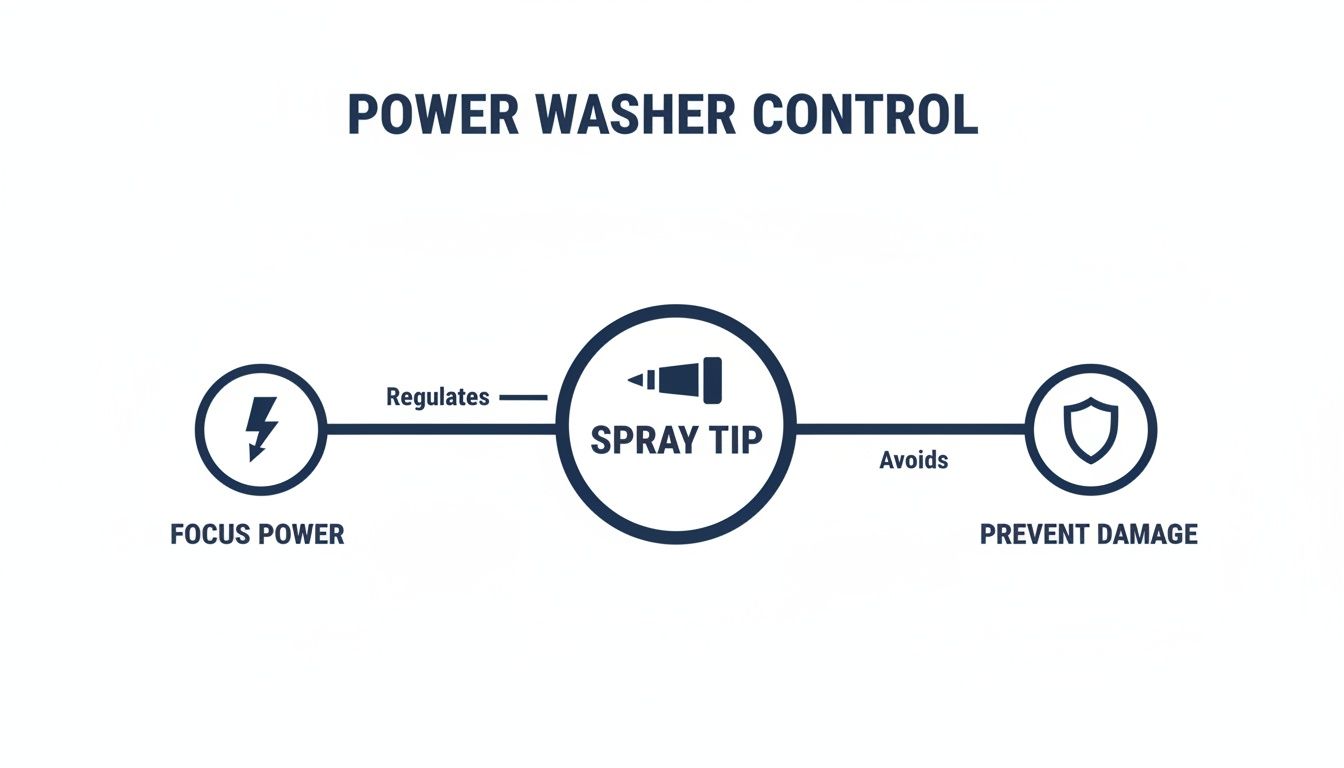
As you can see, the spray tip is the control center. It’s the difference between a clean surface and an expensive mistake.
The Five Core Spray Tips Explained
Most pressure washers come with a standard set of five color-coded tips. Each color corresponds to a specific fan of water, measured in degrees. It's a simple concept: a smaller degree means a tighter, more brutal stream, while a larger degree creates a wider, gentler spray.
Red Tip (0°): The Surgical Tool This is your high-impact, pinpoint nozzle. It creates a laser-like stream of water that delivers every ounce of your machine’s PSI into one tiny spot. It’s incredibly powerful but also incredibly dangerous. This tip can easily gouge wood, strip paint you didn't mean to, and even etch concrete. Save it for hyper-specific tasks, like blasting rust off steel or caked-on mud from excavator tracks.
Yellow Tip (15°): The Stripper The yellow tip gives you a 15-degree fan of water that acts like a scraper. It’s perfect for heavy-duty surface prep on hard materials. Think stripping peeling paint, clearing caked-on grime from concrete before you seal it, or cleaning heavily soiled construction equipment. It strikes a good balance between raw power and decent coverage for tough jobs.
Green Tip (25°): The All-Purpose Cleaner This is the workhorse. The 25-degree green tip is what you'll probably reach for most often for general cleaning. The wider fan balances cleaning power with safety, making it perfect for most driveways, sidewalks, and patios. For contractors doing routine property maintenance, the green tip is a reliable go-to.
White Tip (40°): The Gentle Rinser With a wide 40-degree spray, this tip is designed for cleaning larger areas with less intensity. It's the safest bet for washing vehicles, siding, windows, and most wooden decks. It has enough punch to rinse away dirt and grime but spreads the impact out to avoid damaging softer materials.
Black Tip (65°): The Soap Applicator The black tip has the widest angle (65 degrees) and the lowest pressure. Its main job isn't cleaning—it's applying soap or detergents. The extremely low pressure activates the pressure washer's downstream injector, which pulls your cleaning solution into the water stream for a perfect pre-soak.
To make it even easier, here’s a quick-reference chart breaking down what each color means and where to use it.
Power Washer Spray Tip Color and Angle Guide
This chart connects the dots between nozzle color, spray angle, and the kinds of jobs you'll face in the field.
Nozzle Color | Spray Angle | Pressure Impact | Primary Use Cases |
|---|---|---|---|
Red | 0° | Maximum | Removing rust, caked-on mud, or stubborn stains from metal and concrete. Use with extreme caution. |
Yellow | 15° | High | Heavy-duty surface preparation, paint stripping, cleaning construction equipment. |
Green | 25° | Medium | General cleaning of driveways, decks, siding, and patios. A versatile workhorse. |
White | 40° | Low | Gentle cleaning of vehicles, windows, and delicate surfaces like wood or painted siding. |
Black | 65° | Lowest | Applying soap, detergent, or other cleaning chemicals. Activates the downstream injector. |
Keep this handy. It's a simple way to make sure you’re always grabbing the right tool for the job.
Remember: The angle of the spray fan is the critical factor. A wider fan distributes the water's impact over a larger area, significantly reducing the force at any single point. This is why a 40° tip is safe for a car's paint job, while a 0° tip could destroy it.
For a deeper dive into how these angles translate to different cleaning scenarios, you can find more detail in our pressure washer nozzle chart and guide.
Matching Nozzles to Your Machine and Task
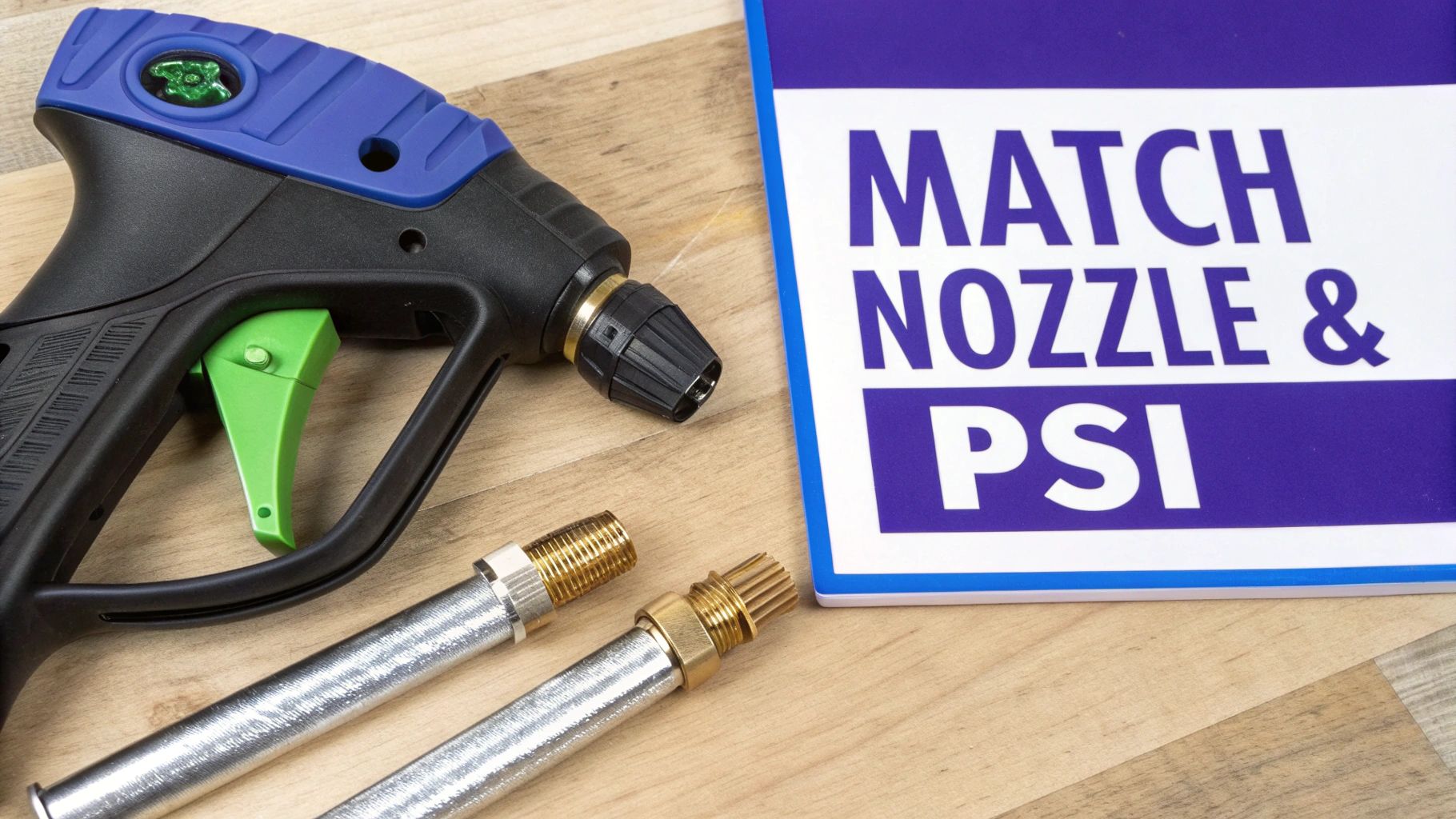
Knowing the color code is a great start, but true expertise comes from matching your power washer spray tips to both your specific machine and the job in front of you. Think of your pressure washer's PSI (pounds per square inch) and GPM (gallons per minute) ratings as its potential power. The nozzle's orifice size is what actually puts that power to work. It’s like tuning an engine—the right nozzle gets you peak performance, but the wrong one will make your machine sputter and struggle.
That relationship between orifice size, pressure, and water flow is everything. If a nozzle's orifice is too small, it chokes the water flow, causing a pressure spike that can overload your pump's unloader valve. Go too big, and you’ll get a massive pressure drop, leaving you with a weak, sloppy stream that just wastes time and water. The sweet spot is finding that perfect balance.
Connecting Orifice Size to PSI and GPM
Every pressure washer is built to run in an ideal operating range. A beast of a machine at 4,000 PSI and 4.0 GPM needs a totally different nozzle than a 2,500 PSI, 2.5 GPM unit to hit its target pressure. The nozzle's orifice is designated by a number (like 4.0, 4.5, or 5.0), which corresponds to its diameter.
Here’s how it all works together:
For a fixed orifice size: More GPM means more PSI.
For a fixed GPM: A smaller orifice creates higher PSI.
This is exactly why you can't just grab any old tip and hope for the best. Slapping a tip designed for a big machine onto your smaller unit will cause a huge loss in pressure. It's an issue we help contractors troubleshoot all the time here at our San Luis Obispo service center.
Using the wrong orifice doesn't just kill your performance—it actively puts a strain on your pump and motor. This leads to premature wear and tear and some seriously expensive repairs. It's the most common, and most preventable, cause of equipment failure we see.
Tailoring Tips to Specific Tasks
Beyond the specs of your machine, the job itself will always dictate your nozzle choice. If you’re stripping paint, you’ll want a high-PSI, narrow-angle tip—like a 15-degree yellow—to get a focused, scraping action. But if you’re washing a delicate wood deck, you need lower pressure and a wider fan, like a 40-degree white, to clean without gouging the wood fibers. When you’re learning how to wash a house, mastering the art of matching the right pressure, nozzle, and technique is absolutely essential for getting great results safely.
For bigger industrial jobs in places like Paso Robles and Santa Maria, getting it right is even more critical. We’ve seen from our clients that 0-degree red tips deliver the 100% impingement force you need for blasting away tough graffiti. Meanwhile, 25-degree green tips are the go-to for concrete cleaning at 3,500 PSI, letting you cover 20% more area per pass compared to wider fans. When time is money, that kind of efficiency makes a huge difference.
Using Specialty Nozzles for Tough Jobs
While the five standard color-coded tips will get you through most jobs, some situations just demand a more specialized tool. This is where specialty nozzles come in. Think of them as the problem-solvers in your toolkit that can seriously cut down your labor time and deliver a better finish on those really tough projects.
Investing in these advanced tools gives you a real edge. For contractors working anywhere in the San Luis Obispo area, from Paso Robles down to Santa Maria, having these specialty power washer tips shows you’re a pro. It tells your clients you’re equipped to handle whatever a job site throws at you.
The Turbo Nozzle for Maximum Impact
If you need raw power, the turbo nozzle (sometimes called a rotary nozzle) is one of the most effective accessories you can own. It combines the concentrated, brute force of a 0-degree red tip with the wider coverage of a fan-spray nozzle.
Imagine a pinpoint stream of water spinning in a tight circle at thousands of rotations per minute. This unique action absolutely demolishes caked-on mud, graffiti, or thick grime on concrete and metal. Best of all, it does it without leaving behind the "zebra stripes" that a standard 0-degree tip is notorious for. It's the go-to tool for heavy-duty cleaning when you need maximum force over a slightly larger area.
A turbo nozzle can slash your cleaning time by up to 50% on tough surfaces like stained concrete or projects involving rust removal. But be warned: its power is immense. Never use it on wood, siding, or vehicles, as it will cause severe damage.
Adjustable and Soap Nozzles for Versatility
Not every job is about brute force. Sometimes, what you really need is flexibility to work smarter, not harder. That’s where other specialty nozzles come in handy, helping you streamline your workflow and protect the surfaces you're cleaning.
Adjustable Nozzles: These are true time-savers. An adjustable nozzle lets you switch between different spray angles—from a narrow, intense stream to a wide fan—just by twisting the nozzle head. It's perfect for jobs with multiple surface types, since you don't have to stop and swap out individual tips. You can go from blasting a brick wall to gently rinsing a nearby window without missing a beat.
Soap Nozzles (Black Tips): While the black tip is often included in standard kits, it’s really a specialty tool with one specific job: applying detergent. Its extra-wide, 65-degree spray pattern and low-pressure output are what trigger your washer's downstream chemical injector, pulling soap into the water stream. This is key for getting an even, safe application of your cleaning solution without damaging the surface with high pressure.
For certain jobs, like applying thick foaming agents, you might need something even more specific. In those cases, you can find dedicated foam gun nozzle attachments designed to get the job done right. Having these tools on hand is what helps a professional deliver better results, faster.
How to Maintain and Troubleshoot Your Spray Tips
Even the best power washer is useless if its spray tip is worn out or clogged. A neglected nozzle is probably the #1 reason for poor performance, causing everything from weak pressure to a sloppy, ineffective spray pattern.
Keeping your tips in prime condition is the cheapest insurance you can buy against frustrating downtime and expensive repairs. It's a simple step, but it's absolutely critical.
Over time, the sheer force of the water slowly erodes the nozzle’s orifice, causing it to widen. This might seem like a tiny change, but it leads to a huge drop in pressure, forcing your pump to work overtime just to keep up. Ignoring a worn-out tip doesn’t just hurt your cleaning power—it puts a constant strain on your machine that can lead to premature failure.
Spotting and Fixing Common Nozzle Issues
The good news is that most nozzle problems are easy to spot and even easier to fix. If you're out on a job in San Luis Obispo or the surrounding areas and notice your washer just isn't hitting like it used to, the nozzle should be your first suspect. Before you assume the pump is failing, run through this quick diagnostic checklist.
Common signs of a worn or clogged nozzle include:
A Sudden Drop in Pressure: If your machine feels weaker than usual, the nozzle's orifice has likely worn down and widened.
A Distorted Spray Pattern: A healthy tip creates a clean, even "V" shape. If yours looks lopsided, streaky, or just plain messy, it's time for a replacement.
Pulsing or Surging: While this can point to pump issues, a partial clog in the nozzle is often the real culprit.
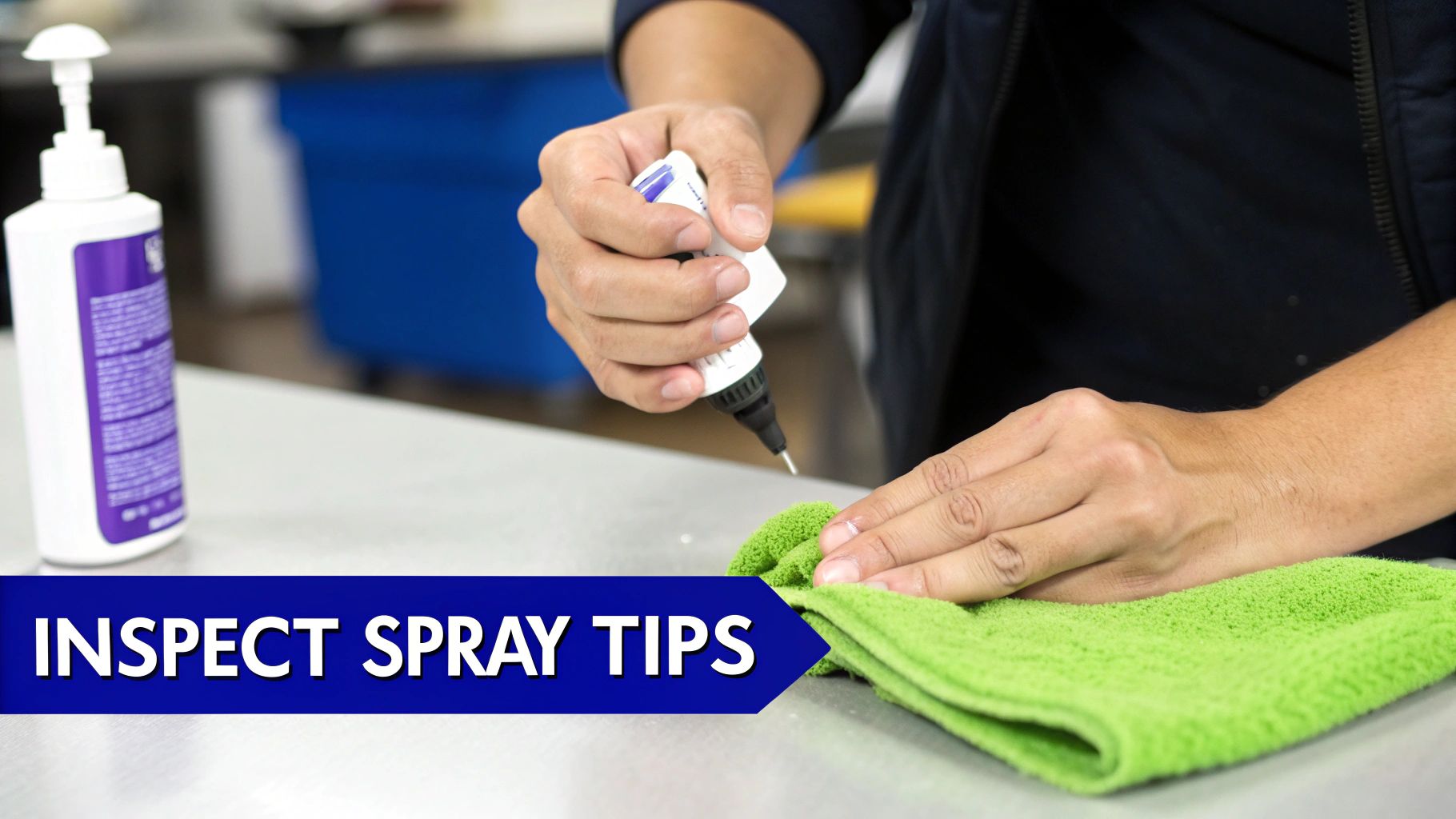
If you suspect a clog, whatever you do, don't grab a nail or a piece of wire to clear it out. You’ll permanently damage the precisely drilled orifice. Instead, use a dedicated tip cleaner tool—it’s basically a set of fine-gauge wires made for this exact job. Just disconnect the tip, gently insert the correct-sized wire to dislodge the debris, and flush it with water.
Troubleshooting Tip: If your pressure suddenly tanks, don't immediately blame the engine or pump. A worn-out power washer spray tip is the most frequent cause. A quick nozzle swap is an inexpensive test that can save you a trip to the repair shop.
For contractors working in Atascadero, Paso Robles, and Arroyo Grande, a well-maintained set of power washer spray tips is essential for staying on schedule. Regular inspection and cleaning only take a few minutes but can save you hours of frustration on the job.
For more complex issues or a full walkthrough on swapping out nozzles, check out our step-by-step guide to replacing pressure washer nozzles.
Your Local Source for Pro-Grade Spray Tips
When you’re a professional contractor on California's Central Coast, the right power washer spray tips aren't just a nice-to-have—they're essential for getting the job done right. At Contractor's Maintenance Service, we're your partner in keeping your equipment at peak performance, making sure you always have the parts you need to keep your projects on track.
Think of us as your go-to source for components, accessories, and expert advice, right when you need it. Our entire mission is built around one thing: eliminating your downtime. We're proud to serve our local communities, making us a quick and convenient stop for anyone working in the region.
Service Areas We Proudly Cover
We stock parts and provide service for contractors all across the heart of the Central Coast, including:
San Luis Obispo
Paso Robles
Atascadero
Arroyo Grande
Pismo Beach
Santa Maria
Cambria
Morro Bay
Nipomo
Grover Beach
Los Osos
Templeton
Our shelves are always loaded with high-quality spray tips from trusted names like Graco and Titan, so you can walk in, grab what you need, and get back to work without costly delays. We get the demands of your job because we live and breathe this stuff.
We don’t just sell parts. We offer hands-on troubleshooting, professional repairs, and custom solutions designed to keep your business running at full throttle.
Your reputation is built on the quality of your tools, and you need a supplier who understands that. Swing by our shop for the right power washer spray tips and the trusted support you need to make every job a success.
Got Questions About Power Washer Tips? We've Got Answers.
Even after you get the hang of spray tips, questions always pop up on the job. We get it. Here are some of the most common ones we hear from contractors right here at our San Luis Obispo service center.
Getting these details down pat is what separates the pros from the rookies. It’s about working safely, efficiently, and making sure your gear doesn’t give out on you when you need it most.
Can I Use a Higher PSI Tip on a Lower PSI Power Washer?
Technically, it might screw onto your wand, but it’s a bad move. Nozzles are engineered to work with a specific PSI and GPM. If you slap a tip designed for a beast of a machine onto your smaller power washer, you'll see a massive pressure drop. The result? A weak, lazy spray that won't clean much of anything.
For the best performance, you have to match the nozzle to what your machine can handle. Our team serves the entire San Luis Obispo area, from Arroyo Grande to Atascadero, and we can help you find the perfect match for your rig.
How Often Should I Replace My Power Washer Spray Tips?
This really comes down to how much you use it, the kind of water you're running through it, and the tip's material. A full-time contractor who’s running their washer every day might start seeing a drop-off in performance after just 50-100 hours of use.
Watch for the tell-tale signs: a spray pattern that's lost its clean edge, a noticeable drop in pressure, or an orifice that looks wider than it should. We tell our guys to give their tips a quick once-over before every big job and swap them out the second performance starts to fade. It'll save your pump a lot of unnecessary strain.
What Is the Safest Spray Tip to Start a Project With?
Always, always start with the widest angle tip you think can get the job done. For most surfaces, that’s going to be your 40-degree (white) or 25-degree (green) nozzle.
Find a spot that's out of the way and test the spray from at least two feet back. If you need more muscle, you can slowly move closer or step down to a narrower tip. Never kick off a job with a red (0°) or yellow (15°) tip—their laser-like streams can carve permanent lines into wood, siding, or even soft concrete before you can blink.
Need the right parts or some expert advice to keep your equipment humming? The team at Contractor's Maintenance Service has your back with high-quality power washer spray tips and real-world support. Stop by our shop or visit us online to get everything you need for your next job.
Comments