


Unlocking Power with Pressure Washer Accessories
Think of your pressure washer as just the engine. By itself, it has plenty of raw power, but you can't really do anything with it until you connect the right tools. The best pressure washer accessories aren’t just optional add-ons; they're what turn a generic machine into a specialized cleaning powerhouse.
Go Beyond the Basic Spray
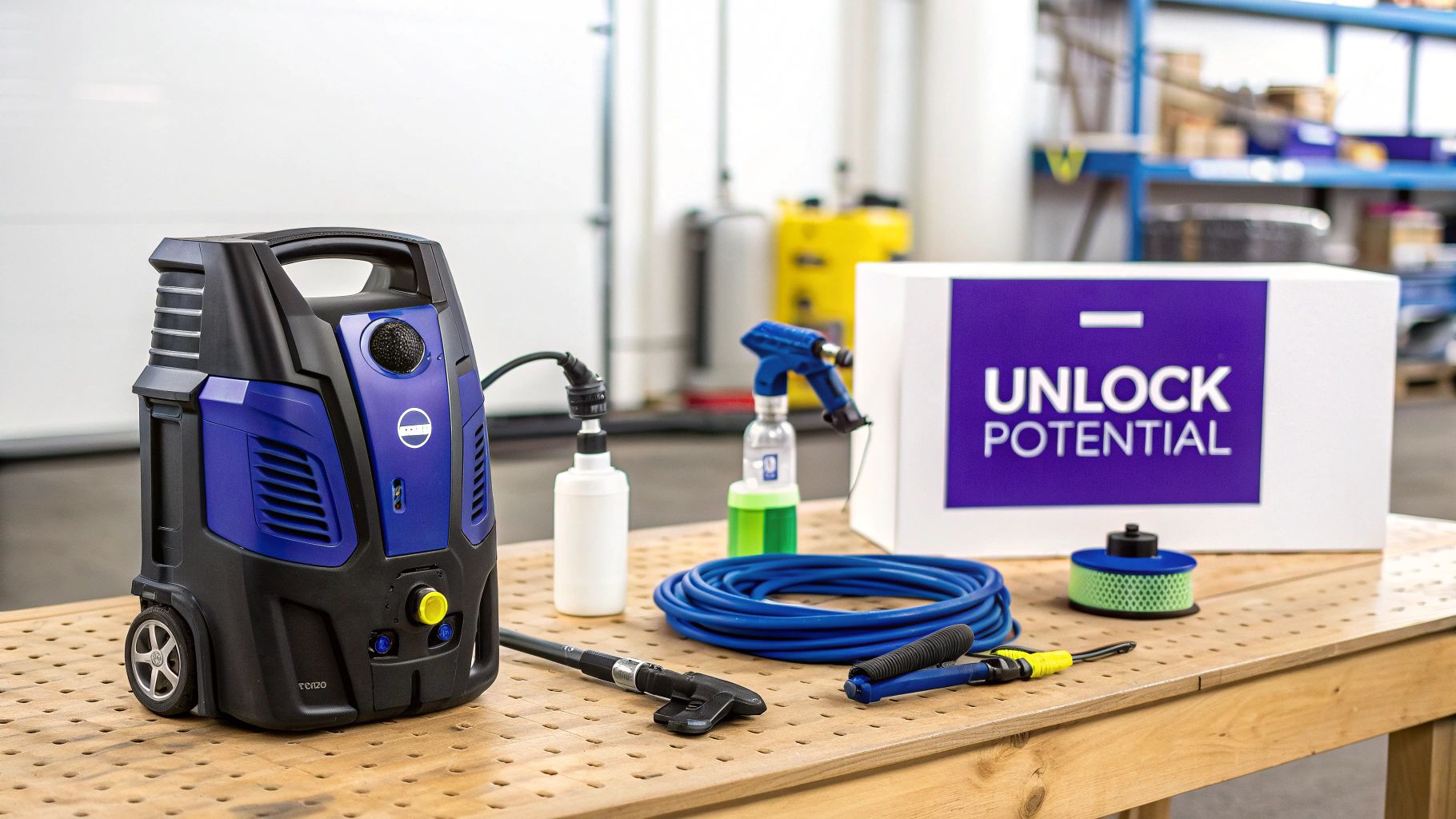
Simply swapping out a nozzle or attaching a surface cleaner can dramatically cut down your job times, deliver a far better finish, and seriously boost your ROI. It's no surprise the global market for these accessories was valued at around USD 2.20 billion and continues to grow. The demand for smarter, more efficient cleaning is on the rise. If you're interested, you can explore more market data about pressure washer accessory growth trends to see just how fast the industry is expanding.
This guide is all about helping you pick the right gear to turn any cleaning challenge into a smooth, efficient job. Whether you're stripping paint, blasting grime off a massive driveway, or laying down detergent, the right accessory makes all the difference.
Your Local Equipment Partner
For any professional, having a go-to local partner is a game-changer. At Contractor's Maintenance Service, we provide the hands-on expertise and hard-to-find parts that keep your equipment running at peak performance. We're proud to support businesses all over the Central Coast, including:
San Luis Obispo
Paso Robles
Atascadero
Arroyo Grande
Grover Beach and Pismo Beach
Morro Bay
Our mission is to provide the expert guidance and parts needed to maximize your equipment's performance, turning every cleaning challenge into a streamlined, efficient operation.
Instead of guessing which part fits or waiting days for an online order to show up, our local know-how means you get the right component the first time. From custom hose fabrication to sourcing the exact fitting you need, we help you avoid downtime and keep your operations running. We're here to help you transform your pressure washer from a basic tool into a precision instrument, perfectly dialed in for the task at hand. Let's walk through the essential accessories that make it all happen.
Your Essential Accessory Toolkit
Think of your pressure washer accessories like a seasoned mechanic’s socket set. Sure, one wrench can turn a bolt, but a full toolkit with different sizes, extensions, and swivels lets you tackle any job with precision and speed. The right accessories transform your pressure washer from a simple tool into a highly versatile cleaning system.
Instead of just spraying water, you can strip paint off a steel beam, scour years of grime from concrete, or gently apply detergent to a fleet of trucks—all by swapping out the tool at the end of your wand. Let’s break down the core components every professional should not just know by name, but truly understand by function.
Nozzles: The Lenses of Your Pressure Washer
Just like a photographer switches lenses to get the perfect shot, you swap nozzles to control the water stream's angle and intensity. The nozzle is easily the most critical accessory you'll use, as it directly dictates both your cleaning power and your margin for error. A narrow stream concentrates all that force into a tiny point for tough jobs, while a wider fan spreads the pressure for more delicate surfaces.
Choosing the wrong one isn’t just slow; it's destructive. Blasting wooden siding with a zero-degree nozzle is like taking a chisel to a canvas—the damage can be instant and irreversible.
Here's a quick look at the standard color-coded nozzles you'll find in almost every professional's toolkit.
Pressure Washer Nozzle Quick Reference Guide
This table breaks down the essential info for the five most common pressure washer nozzles. Think of it as your cheat sheet for matching the right tool to the right task, helping you work safely and efficiently.
Nozzle Color/Angle | Spray Pattern | Primary Commercial Use | Safety & Material Warning |
|---|---|---|---|
Red (0°) | A single, pinpoint jet | Removing caked-on mud from equipment, blasting weeds from cracks, spot-cleaning tough stains on concrete. | Extremely Dangerous. Can easily cause serious injury, etch concrete, and shred wood or siding. Use with extreme caution. |
Yellow (15°) | Narrow fan (chiseling effect) | Surface preparation like stripping paint, removing heavy mildew stains, or cleaning stubborn grime from hard surfaces. | Still very aggressive. Can damage softer materials like wood or vinyl if held too close. |
Green (25°) | Medium fan (sweeping motion) | Your all-around workhorse. Great for cleaning vehicles, driveways, decks, and most home siding. | Offers a good balance of power and coverage, but can still cause damage on delicate surfaces. |
White (40°) | Wide fan (rinsing motion) | Rinsing delicate surfaces like windows, washing cars without risking paint damage, and general clean-up. | Low risk of damage, making it a safe starting point for unfamiliar surfaces. |
Black (Soap) | Widest fan (low pressure) | Applying detergents and cleaning solutions. The low pressure activates the chemical injector. | No cleaning power. Designed only for chemical application. Will not remove dirt on its own. |
Getting comfortable with this color-coded system is non-negotiable. It’s a universal language on the job site that tells you everything you need to know about power and application at a glance, preventing costly mistakes before they happen.
Hoses: The Lifeline of Your Operation
Your pressure washer hose is so much more than a tube—it's the critical link between your pump and the nozzle. Its material, diameter, and length all directly impact your machine's performance and its own durability. A cheap, undersized hose can choke your water flow, causing a frustrating drop in pressure at the nozzle and forcing your pump to work harder than it should.
For any serious commercial use, investing in a high-quality, steel-braided hose is the only way to go. These hoses resist kinking, handle extreme pressures and temperatures, and can take the beating of being dragged across a rough job site. To learn more, check out our detailed guide on selecting the right high-pressure hoses you need to know about.
Wands and Lances: Extending Your Reach
Wands, or lances, are all about control and reach. A standard wand is fine for most ground-level work, but specialized jobs demand better tools. A telescoping lance, for instance, lets you safely clean second-story siding or soffits from the ground, which means no more wasting time setting up ladders. Angled wands are a lifesaver for cleaning out gutters or getting into the undercarriage of vehicles and heavy equipment.
Surface Cleaners: The Key to a Uniform Finish
Trying to clean a big driveway, patio, or warehouse floor with a standard nozzle is painfully slow and almost always leaves behind those ugly "zebra stripes." This is where a surface cleaner becomes your best friend. This accessory, which looks a bit like a push lawnmower, houses two or more rotating nozzles inside a circular deck.
The design delivers a perfectly consistent, streak-free finish in a fraction of the time. For any contractor in San Luis Obispo or nearby areas like Paso Robles and Atascadero who cleans large flatwork, a surface cleaner isn't a luxury—it's an essential, time-saving investment that pays for itself.
Detergent Systems and Injectors
Water alone can't cut through everything. When you're up against grease, oil, or tough organic stains, you need a chemical assist. Detergent injectors (or chemical injectors) are simple but brilliant devices that pull cleaning solutions into the water stream after it leaves the pump.
This is a critical detail because running harsh chemicals directly through your pump will cause corrosion and premature failure. By using the low-pressure black soap nozzle, the injector creates a vacuum that siphons detergent from your container, applying it evenly so it can break down the grime before you blast it away with a high-pressure rinse.
Beyond the core nozzles, the right attachments can open up a whole new world of cleaning capabilities. When you're working on specific surfaces like different types of decking, you'll often need specialized equipment. Exploring various deck accessories, for example, can give you the edge needed to achieve a pristine finish on outdoor wood or composite materials.
Matching Accessories to Your Machine
Choosing the right pressure washer accessories isn't just about picking a tool for a specific task. Think of it like pairing an amplifier with speakers in a high-end audio system—a mismatch won't just sound bad; it can cause real damage. The same logic applies to your pressure washer, where the relationship between your machine's power and your accessory's rating is everything.
This is where a lot of operators, even seasoned pros, run into trouble that leads to lousy performance, busted equipment, or serious safety hazards. An accessory that can't handle your machine's output can fail spectacularly, while one that's too big will completely neuter its cleaning power. Let's demystify this critical relationship so every piece in your toolkit works in perfect harmony with your machine.
Understanding PSI and GPM Compatibility
Every pressure washer is defined by two core metrics: PSI (Pounds per Square Inch) and GPM (Gallons Per Minute). PSI is all about the force of the water, while GPM measures the volume. Together, they create your machine's total cleaning power.
It is absolutely essential that every single accessory—from the hose and wand to the nozzle and surface cleaner—is rated to handle or exceed your machine's maximum PSI and GPM. Hooking up a 3,000 PSI hose to a 4,000 PSI machine is just asking for a burst hose, which can cause serious injury and costly downtime on a job site.
A common mistake is focusing only on PSI while ignoring GPM. A hose might be rated for 4,000 PSI, but if its diameter is too small for your machine’s GPM, it will restrict water flow, strain the pump, and reduce cleaning efficiency. Always check both ratings.
For businesses here in San Luis Obispo and the surrounding areas, getting these specs right is the first step toward a reliable, high-performance cleaning setup. At Contractor's Maintenance Service, we help professionals from Paso Robles to Arroyo Grande verify compatibility, heading off expensive purchasing mistakes before they happen.
Decoding Fittings and Connections
Once you've confirmed the PSI and GPM ratings are a match, the next hurdle is making sure everything physically connects. There’s nothing more frustrating than getting a new accessory on-site only to find it won't connect to your hose or wand. Most commercial-grade pressure washer accessories use one of two main fitting types.
M22 Fittings: These are threaded connectors that screw together for a secure, leak-proof seal. They're extremely common on commercial-grade wands, hoses, and pumps. You'll typically find a 14mm or 15mm inner pin diameter, so it’s vital to know which one your equipment uses.
Quick-Connect (QC) Fittings: These fittings are all about speed and convenience, letting you swap accessories in seconds without tools. They use a male "plug" and a female "coupler" that just snap together. They are incredibly popular for nozzles, wands, and connecting hoses.
This simple decision tree can help you determine which nozzle is appropriate for your next cleaning job based on the surface material. The visual guide above simplifies the choice between a wide-angle nozzle for delicate surfaces and a more focused one for durable materials. For a deeper dive into all the nozzle options, you can check out our guide on choosing the right pressure washer nozzle.
Choosing Materials Built for the Job
The material an accessory is made from is just as important as its performance ratings, especially in demanding professional environments. The choice usually boils down to a trade-off between cost, durability, and corrosion resistance. For quality fittings and components, two materials really dominate the market.
Brass Fittings Brass is a solid, cost-effective choice for many general-purpose commercial jobs. It offers good durability and corrosion resistance, making it a reliable workhorse for everything from wands to couplers. However, in extremely harsh environments or with constant exposure to aggressive chemicals, brass can eventually corrode.
Stainless Steel Fittings When it comes to industrial-grade work, stainless steel is the way to go. It delivers maximum durability and is highly resistant to rust, corrosion, and chemical damage. While it comes with a higher price tag upfront, its longevity in tough conditions—like those found on construction sites in Atascadero or agricultural operations near Morro Bay—makes it a worthwhile investment that pays for itself over time.
This attention to detail is what separates the pros. In fact, commercial and industrial users are a powerhouse in the pressure washer accessories market, where demand for robust nozzles, extension wands, and high-pressure hoses is surging to meet tough hygiene and maintenance standards. Selecting the right materials ensures your toolkit is not just compatible, but truly built to last.
Specialized Tools for Tough Commercial Jobs
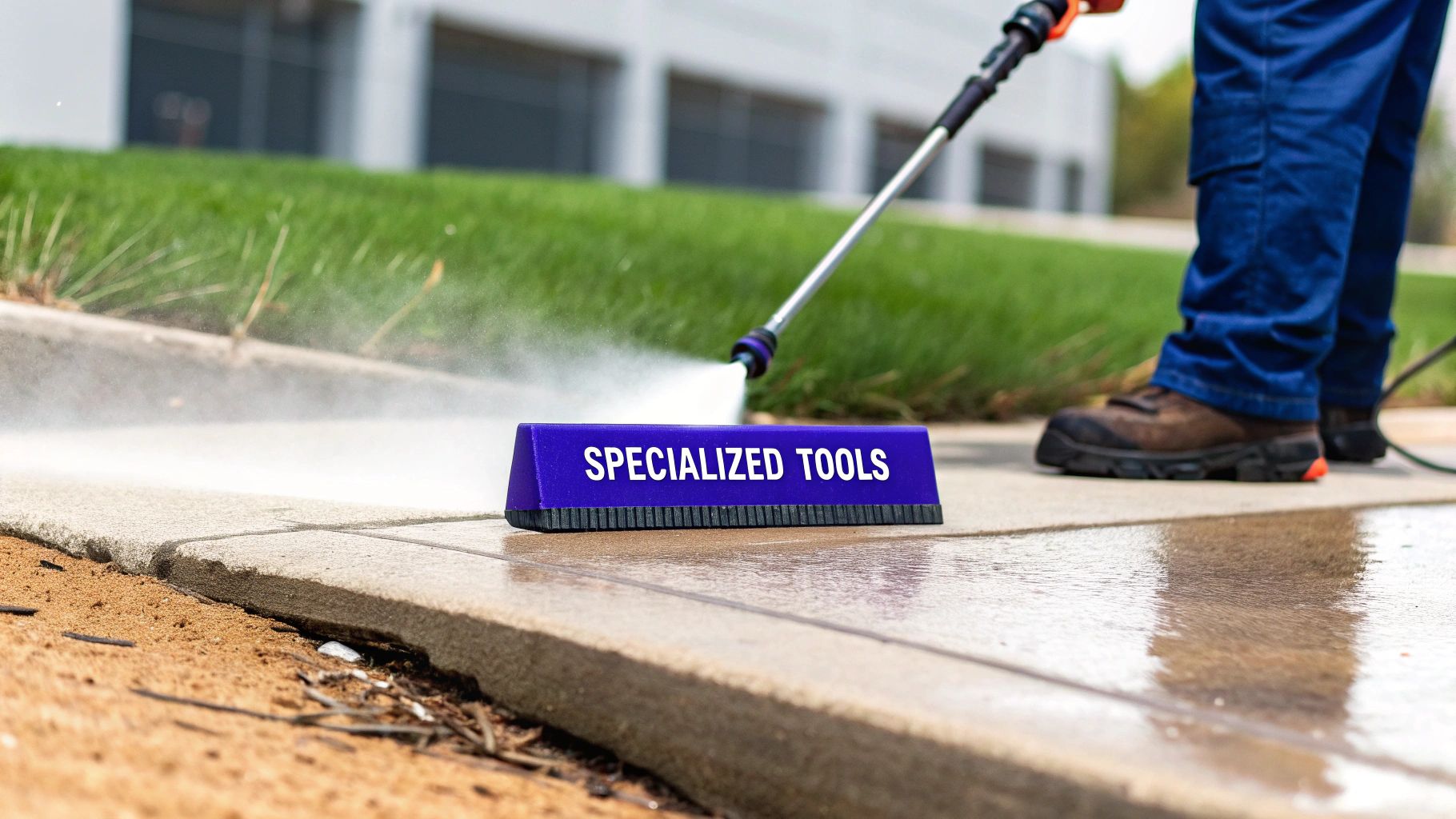
While your standard accessories are the bread and butter of daily cleaning, some jobs just demand more. This is where specialized tools come in—the kind of gear that turns a grueling, all-day task into an efficient, profitable one.
These are the problem-solvers, the game-changing pressure washer accessories that separate the pros from the amateurs. They’re designed for specific, tough commercial challenges that would otherwise chew up hours of manual labor or require entirely different equipment. Investing in them isn't just about getting new gear; it’s about expanding what you can offer and taking on jobs others have to turn down.
For contractors here on the Central Coast, from the vineyards in Paso Robles to the salty air of Pismo Beach, having these tools in your arsenal is a serious competitive edge.
Turbo Nozzles: The Grime Obliterators
Ever tried stripping years of grime off old concrete with a standard 15-degree nozzle? It’s a slow, agonizing process. That’s precisely the problem the turbo nozzle (or rotary nozzle) was built to solve. It masterfully combines the raw, focused power of a zero-degree nozzle with the broad coverage of a fan spray.
So, how does it work? A turbo nozzle takes that pinpoint zero-degree stream and spins it in a rapid conical motion. This creates a powerful scouring action that just obliterates stubborn buildup—think graffiti, rust, or caked-on mud—up to 50% faster than a regular fan nozzle.
For instance, if a property manager in Atascadero needs to restore a neglected brick walkway, a turbo nozzle can strip away moss and stains in a single pass. The job gets done, the original color is restored, and you’re not stuck there all day.
Sandblasting Kits: Stripping Surfaces to the Core
Sometimes, water pressure alone just won't cut it. When you’re up against multiple layers of paint, heavy rust, or tough industrial coatings, you need more firepower. A sandblasting kit is a powerful accessory that essentially turns your pressure washer into an abrasive blasting tool.
It works by siphoning an abrasive material, like sand or baking soda, directly into the high-pressure water stream. The result is an incredibly effective force for surface preparation, stripping materials right down to their original substrate. It's a must-have for restoration jobs or prepping metal for new coatings, allowing contractors in places like Arroyo Grande or Morro Bay to offer advanced paint and rust removal services.
Sewer Jetter Kits: The Ultimate Drain-Clearing Solution
Nothing brings a job site or a commercial property to a grinding halt faster than a clogged drain. Instead of waiting on a plumber, a sewer jetter kit lets you handle it yourself by turning your pressure washer into a high-powered drain-clearing machine.
The kit includes a long, flexible hose with a specialized nozzle at the end. This nozzle features several rear-facing jets that propel the hose deep into pipes, while a forward-facing jet blasts through whatever is in the way—grease, roots, you name it. It's a far more effective and thorough solution than a traditional snake for clearing out stubborn clogs in commercial plumbing.
Expanding Your Service Capabilities
Each of these specialized pressure washer accessories opens the door to new revenue streams and makes you far more efficient on the job. When your team has the right tools, you can confidently take on more complex projects and deliver better results in less time.
Increased Efficiency: A surface cleaner can literally cut sidewalk cleaning time by more than half, freeing up your crew to tackle the next task.
New Services: With a sandblasting kit in your truck, you can go beyond basic cleaning and start offering professional surface stripping and preparation.
Problem-Solving Power: A sewer jetter allows you to provide emergency drain clearing, which is an incredibly high-value service for any commercial client.
For businesses on the Central Coast, having a local partner like Contractor's Maintenance Service is a huge advantage. We can help you pick the right specialized tools for the unique jobs in our area, ensuring you have the power and versatility to handle whatever comes your way.
Your Go-To Partner on the Central Coast
As a contractor, the last thing you need is downtime. When a critical piece of your equipment goes down or you can’t find the right pressure washer accessories to wrap up a job, every minute wasted is money out of your pocket. That’s when having a real, local partner in your corner isn't just a convenience—it’s a necessity. Guessing games and waiting on online orders just don’t fly when you’ve got a deadline to meet.
At Contractor's Maintenance Service, we're not just moving boxes off a shelf. We're in the business of providing practical, hands-on solutions that keep your projects moving forward. We’re all about supporting businesses right here on the Central Coast, making sure you have exactly what you need, when you need it.
Proudly Serving San Luis Obispo County
Our roots are dug deep right here on the Central Coast, and we’re proud to be the trusted resource for local professionals. We handle sales, service, and support for businesses all over the area, including:
San Luis Obispo
Paso Robles
Atascadero
Arroyo Grande
Grover Beach & Pismo Beach
Morro Bay
Being local means we get the unique challenges you’re up against—from agricultural cleaning jobs in North County to the salty, marine-grade grime along the coast.
More Than a Parts Supplier
We see ourselves as a true partner in your success, offering a level of service you just won't find at a big-box retailer. Our support is built around solving the real-world headaches that professional operators face, keeping your business productive and profitable.
Having the right part is only half the battle. Having the expertise to install it, service it, and get you back to work is what really counts. We’re your one-stop shop for keeping your operation running at its best.
We’ve designed our services to solve problems and get you back on the job fast.
Expert Technical Support: No more guesswork. Our team knows this equipment inside and out. We’ll help you find the perfect, fully compatible Graco or Titan accessories for your specific machine and the job you’re tackling.
In-House Repairs and Warranty: When something breaks, we fix it—fast. As an authorized service center, we handle repairs and warranty claims right here, which means a much quicker turnaround for you.
Custom Fabrication: Can’t find the right hose for the job? We custom-fabricate hydraulic hoses to your exact specs, solving those unique equipment challenges on the spot.
Hard-to-Find Parts: We have an extensive network to track down those obscure fittings and components that can otherwise bring a project to a dead stop.
Our mission is simple: provide the practical, effective solutions that keep you working.
Maintenance and Safety for Your Accessories
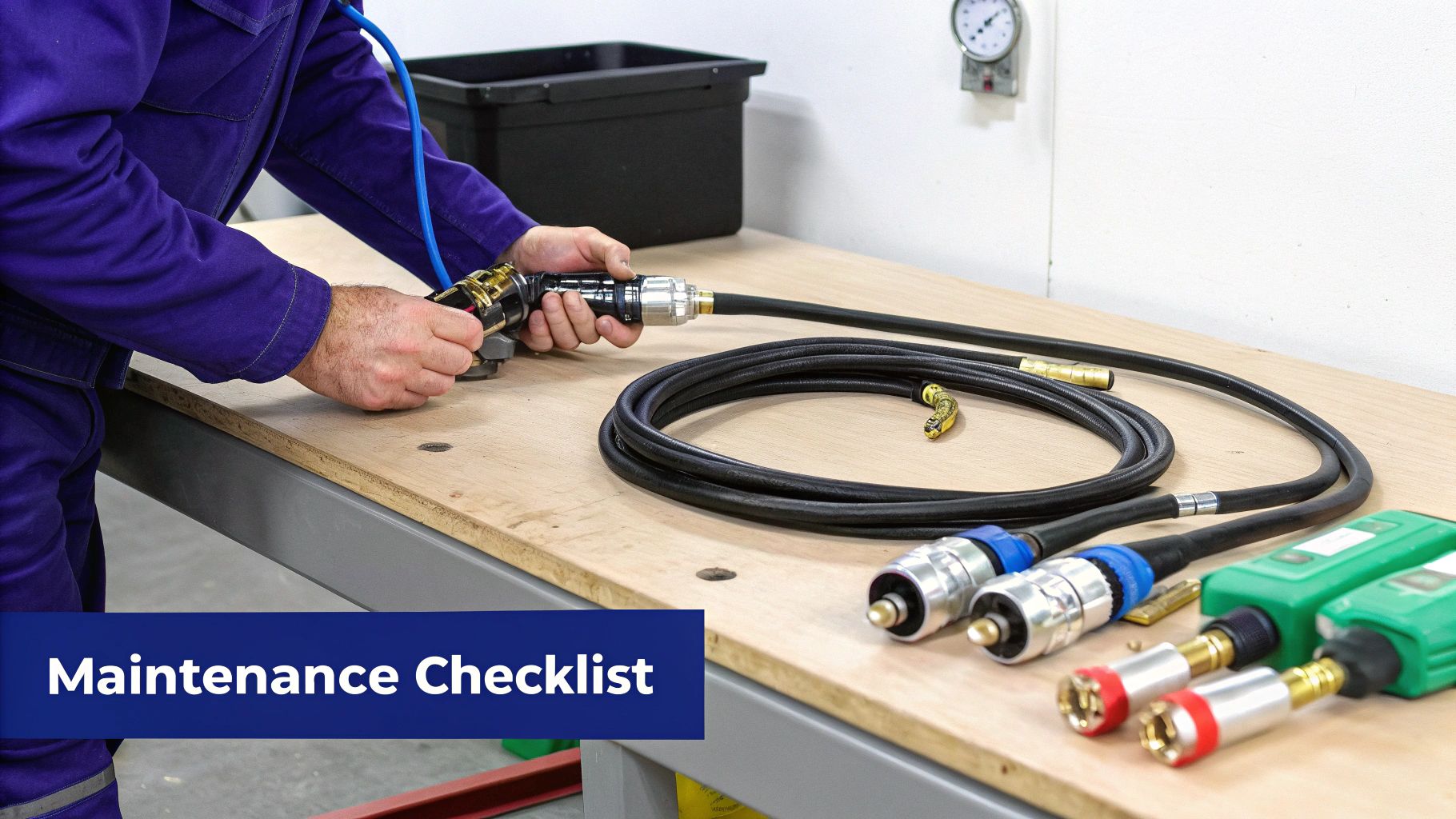
Your pressure washer accessories are the real workhorses on any job. They get dragged, dropped, and blasted with high pressures day in and day out. Just like any professional tool, they need consistent care to perform reliably and, most importantly, safely.
Let’s be honest—skipping maintenance is a gamble. It doesn't just shorten your equipment's lifespan; it poses a real threat to safety on the job.
Proper upkeep protects your investment, keeps you working without costly downtime, and ensures you and your crew go home safe. From San Luis Obispo to Paso Robles, a well-maintained toolkit is the mark of a true pro. Here’s a no-nonsense guide to the essential checks you should be running.
Your Routine Maintenance Checklist
A few minutes of proactive maintenance can head off the vast majority of accessory failures. Make these quick checks a habit, and you'll catch small issues before they sideline your entire operation.
Clean Your Nozzles: After every job, give your nozzles a quick check for debris. A single grain of sand lodged in the orifice can throw off your spray pattern or, worse, cause a dangerous pressure spike. A simple nozzle cleaning tool—or even a thin needle in a pinch—can clear it out and get you back to a clean, steady flow.
Inspect Hoses Religiously: Before you fire up that engine, walk the length of your hoses. Look for any cracks, abrasions, or bulges in the outer casing. A bulge is a major red flag. It means the inner braiding has failed, and a blowout is just a matter of time.
Lubricate O-Rings and Seals: Those tiny rubber O-rings in your quick-connects and wands are all that stand between you and a leaky, pressure-sucking mess. A light coat of silicone grease keeps them from drying out and cracking, preserving that critical seal.
Critical Safety Protocols
The power behind a pressure washer demands respect. When an accessory fails under pressure, it's not just a breakdown; it can turn a tool into a dangerous projectile. Sticking to strict safety protocols isn't just a good idea—it’s non-negotiable for protecting yourself, your team, and your client's property.
Safety isn't just about wearing a hard hat. It starts with the gear itself. One of the biggest mistakes you can make is mismatching pressure ratings, creating a high-risk scenario for a sudden, violent failure.
Always follow these rules. No exceptions.
Verify PSI Ratings: Never, ever hook up an accessory rated for a lower PSI than your machine’s output. Putting a 3,000 PSI hose on a 4,000 PSI machine is asking for a catastrophic failure.
Wear Proper PPE: This is basic, but it saves lives. Always wear safety glasses or a face shield. High-pressure spray and flying debris are no joke. Steel-toed, waterproof boots and gloves are just as essential.
Depressurize Before Disconnecting: This is a big one. Always shut the machine off and then squeeze the trigger gun to bleed all trapped pressure before you change a nozzle or uncouple a hose. It prevents that violent blast of water that can cause serious injury.
Secure All Connections: Before you pull that starter cord, give every fitting a final check. Make sure every quick-connect has clicked securely into place and every threaded connection is tight. A loose fitting can become a missile under pressure.
Taking care of your accessories goes hand-in-hand with pump maintenance. For a deeper dive into keeping the heart of your system in top shape, we recommend you master pressure washer pump maintenance with these essential tips to extend its operational life.
Frequently Asked Questions
Got questions? We've got answers. Here are some of the most common things we hear from professionals working in San Luis Obispo and across the Central Coast.
How Do I Know an Accessory Is Compatible?
Figuring out compatibility is actually pretty straightforward. First, check the specs. Make sure the accessory's PSI and GPM ratings can handle what your machine puts out—it's always safer if they meet or exceed your washer's numbers.
Next up are the connectors. Most commercial gear will use either the screw-on M22 fittings or the simple snap-on Quick-Connects. Once you know the type, just confirm the size, and you'll have a perfect, leak-free fit.
What Is the Best All-Around Nozzle?
If you could only have one nozzle in your toolbox, the 25-degree (green) nozzle would be it. It’s a real workhorse, giving you a great mix of focused power and wide coverage that works for most surfaces.
But for more delicate jobs, like washing windows or vehicles, you'll want to switch to the 40-degree (white) nozzle. Its wider, gentler spray is a much safer bet to get the job done without causing any damage.
Compatibility is non-negotiable. A mismatched accessory doesn't just work poorly; it can be a serious safety risk. We help contractors from Paso Robles to Arroyo Grande get the right part the first time, every time.
Can I Add More Hose Length?
You absolutely can, but there’s a limit. Every extra foot of hose creates a bit of friction, which can lead to a slight drop in pressure at the wand.
To keep performance up, always use high-quality couplers when you connect sections. For most commercial setups, try to keep the total length under 100-150 feet to avoid a noticeable loss in power.
Why Isn't My Detergent Injector Working?
This is a classic problem, and it's usually an easy fix. The first thing to check is your nozzle. Detergent injectors only kick in under low pressure, so you must be using the low-pressure black soap nozzle. High-pressure tips won't draw any soap.
If the nozzle is right, check for a clogged filter or screen in the injector itself—gunk builds up over time. And finally, some detergents are just too thick to pull through the siphon. Try watering down your solution a bit and see if that gets things flowing again.
Get the right advice and the right parts to keep your jobs moving. For expert support and a massive inventory of pressure washer accessories in San Luis Obispo and beyond, trust the team at Contractor's Maintenance Service. Visit us online at https://www.contractorsmaintenanceservice.com to find what you need.
Comments