


A Contractor's Guide to the 0.22 Micron Filter
When you're dealing with industrial fluids and gases, a 0.22 micron filter is your high-security checkpoint. For contractors and maintenance pros, this isn't just another part—it's the gold standard for sterile filtration and a critical defense against contamination that leads to expensive downtime.
The Guardian Against Microscopic Threats
Think of a screen door, but one fine enough to stop a single grain of dust. A 0.22 micron filter works on the same principle, just on a microscopic scale. It physically blocks contaminants like bacteria from getting into sensitive systems where they can wreak havoc.
This process is called size exclusion, and it's the bedrock of sterile filtration in countless industries.
For contractors working up and down the Central Coast, from Paso Robles vineyards to the marine businesses in Morro Bay, equipment reliability is everything. A clogged paint sprayer or a failing pressure washer can grind a profitable job to a halt. The 0.22 micron filter is your first line of defense against those microscopic enemies.
Why This Specific Size Matters
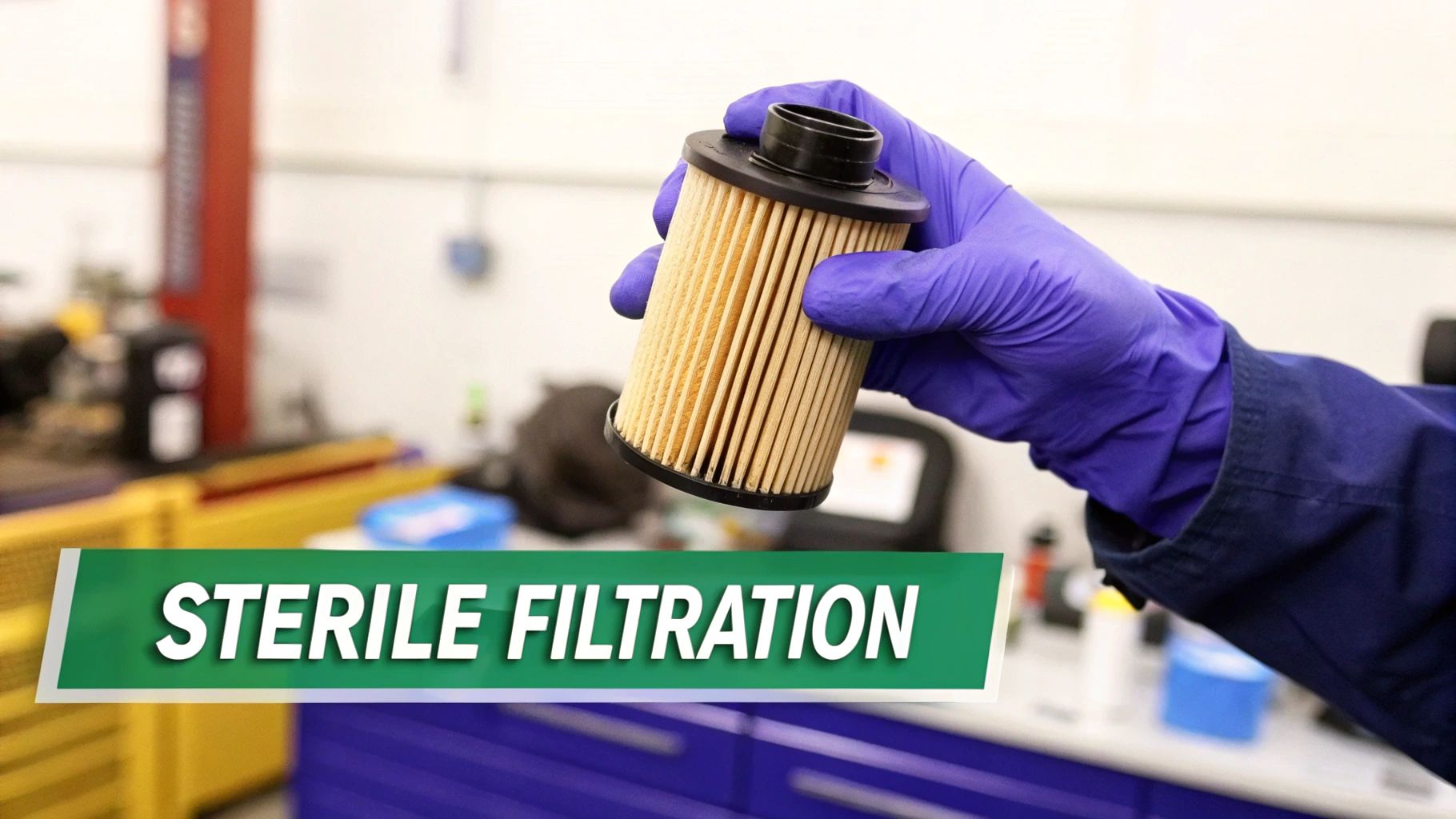
That number—0.22—isn't just a random spec. It was chosen as the industry benchmark because it's smaller than the smallest known bacteria. This ensures that any fluid passing through comes out sterile and pure on the other side.
The 0.22 micron filter is a game-changer for anyone relying on Contractor's Maintenance Service. It became the standard for sterilization back in the 1970s because it reliably removes microorganisms from liquids and gases. Most bacteria (which are 0.5-5 microns) simply can't pass through its pores. This achieves sterile filtration without using heat, which could compromise warranty-covered parts on your Graco or Honda equipment.
While a 0.22 micron filter is the king of sterile filtration, it's helpful to see how it stacks up against other common sizes.
Quick Guide to Micron Filter Pore Sizes
This table gives you a quick look at different filter sizes and what they're typically used for. It really highlights why the 0.22 micron rating is so specialized.
Pore Size (Microns) | Primary Function | Typical Application |
|---|---|---|
0.22 | Sterile Filtration | Removing bacteria from fluids, gases, and solvents. |
0.45 | General Clarification | Removing fine particles, clarifying solutions. |
1.0 | Pre-filtration | Capturing larger sediment to protect finer filters. |
5.0 | Coarse Filtration | Removing visible sediment like sand and rust. |
As you can see, when absolute purity is required, nothing beats the precision of a 0.22 micron filter.
Your Local Partner in Filtration
At Contractor's Maintenance Service, we get the unique challenges of working in San Luis Obispo county, from Atascadero and Arroyo Grande to Pismo Beach. We provide local access to these essential components, ensuring your projects in Templeton or Grover Beach run smoothly without delays.
We’re here to equip you with not just parts, but the knowledge to protect your investments. It’s a similar principle to advanced air purification, where understanding True HEPA filter technology shows how fine filtration protects an environment.
By integrating a 0.22 micron filter, you're investing in uptime, reliability, and the peace of mind that comes with knowing your equipment is protected.
How Sterile Filtration Protects Your High-Value Equipment
Think of a 0.22 micron filter as your equipment’s personal bodyguard. It works through a pretty straightforward process called physical sieving—basically, it's a microscopic maze where your essential fluids can pass through, but all the harmful junk gets trapped.
This kind of protection is non-negotiable for high-value gear like Graco paint sprayers and Honda engines. When you filter paints, solvents, or maintenance fluids down to this level, you stop microbial growth dead in its tracks. And that’s not a minor issue; for a lot of contractors here on the Central Coast, it’s one of the main reasons equipment fails.
The Dangers of Biofilm Buildup
Without that fine-tuned filtration, bacteria can form destructive biofilms. These are nasty, slimy layers that build up inside your equipment, kicking off a chain reaction of problems that hit your productivity and your wallet hard.
The consequences of letting biofilm get a foothold are serious and expensive:
Clogged Nozzles: Biofilm building up in airless sprayers is a recipe for inconsistent spray patterns, sputtering, and eventually, total blockages.
Jammed Components: That sticky gunk can interfere with the movement of pistons, valves, and other precision parts, leading to premature wear and system failure.
Corrosion: Microbial colonies can actually speed up corrosion inside fluid lines, tanks, and sensitive engine components, drastically shortening the lifespan of your machinery.
At the end of the day, when you invest in proper sterile filtration, you're not just buying another part. You're buying insurance against surprise breakdowns and costly repairs. It extends the life of your most important tools and protects your bottom line. It's the same principle as using a quality fuel tank strainer to keep big debris out of an engine—this just stops the microscopic threats.
The Gold Standard for Microbial Capture
For any industrial maintenance pro, especially contractors who rely on painting and coating equipment from brands like Wagner or Titan, the 0.22 micron filter is the undisputed gold standard for sterile filtration. It's the most dependable way to keep your maintenance fluids and hydraulic systems free from bacterial contamination.
Most bacteria are between 0.2 and 2 microns in size, so a 0.22 micron filter is over 99.999% effective at capturing them. It's a nearly absolute barrier against the stuff you can't see.
Investing a small amount in a high-quality filter today can save you from hundreds, or even thousands, of dollars in emergency repairs and lost job hours tomorrow. It's one of the smartest preventive maintenance decisions a contractor can make.
Here at Contractor's Maintenance Service, we serve the hardworking professionals across San Luis Obispo county. Whether you're in San Luis Obispo, Paso Robles, Atascadero, Arroyo Grande, Pismo Beach, or Morro Bay, we know that equipment uptime is everything. Using the right filtration isn’t just a good idea—it’s a critical step toward keeping your gear reliable.
Choosing The Right Filter Material For Your Job
When you’re spec’ing a 0.22 micron filter, it’s easy to focus on the pore size and call it a day. But the truth is, the material the filter is made from is just as critical. Picking the right one means smooth, reliable performance, while the wrong choice can lead to filter failure, damaged equipment, and a whole lot of expensive downtime.
The decision really comes down to what you’re running through the system. Chemical compatibility is the name of the game.
Material Matters For Chemical Compatibility
If you’re working with aggressive solvents or harsh chemicals, a PTFE (Polytetrafluoroethylene) filter is a must. Its bulletproof chemical resistance means it won't break down or, worse, leach contaminants back into your fluid. For water-based solutions, on the other hand, something like PES (Polyethersulfone) is a fantastic choice, known for its great flow rates and durability.
Making the wrong call here can be disastrous. An incompatible filter can swell, dissolve, or completely fall apart, sending a rush of particles straight into the sensitive equipment you were trying to protect.
Here’s a quick rundown of some common materials you'll encounter:
PTFE: Your go-to for aggressive organic solvents, strong acids, and bases. It's naturally hydrophobic, meaning it repels water.
PES: Perfect for aqueous (water-based) fluids. It offers high flow rates and low protein binding, making it a solid all-rounder.
PVDF (Polyvinylidene Fluoride): A versatile workhorse with broad chemical compatibility and low protein binding, suitable for both water-based solutions and milder solvents.
To help you match the right filter material to your job, this quick-reference chart breaks down what works best with common industrial fluids and what to avoid.
Filter Material Compatibility Chart
Filter Material | Best For (Fluid Type) | Avoid Using With | Key Advantage |
|---|---|---|---|
PTFE | Aggressive solvents, strong acids/bases | Aqueous solutions (without pre-wetting) | Superior chemical resistance |
PES | Aqueous solutions, buffers, general filtration | Strong organic solvents, concentrated acids | High flow rates, low protein binding |
PVDF | Mild solvents, aqueous solutions, proteins | Ketones, esters, highly alkaline solutions | Broad chemical compatibility |
Nylon | General solvents, alkaline solutions | Strong acids, halogenated hydrocarbons | Good strength and durability |
Ultimately, choosing the right material ensures your filter performs as expected, maximizing its lifespan and protecting your investment.
This decision tree shows how selecting the right 0.22 micron filter acts as a crucial barrier, protecting your valuable downstream equipment from harmful contaminants. As the flowchart shows, the filter is the final checkpoint standing between your fluid source and the long-term health of your machinery.
Your Local Filtration Source On The Central Coast
Beyond chemical resistance, you also need to think about the real-world conditions on your job site. A filter has to be able to handle the operating temperatures and pressures without failing. For contractors in San Luis Obispo and nearby towns like Paso Robles and Atascadero, having a local partner who gets it is a game-changer.
At Contractor's Maintenance Service, we've helped countless professionals in Arroyo Grande, Pismo Beach, and Morro Bay find the exact filtration components they need. Whether it's a simple, durable unthreaded gun filter from our shop at https://www.contractorsmaintenanceservice.com/product-page/gun-filter-unthreaded or a more complex system, our experience on the ground ensures you get the right part every single time. To get a wider view of your options, checking out a comprehensive comparison of water filtration systems can offer some great insights.
Choosing the correct filter material and housing isn't just about performance—it's about operational safety and reliability. The right filter maximizes efficiency and prevents catastrophic failures that can bring a project to a standstill.
When you take the time to consider all these factors, you can be confident your 0.22 micron filter is providing the precise, dependable protection your equipment demands.
Installation and Maintenance Best Practices
You can pick the perfect 0.22 micron filter, but if you fumble the installation or slack on maintenance, you're not going to get the performance you paid for. It's a classic case of a small oversight leading to big problems—poor filtration, damaged equipment, and the kind of downtime that kills a schedule.
Following a few simple best practices will keep your filtration system running at peak efficiency from day one.
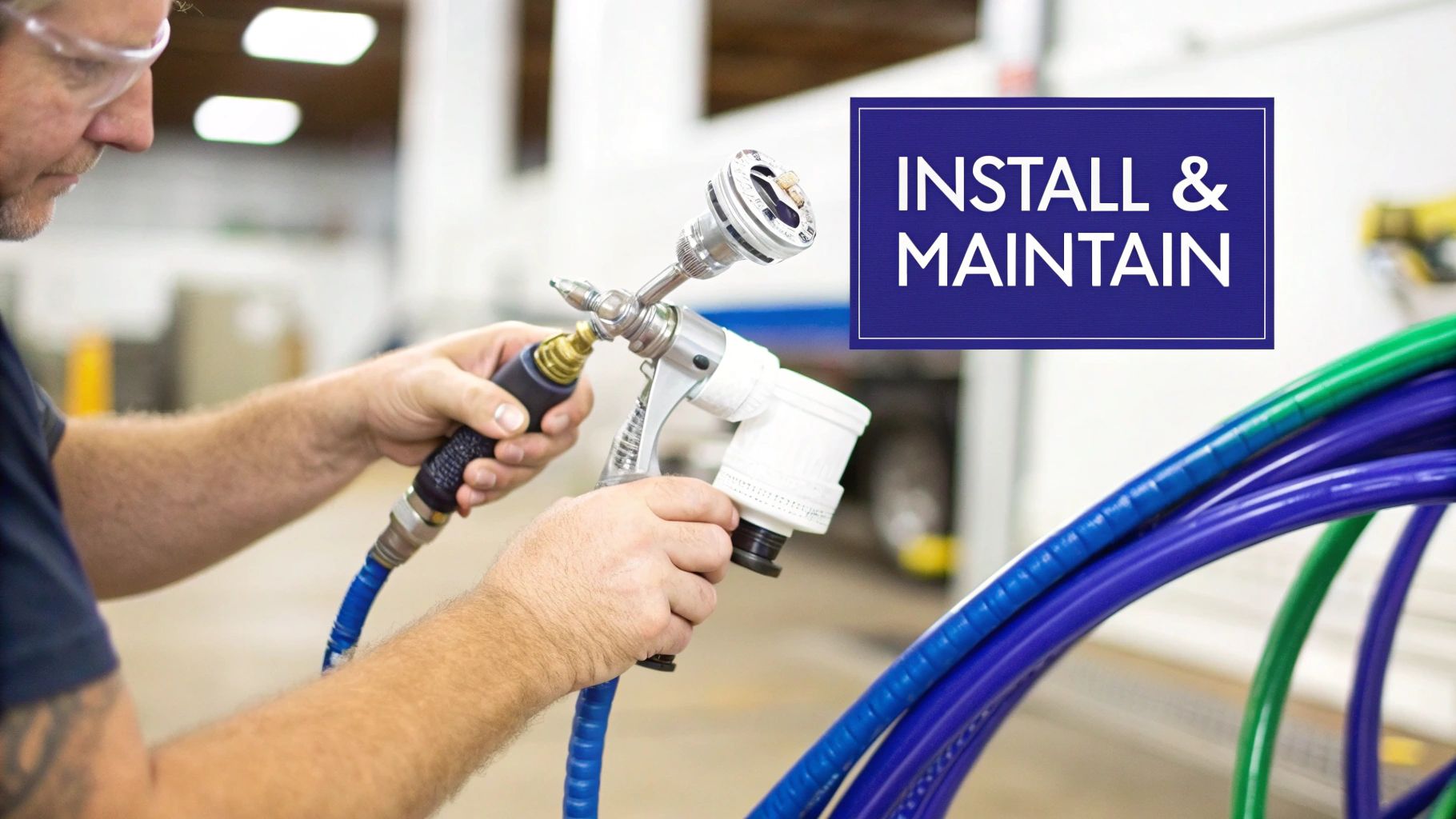
Think of the installation process as setting the stage for success. Before you even touch the filter, put on a pair of clean gloves. The oils and dirt from your hands can instantly clog some of the filter’s fine pores, handicapping its performance before it even gets started.
The Critical Step of Priming Your Filter
One of the most common mistakes we see is people skipping the priming step. When you install a new filter, the housing is full of air. If you just blast fluid through it, you'll create an "airlock" that either chokes the flow down to a trickle or stops it completely.
Priming is just the simple process of getting that trapped air out before you put the system under full pressure.
Here's how to do it right:
Install the filter into its housing. Double-check that all seals and gaskets are seated correctly—this is your defense against leaks.
Slowly introduce the fluid into the system at low pressure. Let it gently fill the housing and soak the filter media, pushing the air out ahead of it.
Vent the housing by opening the bleed valve or slightly loosening the outlet fitting. Wait until you see a steady, bubble-free stream of fluid, then tighten everything back up.
This quick procedure guarantees a smooth, uninterrupted flow right from the start.
A properly installed and primed filter not only works better but lasts longer. Skipping these steps is like buying a high-performance engine and never changing the oil—you're just inviting future problems.
Recognizing and Responding to a Clogged Filter
Every filter, no matter how good, will eventually clog. The trick is spotting the warning signs so you can swap it out before it triggers a bigger issue. The most reliable indicator of a spent 0.22 micron filter is a significant pressure drop across the housing.
As the filter fills with contaminants, it gets harder for fluid to push through. This makes the pressure on the inlet side climb while the outlet pressure falls. Most industrial setups have pressure gauges to monitor this difference. Once that differential pressure hits the manufacturer’s recommended limit, it’s time for a new filter.
Another dead giveaway is a reduced flow rate. If your equipment suddenly feels sluggish or isn't performing like it should, a clogged filter is a prime suspect. At Contractor's Maintenance Service, we help professionals from San Luis Obispo to Paso Robles and Atascadero troubleshoot these exact problems every day. We also service equipment down in Arroyo Grande, Pismo Beach, and Morro Bay, providing both the parts and the know-how.
Being proactive is always the best strategy. For a deeper look at building a solid upkeep schedule, our guide on the top 10 preventive maintenance best practices for 2025 offers some great strategies. Sticking to a schedule based on your usage is the best way to prevent surprise failures and keep your operation running like clockwork.
Your Go-To Filtration Partner on the Central Coast
When a critical piece of equipment goes down, you need the right parts and expertise—and you need them fast. For contractors and industrial managers, waiting days for a shipment isn't just an inconvenience; it's lost time and money. That's why having a local partner who gets the urgency of your work is so important. Here at Contractor's Maintenance Service, we're your dedicated filtration specialists right here in San Luis Obispo County, ready to keep your operations running smoothly.
We're proud to serve the hardworking professionals across the Central Coast. Our reach extends throughout the region, making sure you always have reliable access to high-quality filtration solutions.
Serving All of San Luis Obispo County
No matter where your job site is, we’ve got you covered. Our local counter is a hub for contractors from all over:
San Luis Obispo: The heart of our service area, providing quick access for city-based projects.
Paso Robles & Atascadero: Supporting the robust industrial and agricultural needs of the North County.
Arroyo Grande, Pismo Beach, & Grover Beach: Catering to the diverse construction and maintenance demands of the Five Cities area.
Morro Bay & Templeton: Equipping businesses in our coastal and rural communities with the right parts for the job.
Finding the correct 0.22 micron filter isn’t just about matching a part number. It's about getting expert guidance to ensure the filter you choose meets the specific demands of your equipment and application, preventing costly failures down the line.
More Than Just a Parts Counter
While our local counter in San Luis Obispo provides immediate access to essential components, our support doesn't stop there. We also offer convenient nationwide shipping for customers beyond the Central Coast, making sure everyone can benefit from our curated selection and expertise.
As an authorized service center for leading brands, we don't just sell you a box. We bring the deep product knowledge needed to help you select the perfect 0.22 micron filter and system components. Whether you're managing a large industrial facility in Paso Robles or a construction project in Arroyo Grande, our team is here to deliver practical, effective solutions that protect your valuable equipment and keep you up and running.
Common Questions About 0.22 Micron Filters
When you're dealing with industrial filtration, a lot of questions can come up. To clear things up, we've put together answers to the most common queries we hear from contractors and maintenance managers about 0.22 micron filters. This quick guide should cover the key concepts and practical concerns.
Why Is A 0.22 Micron Filter Called A “Sterilizing” Filter?
A 0.22 micron filter gets its "sterilizing" or "sterile" label because its pores are engineered to be smaller than the tiniest known bacteria. As fluid moves through it, the filter acts as a physical wall, catching and removing virtually all microorganisms. It's an industry-validated way to achieve sterility without needing heat.
For anyone working with sensitive gear like paint sprayers or hydraulic systems, this is a huge deal. It stops bacteria from creating biofilm, which is a major cause of clogs, corrosion, and component failure. In short, it purifies the fluid to protect your expensive equipment.
What's The Real Difference Between A 0.22 And 0.45 Micron Filter?
The main difference is the level of purity you get. A 0.22 micron filter delivers true sterile filtration, which is non-negotiable when you absolutely cannot have any microbial growth. A 0.45 micron filter is great for general clarification and removes most bacteria, but it might let some of the smaller strains sneak through.
Here’s a simple way to think about it:
0.22 Micron: This is your high-security checkpoint. It guarantees no bacteria get past. It's the go-to for protecting critical systems where any contamination spells failure.
0.45 Micron: This is more like general particle control. It’s often used as a pre-filter to lighten the load on a finer filter down the line, or in situations where just cutting down the bioburden is good enough.
For contractors here in San Luis Obispo and the surrounding areas like Paso Robles and Atascadero, choosing the 0.22 micron size is the best way to ensure maximum protection for high-value equipment.
How Do I Know When It’s Time To Replace My Filter?
The clearest sign that your 0.22 micron filter is ready for a change is a significant jump in back pressure, often called "pressure drop." As the filter does its job catching contaminants, its pores start to clog, making it tougher for fluid to pass through. This resistance makes the pressure on the inlet side of the filter climb.
Most industrial systems have pressure gauges to monitor this. Once the pressure difference between the inlet and outlet goes beyond the manufacturer's recommendation—or if your flow rate takes a noticeable dip—it's time for a new filter. Sticking to a preventive maintenance schedule based on your fluid type and volume is also a smart move to avoid surprise shutdowns.
Can I Just Clean and Reuse A 0.22 Micron Filter?
In nearly every industrial setting, the answer is a hard no. Most 0.22 micron filters, especially the disposable cartridge or capsule types, are strictly single-use. The filter media is incredibly delicate, and its microscopic pores trap gunk so effectively that cleaning it without causing damage is practically impossible.
Attempting to backflush or clean a sterile filter is a bad idea. You risk compromising its integrity, which could tear the membrane or, even worse, flush trapped bacteria right back into your system. For guaranteed performance and safety, always replace the filter as recommended.
This simple practice ensures you maintain that sterile barrier and protect your equipment without fail. Professionals from Arroyo Grande to Morro Bay depend on fresh, quality filters to keep their operations running smoothly. We're proud to serve these communities, along with Pismo Beach, Grover Beach, and Templeton, getting them the right parts right when they need them.
For expert advice on picking the perfect 0.22 micron filter or any other industrial part for your job on the Central Coast, trust the team at Contractor's Maintenance Service. We offer the high-quality components and practical know-how you need to protect your equipment and stay productive. Visit us online or stop by our San Luis Obispo counter to find the right solution today.
Comments