


Your Essential Guide to Compressor Air Filter Maintenance
A good compressor air filter is more than just a part; it's the first line of defense for your expensive pneumatic tools. It works around the clock, stripping damaging contaminants like dust, oil, and moisture from the air stream. Think of it as a dedicated gatekeeper, ensuring only pure, clean air makes it to your equipment, saving you from frustrating breakdowns and costly repairs.
The Unsung Hero Guarding Your Equipment
Picture this: you're in the middle of a critical job, and your paint sprayer starts spitting, or your nail gun jams. The culprit isn't always obvious, but nine times out of ten, it's dirty, moist air. This is exactly where the compressor air filter proves its worth, silently protecting your high-performance tools from the inside out.
Clean, dry compressed air is the lifeblood of any pneumatic system. Without proper filtration, microscopic particles will chew away at sensitive internal components. It's a slow death for your tools, leading to premature wear, a frustrating drop in performance, and eventually, expensive trips to the repair shop. A single, high-quality filter stops this destructive cycle before it starts.
Why Clean Air is Non-Negotiable
Contaminants flowing through an air line are like liquid sandpaper grinding away at the guts of your tools. Dust, rust flakes from the compressor tank, and even tiny oil aerosols can score cylinders, destroy seals, and clog delicate passages. The damage is often subtle at first—maybe a slight drop in power or an inconsistent spray pattern—but it always leads to bigger, more expensive problems down the road.
This is especially true for professionals who depend on their gear every single day. For contractors and maintenance crews across San Luis Obispo County, consistent tool performance isn't just a nice-to-have; it's directly tied to the bottom line.
A properly functioning compressor air filter is one of the smartest, most cost-effective investments you can make for your equipment. It prevents problems that can easily run you hundreds, if not thousands, of dollars in downtime and repairs.
Your Local Partner for Peak Performance
Knowing why you need a good air filter is the first step. Having a local expert you can count on makes all the difference. For businesses and pros here on California's Central Coast, we’re proud to be that partner, making sure you get the right parts and advice exactly when you need them.
We're on the ground, serving communities all over the region, including:
San Luis Obispo
Paso Robles
Atascadero
Arroyo Grande
Grover Beach
Pismo Beach
Morro Bay
Santa Maria
And the surrounding Central Coast communities
Whether you're working out of a shop in SLO or on a job site in North County, our team has your back. We don’t just sell components; we provide the practical, hands-on knowledge to help you choose, install, and maintain the right filtration system for your specific setup. It's a proactive approach that keeps your tools running smoothly, protects your investments, and helps you keep your projects on schedule and on budget.
How a Compressor Air Filter Really Works
To really get why these filters are so important, you have to look at what's happening on the inside. A compressor air filter isn't just a simple screen. It’s more like a multi-stage security checkpoint for air, built to clean up the air stream before it ever touches your expensive equipment. Each stage has a specific job, and they all work together to give you clean, dry air.
This diagram shows you the basic idea—how dirty, contaminated air gets transformed by the filter.
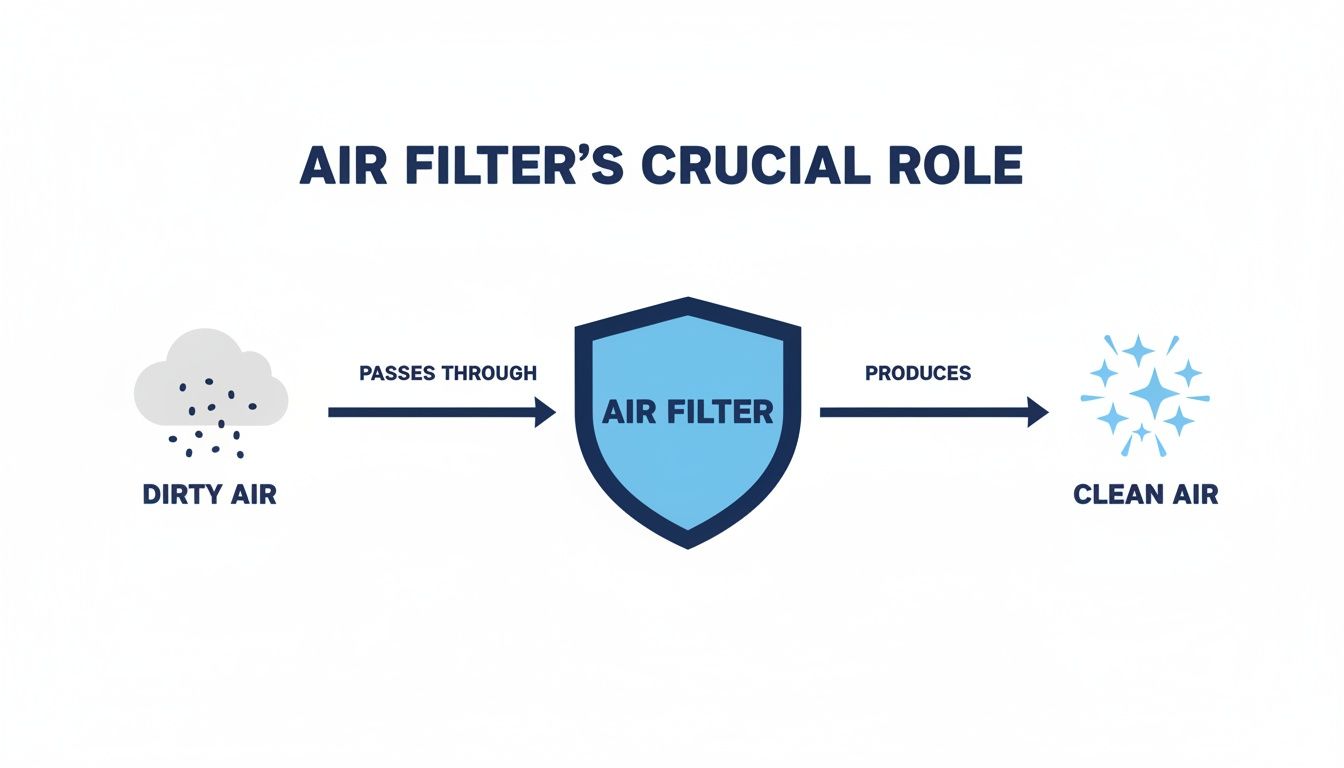
Think of the filter as a protective shield. It takes harmful, debris-filled air and turns it into a clean resource your tools can actually use. For any professional relying on pneumatic tools, this isn't just a feature; it's a necessity.
The First Line of Defense: Particulate Filtration
The journey starts at the particulate filter. This is the first guard at the checkpoint, and its job is to stop the most obvious threats. It physically blocks and captures bigger, solid contaminants—things like dust, dirt, pollen, and even rust flakes from inside the compressor tank. The process is called interception, which is a fancy way of saying particles literally crash into the filter media and get stuck.
Without this first step, all that gunk would quickly clog up the more sensitive filters down the line. By handling the "heavy lifting," the particulate filter lets the rest of the system focus on the finer, trickier stuff.
Capturing Liquids with Coalescing Filters
Next up, the air passes through a coalescing filter. This is where things get more specialized. This filter is designed to trap tiny liquid aerosols—microscopic droplets of oil and water that are way too small for a standard particulate filter to catch. It works like a super-dense forest of fine fibers.
As air winds its way through this fibrous maze, two things happen:
Inertial Impaction: Heavier oil and water droplets can’t make the sharp turns with the airflow. Their momentum sends them crashing straight into a fiber, where they stick.
Diffusion: The absolute smallest particles move around randomly (a process known as Brownian motion) and eventually bump into the filter fibers.
As these tiny droplets build up, they merge—or "coalesce"—into larger, heavier drops. Gravity then does its job, pulling them down into a collection bowl to be drained away. This is what keeps them from wrecking sensitive equipment like your Graco or Wagner/Titan sprayers.
The Final Polish: Activated Carbon Filters
The final stage is often an activated carbon filter. Imagine a high-tech sponge with a massive internal surface area. Its job is to absorb what the other filters missed. Its main role is to pull out oil vapors and odors through a process called adsorption.
Unlike absorption, where something soaks in, adsorption makes vapor molecules chemically stick to the carbon's surface. This is a huge deal for jobs like automotive painting or supplying breathing air, where even a tiny trace of oil vapor can ruin a perfect finish or create a serious safety hazard. You can dive deeper into this topic in our guide to intake air filter compressors.
By the time the air makes it through this multi-stage system, it has been thoroughly cleaned, dried, and purified. This isn't just about stopping clogs; it's about protecting the precision engineering inside every single pneumatic tool you own.
This kind of meticulous filtration is the backbone of a fast-growing industry. The industrial air compressor market is projected to jump from USD 20.1 billion in 2025 to USD 30.2 billion by 2035. This growth highlights why staying on top of maintenance with a high-efficiency compressor air filter, which can capture up to 99.99% of particles, is no longer optional for serious contractors.
Choosing the Right Filter for Your Application
Picking the right compressor air filter isn’t like grabbing a generic part off the shelf. It’s a strategic decision that protects your tools, guarantees the quality of your work, and ultimately saves you money. But to make the right call, you need to understand the language of filtration—specs like micron ratings, flow rates, and efficiency.
It's not as complex as it sounds. These numbers are just tools to help you match a filter to a job. Whether you're a professional painter in San Luis Obispo or running a construction crew in Paso Robles, getting this right means longer tool life and fewer headaches.
Decoding Micron Ratings
One of the most important specs you'll see is the micron rating. A micron is tiny—one-millionth of a meter, to be exact. For a little perspective, a human hair is about 70 microns thick, and a single red blood cell is around 5 microns. So, when a filter has a 5-micron rating, it's capable of capturing particles you can't even see.
Understanding this scale is the first step to choosing the right filter.
General Purpose (40-50 microns): These are great for catching larger dust and debris. Think of them as the first line of defense for rugged tools like impact wrenches.
Fine Filtration (5 microns): You'll need this level of filtration to protect the sensitive internal parts of tools like nail guns or sanders.
Ultra-Fine Filtration (0.01-1 micron): This is essential for jobs where even the tiniest contaminant can cause big problems, like automotive painting or breathing air systems. For a deep dive, check out our contractor's guide to the 0.22-micron filter.
Matching Flow Rate and Pressure
Next up is the flow rate, measured in Cubic Feet per Minute (CFM). Think of CFM as the volume of air your compressor pushes out. Your filter must be rated to handle that volume. If you pair a high-CFM compressor with an undersized filter, you’re creating a bottleneck.
This restriction is called pressure drop, and it effectively starves your tools of the air they need to work properly. Your compressor has to work overtime just to force air through, which wastes energy and puts extra strain on the motor. The goal is simple: choose a filter with a CFM rating that meets or exceeds your compressor's output.
Selecting the right filter is a crucial business decision. A mismatched filter doesn't just reduce performance; it actively increases your operational costs through wasted energy and accelerated equipment failure.
Filter Types for Specific Jobs
Different jobs create different kinds of junk in your air lines, which is why there are specialized filters. For professionals working in Atascadero, Arroyo Grande, Santa Maria, or anywhere on the Central Coast, matching the filter type to the task is just as important as getting the micron and CFM ratings right.
Here's a quick look at the main players.
Compressor Air Filter Types at a Glance
Filter Type | Primary Function | Removes | Best For | Typical Micron Rating |
|---|---|---|---|---|
Particulate Filter | General-purpose solid contaminant removal | Dust, dirt, rust, pollen | Powering basic air tools, initial filtration stage. | 5 to 40 microns |
Coalescing Filter | Fine liquid and aerosol removal | Oil aerosols, water vapor, fine particles | Automotive painting, sandblasting, sensitive pneumatics. | 0.01 to 1 micron |
Vapor Removal Filter | Gas and odor elimination | Oil vapor, chemical odors, fumes | Breathing air systems, food-grade applications, critical finishing. | N/A (Adsorption) |
Understanding these differences is key. For example, if you use only a particulate filter for a spray painting job, you'll let oil aerosols pass right through and ruin your finish with "fisheyes."
For the most demanding applications, you’ll want to stack filters in the correct sequence—particulate, then coalescing, and finally vapor removal—to ensure the highest quality compressed air. This strategic approach is at the heart of the compressed air treatment market, a sector that hit USD 5,893.3 million in 2024 and is projected to reach USD 8,350.1 million by 2030. The right filter can slash a compressor's energy use by 20-40%—a huge saving when you consider compressors account for 10% of all industrial electricity. You can read more about these market trends and the importance of efficiency.
Your Essential Maintenance and Replacement Guide
Think of proactive maintenance as your secret weapon against unexpected downtime and those eye-watering repair bills. Just like you wouldn't skip an oil change on your truck, regularly servicing your compressor air filter is a fundamental task that protects the whole system. This guide is your practical, step-by-step playbook for keeping that filtration system in peak condition.
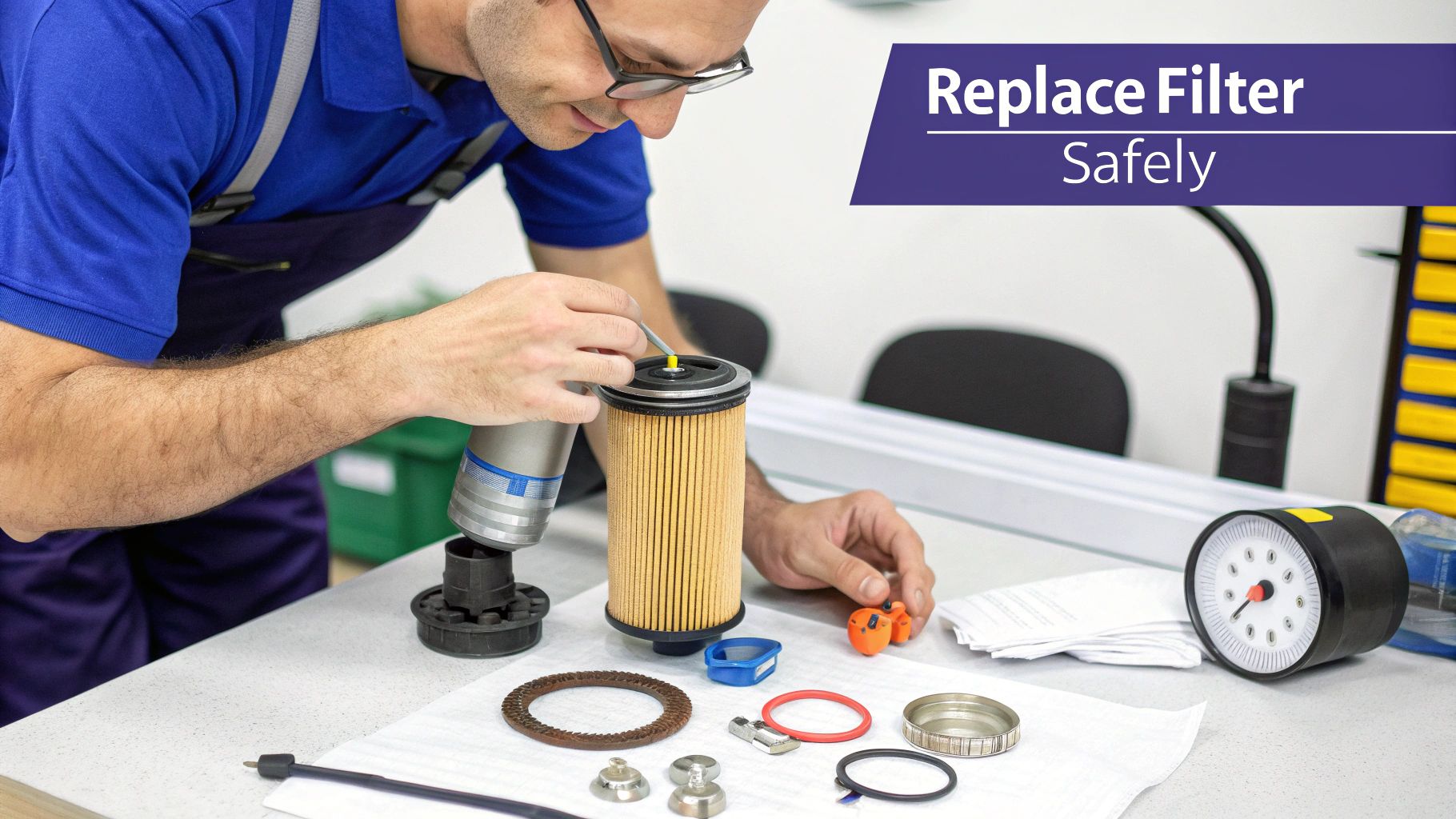
This isn't just about ticking boxes on a schedule; it’s about learning to read the signs your equipment gives you. For professionals working around San Luis Obispo, Paso Robles, Atascadero, and Santa Maria, a few minutes of inspection can be the difference between a productive day and a project grinding to a halt.
Creating a Simple Inspection Schedule
Consistency is everything. You don't need a complex, laminated checklist—just a simple routine to spot small problems before they become big ones. A little proactive care for your compressor air filter pays off big time in tool longevity and performance.
Here’s a simple schedule that works:
Daily Check: Before firing up the compressor, give the filter bowl a quick glance. Use the manual drain valve to empty out any moisture that’s collected. It takes less than 30 seconds.
Weekly Inspection: Now, take a closer look at the pressure drop gauge. Is the needle climbing? A significant increase means the filter is getting clogged and choking off airflow. Also, scan the filter housing for any visible cracks or damage.
Monthly Review: Do your weekly checks, but also take a moment to inspect the automatic drain (if you have one) to make sure it's cycling correctly. A stuck drain is a fast track to sending moisture downstream.
This straightforward routine helps you catch over 90% of common filter-related issues before they cause any real trouble.
Visual Cues of a Failing Filter
Your air filter system will tell you when it needs attention. You just have to know what to look for. Ignoring these signs forces your compressor to work harder, which wastes energy and puts unnecessary wear on the motor.
A clogged filter can jack up your energy consumption by 10% or more as the compressor struggles to shove air through the restriction. That's money literally vanishing into thin air.
Keep an eye out for these clear warning signs:
Rising Pressure Drop: This is your most reliable indicator. If your pressure drop gauge is creeping into the red zone (usually 6-10 PSID above a clean filter’s reading), it’s time for a new element.
Visible Contaminants Downstream: If you disconnect an air hose and see oily residue or water droplets, your coalescing filter has probably failed or is completely overwhelmed.
Reduced Tool Performance: Are your air tools feeling sluggish or lacking their usual punch? A clogged filter could be starving them of the air they need to do their job properly.
Your Step-by-Step Replacement Guide
Swapping out a filter element is a simple job you can easily handle yourself with a few basic tools. Just follow these steps to get it done safely and correctly, protecting both you and your equipment.
Depressurize the System: This is the most critical safety step. Shut off the air supply to the filter and slowly open the drain valve to bleed off every last bit of trapped pressure. Never, ever try to open a filter housing that’s still under pressure.
Remove the Filter Bowl: Unscrew the bowl or housing. Some have a locking ring or need a special wrench. Be ready for a little residual moisture or oil to drip out, so have a rag handy.
Take Out the Old Element: Simply pull the old filter element out. Pay attention to how it’s seated and whether there are any O-rings or seals attached that need to come with it.
Clean and Inspect: Use a clean, lint-free rag to wipe the inside of the filter bowl. Look closely at the bowl for any cracks and check the condition of the main O-ring that seals it to the housing. If it’s cracked, brittle, or flattened, replace it.
Install the New Element: Pop the new filter element into the housing, making sure it sits correctly and seals properly.
Reassemble and Test: Screw the bowl back on. Hand-tighten it firmly, but don't go overboard and crack the plastic or strip the threads. Slowly turn the air back on and check for any leaks around the seal with a bit of soapy water.
This simple maintenance routine is a core part of protecting your equipment investment. For more insights on equipment care, especially on how to maintain power tools in dusty climates, it's always good to expand your knowledge.
The demand for clean compressed air is only growing. According to Market Research Future, the global market for air compressor filters and dryers was valued at USD 7.595 billion in 2024 and is expected to hit USD 11.71 billion by 2035. Putting off a simple filter replacement can cut a compressor's lifespan by up to 50%—a risk no business can afford to take.
Troubleshooting Common Air Filter Problems
Even with a perfect maintenance schedule, your compressed air system can sometimes throw you a curveball. When issues pop up, the compressor air filter is often one of the first places to look. Since it’s your system’s first line of defense, knowing how to spot and solve common problems here can save you a massive headache.
Think of it as detective work. You start with the symptom—like a sudden drop in air pressure—and work your way backward to find the root cause. This practical approach will help you resolve a lot of the common hiccups on your own, saving you valuable time and money.
Identifying the Root Cause
When a problem arises, it’s tempting to just swap the filter element and hope for the best. While that sometimes works, it often just puts a Band-Aid on a bigger issue. Understanding the why behind the failure is the real key to a long-term fix.
For instance, a filter that clogs up way too fast might not be the problem itself. It could be a symptom of an overworked compressor generating excess gunk. Digging a little deeper helps you fix the actual source of the trouble, not just the most obvious sign.
A sudden performance issue is more than an annoyance; it's your equipment's way of telling you that something in the system is out of balance. Listening to these signals is crucial for preventing a small problem from turning into a catastrophic failure.
Common Air Filter Issues and Solutions
This diagnostic table is designed to be your go-to reference. It connects common symptoms to their likely causes and gives you clear, actionable steps to get your system back up and running.
Here’s a quick rundown of what to look for when your system starts acting up.
Common Air Filter Issues and Solutions
Symptom / Problem | Likely Cause(s) | How to Fix It |
|---|---|---|
Sudden Loss of Air Pressure | The filter element is completely clogged. | Replace the filter element immediately. A clogged filter suffocates your tools. |
Water in the Air Lines | The coalescing filter is saturated or the drain valve is stuck or clogged. | Check and clean the manual or automatic drain. If the problem persists, replace the coalescing element. |
Oil Appearing Downstream | The coalescing filter has failed or the compressor is passing too much oil. | Replace the coalescing filter element. If the issue returns quickly, your compressor may need service. |
Filters Wear Out Too Quickly | The filter is undersized for the compressor's CFM, or there's excessive contamination. | Verify the filter's CFM rating matches your compressor. Investigate upstream sources of contamination. |
Running through these checks will solve the majority of day-to-day filter problems and keep your equipment in good shape.
When You Need Expert Help on the Central Coast
Sometimes, a problem goes beyond a simple part replacement. If you've worked through these steps and are still facing issues, it might be time to call in a professional. For contractors and businesses on California's Central Coast, having local support you can trust is essential.
Our team at Contractor's Maintenance Service is here to help. We provide expert diagnostics and hands-on service for professionals throughout the region. We proudly serve:
San Luis Obispo
Paso Robles
Atascadero
Arroyo Grande
Grover Beach
Pismo Beach
Morro Bay
Santa Maria
And other surrounding communities.
Whether it’s an underlying compressor issue or a complex filtration challenge, we have the tools and experience to diagnose the problem accurately. Our goal is to provide fast, reliable solutions that get you back to work with minimal downtime, ensuring your equipment operates at peak performance. Don't hesitate to reach out when you need a hand.
Your Local Expert for Parts and Service on the Central Coast
Knowing how your compressor's air filter works is a great start, but having a trusted local partner for parts and service is what keeps you up and running. When you need more than just information, Contractor's Maintenance Service is your hands-on resource for professional equipment here on California's Central Coast.
We’ve built our name on providing practical support that keeps local operations moving. You can count on us for specialized knowledge and quick assistance across a wide range of communities, including:
San Luis Obispo
Paso Robles
Atascadero
Arroyo Grande
Grover Beach
Pismo Beach
Morro Bay
Santa Maria
More Than Just Parts on a Shelf
We don't just sell components; we deliver complete solutions designed to prevent expensive interruptions to your workflow. Our team offers expert diagnostics to get to the root cause of equipment failures, so you get the right fix the first time around.
As an authorized service center for top brands like Graco and Wagner/Titan, we handle everything from warranty repairs to routine tune-ups. This means your equipment is always serviced to the manufacturer's standards, protecting its performance and lifespan.
Our goal is simple: be your go-to resource for everything from a critical compressor air filter you can grab today at our San Luis Obispo counter to a custom hydraulic hose we can build while you wait. We pair fast turnarounds with deep product knowledge.
Your Partner in Preventative Maintenance
Ultimately, our mission is to help you sidestep downtime altogether. We put together preventative maintenance programs that are specifically tailored to your equipment and how hard you run it.
By catching potential issues before they turn into critical failures, we help keep your tools on the job site instead of in the repair shop. This proactive approach is all about keeping your business running smoothly. To get a better sense of our philosophy on equipment care, check out our guide on comprehensive maintenance services in San Luis Obispo and see how we can help you succeed.
Common Questions About Compressor Air Filters
Let's tackle some of the most frequent questions we get from pros around the Central Coast. These are the practical, on-the-ground concerns that pop up once you've got the basics down. Our goal is to clear up any lingering confusion and make sure you're set up for success.
How Often Should I Change My Filter?
There's no single magic number here. The real answer depends entirely on your specific work environment and how hard you run your compressor. A filter on a dusty construction site in Paso Robles is going to get clogged a lot faster than one inside a clean, climate-controlled workshop in San Luis Obispo.
The best way to know for sure is to keep an eye on the pressure drop indicator on your filter housing—it’s your most reliable guide. But for a solid rule of thumb, plan on inspecting the filter weekly and swapping out the element every 400-500 operating hours or every six months, whichever comes first. Sticking to a proactive schedule like this is the best way to keep your system healthy and your tools protected.
Can I Clean and Reuse a Filter Element?
It’s tempting to try and save a few bucks by cleaning and reusing a filter, but we strongly advise against it. This is especially true for coalescing filters, which rely on an incredibly fine, delicate internal media to do their job.
When you try to blow out or wash a filter, you risk creating microscopic tears and holes in the filter fibers. You won't be able to see them, but these tiny pathways give contaminants a free pass right into your air lines. The filter becomes completely useless, putting your expensive pneumatic equipment in the line of fire. When in doubt, a new filter is always the safer, smarter choice.
A compromised filter isn't just inefficient; it's an open door for the very contaminants you're trying to block. The small cost of a new element is cheap insurance against a major tool repair down the road.
What Happens If I Use the Wrong Filter?
Using the wrong filter isn't a minor mistake—it can cause immediate and significant problems for your entire compressed air system. The exact consequences depend on the type of mismatch:
Wrong Size (CFM): An undersized filter with too low of a CFM rating acts like a choke point in your air line. It restricts airflow, which starves your tools of the power they need to perform. Your compressor has to work overtime just to keep up, driving your energy costs through the roof.
Wrong Type: This is a classic, costly error. If your system needs oil aerosol removal but you only install a standard particulate filter, you're letting harmful oil and moisture flow directly to your sensitive tools. For equipment like paint sprayers, this can cause serious damage and will likely void the manufacturer's warranty.
For professionals working everywhere from Atascadero to Santa Maria and Arroyo Grande, getting the filter right isn't just about maintenance—it's fundamental to the quality of your work and the longevity of your gear.
Need the right filter or expert advice for your specific application? The team at Contractor's Maintenance Service has you covered with parts, service, and hands-on expertise. Visit us online at https://www.contractorsmaintenanceservice.com to see how we can help keep your equipment running at its best.
Comments