


A Complete Guide to Pressure Washer Spray Tips
Think of your pressure washer as a high-performance engine.All that raw power is useless until you tell it what to do. That's where the spray tip comes in. These small, interchangeable nozzles are the single most important factor in getting a safe, effective clean. They take your machine's power and focus it for a specific job, whether you're gently rinsing a car or blasting away years of grime.
The Conductor of Your Cleaning Orchestra
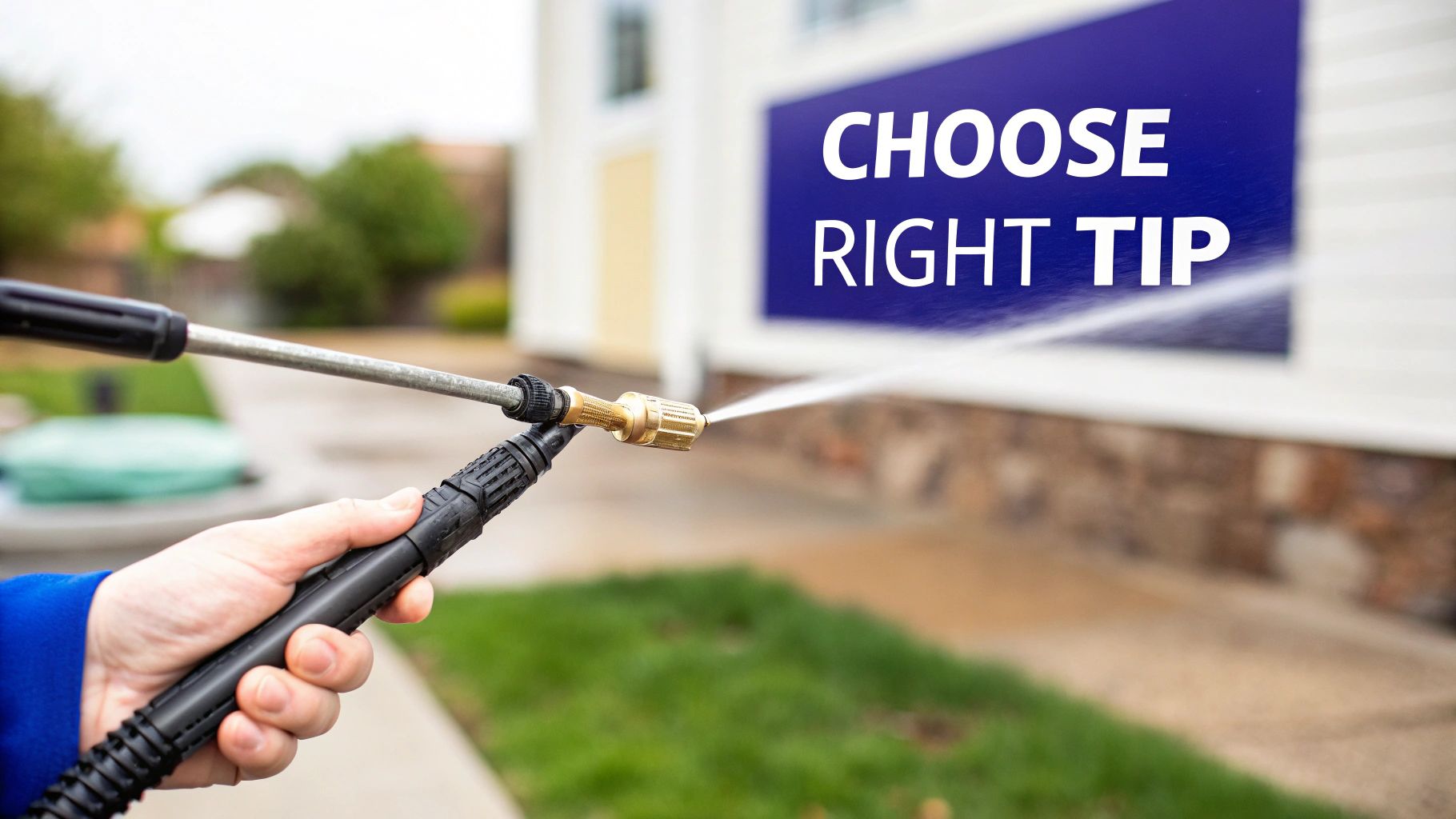
The spray tip is the conductor of your pressure washer's orchestra. It transforms a potent, raw force into a precise cleaning instrument, telling the high-pressure water exactly how to perform. Without the right tip, you're just spraying water wildly. With it, you're directing a specialized tool designed for a specific purpose.
It's a lot like a simple garden hose nozzle. Twist it one way, and you get a wide, gentle mist perfect for watering flowers. Twist it the other, and you get a focused jet that blasts mud off a shovel. A pressure washer tip works on the same principle, but it amplifies the effect a thousand times over. One small change can be the difference between safely cleaning a wooden deck and permanently etching ugly streaks into its surface.
Mastering the Core Concepts
Picking the right nozzle is the most critical decision you'll make before pulling that trigger. It doesn’t just guarantee a better clean—it protects your property from expensive damage and prevents needless wear and tear on your pressure washer’s pump.
To make the right choice every time, you need to understand three key elements:
Color-Coded Angles: This is a universal system that gives you the angle of the water fan at a glance. It ranges from a pinpoint 0-degree stream to a wide 40-degree spray, and each color means something different.
Orifice Size: Inside every tip is a tiny hole that ultimately dictates the final pressure. This size must be matched to your machine's PSI and GPM ratings.
Matching Tip to Task: This is the real skill. It’s the art of combining the right angle and orifice size for the surface you're cleaning, whether it's soft wood, grimy concrete, or a dirty vehicle.
The massive demand for pressure washers is largely driven by the residential sector, as homeowners look for better ways to clean patios, driveways, and siding. This has pushed manufacturers to innovate, balancing powerful performance with water conservation. You can find out more about these pressure washer market trends and insights.
For our local clients in San Luis Obispo County, getting this right is key to maintaining property value. Whether you're in Paso Robles, Atascadero, Arroyo Grande, or coastal towns like Pismo Beach and Morro Bay, choosing the right spray tips ensures you get professional results without putting your home or equipment at risk.
Decoding the Universal Color Code for Nozzles
Figuring out pressure washer spray tips gets a lot easier once you learn the universal color code. It's an industry-standard system that gives you a quick, at-a-glance idea of a nozzle's spray pattern and how intense it is. Think of it like a set of specialized tools, where each color is designed for a specific job.
Each color corresponds to a different spray angle, measured in degrees. A smaller degree number means a tighter, more concentrated stream of water—and a lot more power. A larger degree creates a wider, gentler fan, covering more ground with less force.
Let’s break down what each color means and, more importantly, when you should (and shouldn't) use it.
The Red Tip (0-Degree): A Surgical Tool
The red pressure washer spray tip delivers a 0-degree stream. This isn't a spray or a fan; it's a pinpoint jet, like a high-powered pencil of water. It focuses all of your machine's PSI into one tiny spot, making it incredibly powerful and just as dangerous if you're not careful.
Think of the red tip as a surgical tool, not a cleaning brush. You should only pull this one out for the most stubborn, isolated spots on extremely tough surfaces.
Best For: Blasting caked-on mud from undercarriages, clearing weeds from deep cracks in concrete, or hitting tiny, tough rust stains on metal.
Safety Warning: Never use this tip on wood, siding, cars, or any other soft material. Its focused power can easily etch concrete, splinter wood, and cause serious injury if it hits your skin. This is the tip of last resort for pros.
The Yellow Tip (15-Degree): The Stripper
Next up is the yellow pressure washer spray tip, which gives you a 15-degree fan of water. This is still a very concentrated spray, perfect for heavy-duty surface prep and stripping jobs. It packs a serious punch but covers a slightly wider area than the red tip, making it more practical for bigger tasks.
Reach for this tip when you need to strip stubborn materials off hard, unpainted surfaces. It's what you use to get a surface ready for a new coat of paint or a refinish.
Pro Tip: When using the yellow or red tips, always keep a safe distance from the surface and keep the wand moving. If you pause in one spot for even a second, you can cause permanent damage—even on tough materials like concrete.
The Green Tip (25-Degree): The All-Purpose Workhorse
The green pressure washer spray tip is easily the most versatile and commonly used nozzle of the bunch. With its 25-degree spray pattern, it hits the sweet spot between cleaning power and surface coverage. This makes it the go-to choice for most general cleaning jobs around a property.
If you're ever not sure which tip to start with, the green one is almost always a safe bet. It's strong enough to lift dirt and grime from driveways, patios, and walkways without being so aggressive that it causes instant damage. For professionals and homeowners in areas like San Luis Obispo and Paso Robles, this is the tip you'll grab most often for cleaning dirty sidewalks and outdoor living spaces.
The White Tip (40-Degree): The Gentle Rinser
The white pressure washer spray tip produces a wide, 40-degree fan of water. This broad spray spreads out the pressure significantly, making it the perfect choice for cleaning delicate materials that could easily be damaged by more aggressive nozzles.
Ideal Applications: * Washing cars, trucks, and boats. * Cleaning windows and screens. * Gently rinsing painted siding or softwoods like cedar and pine.
This is your finishing nozzle. It's great for rinsing surfaces clean without any risk of causing harm.
The Black Tip (Soap Nozzle): The Applicator
Finally, we have the black pressure washer spray tip, which is in a class of its own. It's not designed for high-pressure cleaning at all. In fact, it has the widest opening of any tip, which creates a very low-pressure stream. This low pressure is what activates your pressure washer's detergent siphon or soap tank.
Use this tip only for applying soap, cleaners, or other chemical treatments before you start the real high-pressure work. After you let the detergent sit on the surface for a bit, you’ll switch to a green or white tip to blast it all away.
To get a better handle on how each nozzle works with your machine's specs, you can explore our complete pressure washer nozzle chart to match the right tool to your project's needs.
Pressure Washer Spray Tip Color and Angle Guide
Here's a quick reference table to help you remember which nozzle does what. It’s a handy guide to keep in your truck or workshop.
Nozzle Color | Spray Angle | Pressure Level | Best For |
|---|---|---|---|
Red | 0° | Extreme / Pinpoint | Removing stubborn, isolated stains on concrete or metal; weed removal. |
Yellow | 15° | High / Stripping | Surface preparation, stripping paint or grime from hard, unpainted surfaces. |
Green | 25° | Medium / All-Purpose | General cleaning of driveways, decks, siding, patios, and brick. |
White | 40° | Low / Gentle | Cleaning delicate surfaces like vehicles, windows, and painted wood. |
Black | 65°+ | Very Low / Soap | Applying detergents and cleaning solutions before pressure washing. |
Having this chart handy can save you a lot of guesswork on the job site and helps ensure you're always using the right tool for the job, protecting both the surface you're cleaning and your equipment.
Matching Your Tip to Your Machine and Surface
While the color code tells you the spray angle, the real secret to getting professional results is matching your pressure washer spray tips to your machine’s power. This is where we look past the colors and focus on the nozzle's orifice size—that tiny hole the water blasts through. Getting this right is everything for performance and the health of your equipment.
Think of it like this: your pressure washer's pump is built to push out a specific volume of water (Gallons Per Minute, or GPM) at a certain force (Pounds per Square Inch, or PSI). The orifice size acts as a gatekeeper, deciding how much of that power actually makes it to the surface. It’s a delicate balancing act.
If your nozzle's orifice is too small, it chokes the water flow and forces your pump to work way too hard, which can lead to overheating and a much shorter lifespan. On the other hand, an orifice that’s too big won't create enough resistance, leaving you with a weak, sad stream that won’t clean much of anything.
Finding the Perfect Balance with PSI and GPM
To hit that sweet spot, you need to match the tip's orifice size to your specific pressure washer. This isn’t guesswork. It's a simple matter of looking at a standard nozzle chart, which cross-references your machine’s PSI and GPM to give you the exact orifice size you need.
For instance, a heavy-duty machine rated for 4000 PSI and 4.0 GPM needs a totally different orifice size than a homeowner unit running at 2800 PSI and 2.3 GPM. Using the wrong one is like putting diesel in a gasoline engine—it just won’t run right.
The most popular pressure washers fall into a specific performance bracket. In fact, spray tips designed for the 1,501 to 3,000 PSI range accounted for 46% of all pressure washer sales worldwide in 2024. This mid-range power offers a great balance between effective cleaning and surface safety, making it a favorite for both residential and light commercial use.
This decision tree helps visualize the first step in selecting the right pressure washer spray tips based on your cleaning surface.The visual guide points you toward a red tip for hard surfaces, green for general jobs, and white for anything delicate. It’s a great starting point.
Matching the Tip to the Surface
Once you’ve nailed down the right orifice size for your machine, the final piece of the puzzle is choosing the right color-coded angle for the surface you're cleaning. This is where your know-how comes in to deliver a perfect, damage-free finish.
Let's say you're working with a 3200 PSI, 2.5 GPM machine. You’ve checked a chart and figured out you need a 3.0 orifice size. Now, what are you cleaning?
Cleaning a Wooden Deck: Wood is soft and splinters easily under too much pressure. You’d grab a white (40-degree) or green (25-degree) tip. The safest move is to start with the white tip, test a small, hidden spot, and only move to the slightly more aggressive green tip if you need a bit more punch.
Blasting Grime from a Concrete Driveway: Concrete is tough and can take a lot more force. Here, you could confidently use a yellow (15-degree) tip or even a turbo nozzle for really deep cleaning. This is especially true for tasks like properly cleaning concrete surfaces where you’re trying to lift out oil stains and years of caked-on dirt.
Local Expertise for San Luis Obispo County
For our customers in San Luis Obispo, Paso Robles, and Atascadero, local conditions really matter. The coastal air in Morro Bay and Pismo Beach leads to stubborn salt and mildew, while the agricultural work around Arroyo Grande means tackling heavy mud and grime on equipment.
Knowing how to pair the right orifice size with the right spray angle is what lets you handle these different cleaning jobs like a pro. It’s the difference between guessing and making precise, smart choices that protect your investments. It ensures that every time you pull the trigger, you're delivering the perfect blend of power and precision.
And don't forget, the nozzle is just one part of the whole system. Understanding high pressure hoses and what you need to know is just as important for a safe and effective setup.
Upgrading Your Arsenal with Specialty Nozzles
Once you’ve gotten the hang of the standard color-coded tips, it’s time to look at specialty nozzles. These are the attachments that can seriously slash your cleaning time and let you tackle jobs the basic set just can’t handle.
Think of it like moving from a simple socket set to an impact wrench with specialized attachments. Your standard tips get most jobs done, but specialty nozzles are purpose-built to do certain things much faster and far better. Professionals rely on these to save labor and deliver a higher quality finish.
The Turbo Nozzle: A Concrete Cleaning Game-Changer
The turbo nozzle, sometimes called a rotary nozzle, is usually the first upgrade people make—and for good reason. This clever tool gives you the raw, paint-stripping power of a 0-degree red tip but spreads it out over the area of a 25-degree green tip. How? It takes that pinpoint 0-degree stream and spins it in a tight cone at thousands of RPMs.
The result is an intense, pulsating cone of water that absolutely demolishes built-up grime on hard surfaces.
How It Works: It creates a zero-degree stream that rotates rapidly, blasting a wider path without sacrificing the intensity needed for a deep clean.
Ideal Applications: This is the undisputed champion for cleaning old, grimy concrete driveways, brick patios, and walkways. It lifts out deep-set stains that a standard fan nozzle would just skim over.
What to Watch For: Just like a red tip, this nozzle is extremely aggressive. Keep it far away from wood, siding, or vehicles—it will cause immediate and severe damage.
Adjustable Nozzles for On-the-Fly Flexibility
An adjustable nozzle, sometimes called a variable or 5-in-1 nozzle, is all about convenience. Instead of stopping to swap out tips, you just twist the nozzle head to switch between different spray angles. Most cycle from a 0-degree blast to a 40-degree fan, plus a low-pressure soaping mode.
This is a fantastic tool for jobs with mixed surfaces, like washing a house where you need to go from blasting algae off brick to gently rinsing window trim.
Foam Cannons for Automotive Detailing
If you’re serious about washing a car, truck, or piece of equipment, a foam cannon is non-negotiable. This attachment connects to the end of your wand and uses the high-pressure stream to mix car soap and air, blanketing the surface in a thick, clinging foam.
This isn't just for show. The thick foam clings to the vehicle, giving the soap time to loosen and lift dirt and road grime before you ever have to touch the paint with a wash mitt. This pre-soak process is the single best way to reduce the risk of swirl marks and scratches.
For professionals and homeowners in San Luis Obispo County—from the dusty roads of Paso Robles and Atascadero to the salty air in Morro Bay and Pismo Beach—a foam cannon is essential for protecting a vehicle's finish. It's also a workhorse for cleaning agricultural equipment out in areas like Arroyo Grande. This need for specialized tools is a big reason why professional-grade pressure washers now make up 31.2% of the market, driven by demand in sectors like automotive and agriculture. You can learn more about this trend by exploring the growing US pressure washer market.
Safe and Effective Pressure Washing Techniques
Knowing which nozzle to snap on is only half the battle. Just as important is your technique—how you actually handle that wand. Think of it like a precision tool, not a blunt instrument. Good form is what separates a professional-grade clean from a surface scarred with permanent "tiger stripes" or etching.
This is all about turning raw power into controlled, consistent cleaning. It starts with your stance and how you move. You want to stand a comfortable distance from the surface and always, always keep that wand moving in smooth, even sweeps. Pausing in one spot, especially with a high-pressure nozzle, is a recipe for disaster.
Achieving a Professional Finish
So, how do you avoid those ugly streaks? Overlap your passes. Every sweep should cover the previous one by about 30-50%. This simple trick ensures you get an even clean with no missed spots or harsh lines. If you've ever used a can of spray paint, it's the exact same idea.
You also need to maintain a consistent distance from the surface. A good rule of thumb is to start about 12-18 inches away. Moving closer ramps up the pressure, while stepping back eases off. This gives you incredible control, letting you adjust on the fly for stubborn dirt or more delicate areas.
Prioritizing Safety on Every Job
Let's be clear: pressure washers are powerful and demand respect. An accidental spray isn't just a splash—it can cause serious lacerations or inject water and bacteria deep into your skin. Safety has to be the first thing on your mind before you ever pull the trigger.
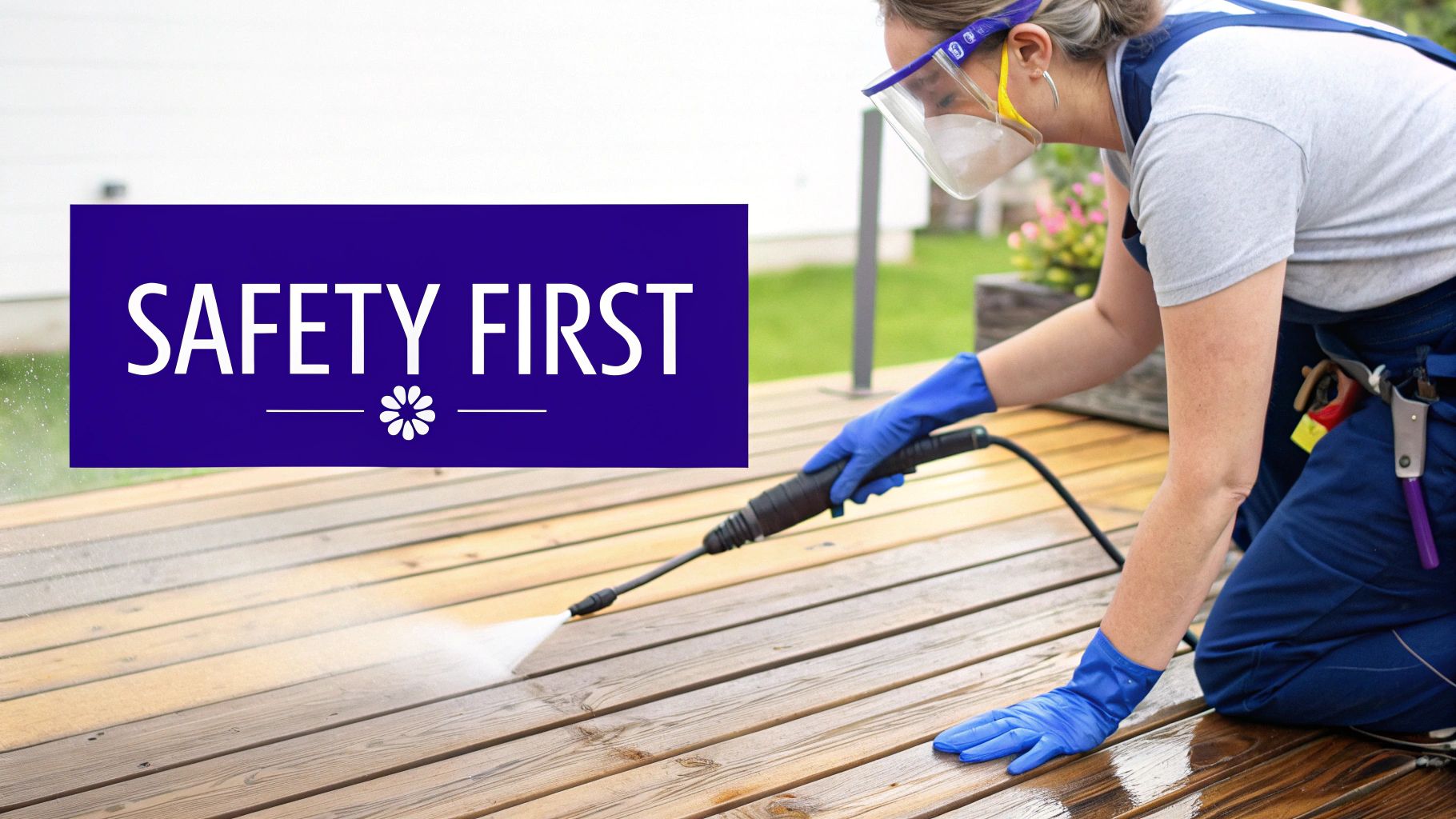
Personal Protective Equipment (PPE) is non-negotiable. Always wear:
Safety Goggles: To shield your eyes from high-velocity water and flying debris.
Steel-Toed Boots: To protect your feet from accidental sprays and give you solid footing.
Gloves: For a better grip on the wand and an extra layer of protection.
Safety isn't just about what you wear; it's about being aware. Never point the wand at a person, a pet, or yourself. Pay attention to your surroundings, especially electrical outlets, power lines, and breakable items like windows.
Before you even think about blasting sensitive surfaces, you need to understand the right approach and the risks involved. For instance, it's worth reading up on the considerations for pressure washing windows to avoid a very expensive mistake.
Critical Mistakes to Avoid
A few common mistakes can lead to serious property damage or injury. Here are the big ones to steer clear of:
Using a 0-degree (Red) Tip on Wood or Siding: This is the fastest way to splinter wood or shatter vinyl siding. That red tip is for very specific, heavy-duty tasks on concrete or metal—and even then, use it with caution.
Working Too Close to the Surface: Getting too aggressive can etch concrete, strip paint right off a car, and completely ruin soft surfaces. Always start with a test spot in a hidden area.
Ignoring Electrical Hazards: Water and electricity are a deadly mix. Keep a wide berth from power lines, meters, and outdoor outlets.
For professionals and homeowners across San Luis Obispo and neighboring communities like Paso Robles, Atascadero, and Arroyo Grande, mastering these techniques is essential. Whether you're cleaning coastal salt spray in Pismo Beach or agricultural grime in rural SLO County, safe and effective methods are what protect your property and your investment.
Professional Pressure Washing in San Luis Obispo County
Getting the hang of your pressure washer spray tips gives you incredible control, and there's a real satisfaction in a DIY job well done. But let's be honest—some projects are just too big, too stubborn, or too delicate for a standard home unit. When you're up against large-scale grime or high-value surfaces, that's when calling in a professional with commercial-grade equipment and specialized training becomes the smart move.
Sometimes, the scale of the job or the risk of accidental damage makes an expert the most cost-effective choice in the long run. For our neighbors on the Central Coast, that’s where we come in.
Your Local Experts on the Central Coast
We're proud to offer professional pressure washing services for homes and businesses all across San Luis Obispo County. Our team is fully equipped to handle the unique cleaning challenges that come with living in our beautiful region.
We serve a wide range of communities, including:
San Luis Obispo
Paso Robles
Atascadero
Arroyo Grande
Grover Beach
Pismo Beach
Morro Bay
Nipomo
Templeton
Los Osos
Cambria
Cayucos
Whether you're fighting stubborn salt spray buildup on the coast or baked-on agricultural grime further inland, our technicians have the right tools and know-how. We understand the local environment and adjust our methods to match.
For a lot of property owners, the biggest benefit of hiring a pro is just plain peace of mind. Knowing an experienced crew is using the right pressure, nozzles, and cleaning solutions to protect your investment is invaluable. It helps you avoid the costly mistakes that can so easily happen with a DIY attempt.
Services We Specialize In
Our experience goes way beyond a simple driveway cleaning. We handle a diverse mix of residential, commercial, and agricultural projects, making sure every surface is restored safely and effectively. We combine our deep knowledge of pressure washer spray tips with powerful, specialized equipment to deliver results that typical consumer machines just can’t touch.
We specialize in everything from restoring grimy driveways and cleaning delicate home exteriors without causing damage to tackling massive commercial buildings. We also have plenty of experience with agricultural equipment, blasting away caked-on mud and grease to keep machinery in top shape.
For anyone in the SLO area who wants a perfect clean without the headache, we offer a reliable, local solution. You can learn more about our commitment to the community by checking out our guide to professional pressure washing in San Luis Obispo CA. Let us partner with you to maintain the beauty and value of your property.
Questions We Hear All the Time About Spray Tips
Here are the quick-and-dirty answers to some of the most common questions we get about pressure washer spray tips. Think of this as the practical advice you need to solve problems on the job and get a better, safer clean.
What Is the Best All-Around Spray Tip?
If you could only have one tip, it would be the green 25-degree tip. It’s the undisputed workhorse for a reason. It gives you a fantastic balance of cleaning power and surface coverage, making it your go-to for most jobs like driveways, patios, and outdoor furniture.
When in doubt, start with green. It’s almost always a safe and effective choice.
Can I Just Use One Nozzle for Everything?
While the green tip is a champ, trying to use one nozzle for everything is a terrible idea. Think of it this way: you wouldn't use a sledgehammer to hang a picture frame. Using a high-pressure tip like the yellow (15-degree) on a soft wooden deck will chew it up and leave permanent scars.
On the flip side, trying to blast stubborn concrete stains with a gentle white (40-degree) tip will just waste your time and leave you frustrated. Matching the tip to the surface isn't just a suggestion—it's critical for getting the job done right without causing damage.
Why Did My Pressure Washer Suddenly Lose Pressure?
If your machine feels weak, the nozzle is the first place you should look. Over time, the sheer force of the water erodes the inside of the tip, widening the orifice. A worn-out orifice means a major drop in pressure.
If you’re noticing a decline in performance, the easiest and most effective first step is to swap in a new set of pressure washer spray tips. Another common culprit is simply using a nozzle with an orifice that's too large for your machine's PSI and GPM. Always double-check that your tip is correctly matched to your pressure washer's specs.
How Often Should I Replace My Spray Tips?
For professional contractors here in San Luis Obispo County who are running their gear every day, a good rule of thumb is to replace spray tips every 3 to 6 months. For homeowners in places like Paso Robles or Atascadero who use their machines less often, a new set every year or two will probably do the trick.
Key Takeaway: Don't wait for a complete failure. If you notice your cleaning times getting longer or you're seeing streaky, uneven results, it's time for a new tip. This small investment keeps your machine running at peak efficiency and ensures you get a professional-quality finish.
For folks dealing with tough coastal grime in Arroyo Grande, Pismo Beach, or Morro Bay, a fresh tip is the simplest way to bring your machine back to full power.
When your equipment needs more than just a new nozzle, you need an expert you can trust. For reliable parts, service, and professional advice on pressure washers and other industrial tools, Contractor's Maintenance Service is your local partner.
Visit us online to see our full range of products and services at https://www.contractorsmaintenanceservice.com.
Comments