


The Ultimate Guide to Air Pressure Regulator Performance
An air pressure regulator is one of those essential pieces of hardware that quietly does its job, but without it, everything falls apart. Think of it as a gatekeeper. It takes the raw, high-pressure, and often jumpy air from your compressor and dials it down to a stable, usable pressure that your pneumatic tools can actually handle.
Without a regulator, you're essentially gambling with your equipment and your results. It's the difference between a smooth operation and a costly failure.
Understanding the Essential Role of an Air Pressure Regulator
Ever tried writing with a fountain pen that floods the page one second and runs dry the next? That’s what it's like for an air tool fed by an unregulated compressor. Your compressor tank stores air at incredibly high pressures—far more than what’s safe or effective for most tools. An air pressure regulator steps in to tame that power, turning it into a predictable and steady stream.
This isn't just about convenience; it’s a non-negotiable part of the system. A good regulator is your first line of defense, protecting your valuable tools from the kind of excessive force that leads to premature wear, tear, and even catastrophic breakdowns. More importantly, it ensures your equipment performs exactly as the manufacturer designed it to, every single time.
To really nail down why this matters, let's look at the core functions a regulator handles.
We've put together a quick table that breaks down the main jobs of an air pressure regulator and the real-world difference each one makes for your operations.
Key Functions of an Air Pressure Regulator at a Glance
Function | Benefit for Your Equipment | Real-World Impact |
|---|---|---|
Pressure Reduction | Takes high-pressure inlet air and reduces it to a lower, safer outlet pressure. | Prevents overwhelming your tools, which are designed for much lower pressures than what a compressor stores. |
Pressure Stability | Maintains a constant output pressure, even when the inlet pressure fluctuates. | Eliminates sputtering spray guns, inconsistent impact wrench torque, and other quality control nightmares. |
Flow Control | Ensures a consistent volume of air is delivered to the tool on demand. | Your tools get the air they need to run at peak performance without starving or being overpowered. |
System Protection | Acts as a safety buffer between the high-pressure compressor and downstream components. | Extends the life of your hoses, fittings, and the internal mechanisms of your pneumatic tools. |
Ultimately, a regulator transforms raw, unpredictable power from your compressor into a controlled, reliable energy source that you can count on for every job.
Why Consistent Pressure Is Non-Negotiable
For any professional, consistency is the name of the game. Whether you’re laying down a perfect finish with an airless sprayer or torquing bolts on a critical assembly, the final result hinges on stable air pressure. When that pressure wavers, so does the quality of your work.
Here’s why you can’t afford to overlook it:
Protecting Your Investment: Pushing a tool beyond its rated PSI is a surefire way to destroy seals, crack housings, and turn a high-dollar piece of equipment into a paperweight. A regulator is cheap insurance.
Ensuring Quality Results: Think about spray painting. Even a small drop in pressure can cause the gun to spit and sputter, ruining the finish and forcing you into time-consuming rework.
Boosting Operator Safety: An over-pressurized tool or hose can rupture violently, turning a normal workday into a trip to the emergency room. Regulators are a critical safety device that keeps pressure in a safe zone.
These devices are so fundamental that they're practically everywhere. In industrial maintenance, they are the unsung heroes keeping job sites running smoothly. The global market, valued at around USD 1.2 billion in 2023, is projected to climb to USD 1.9 billion by 2032—a clear sign of just how vital they are. For a deeper dive, you can explore more data on the industrial air pressure regulator market.
Your Local Experts in San Luis Obispo and Surrounding Areas
For contractors and maintenance pros, getting the right part and solid advice quickly is what keeps downtime to a minimum. Having a local partner who gets it makes all the difference.
At Contractor's Maintenance Service, we know that a single bad regulator can bring your whole operation to a standstill. We don't just sell parts; we provide the hands-on expertise to make sure your pneumatic systems are dialed in and ready to perform, day in and day out.
We’re proud to support professionals across the region. Our team serves the local city of San Luis Obispo and the surrounding areas, including Paso Robles, Atascadero, Arroyo Grande, Grover Beach, Pismo Beach, Cambria, Morro Bay, Santa Maria, and Nipomo. When you need the right air pressure regulator or help diagnosing a problem, we’re here to keep your projects moving forward.
How an Air Pressure Regulator Works: A Look Inside
From the outside, an air pressure regulator seems simple enough. You turn a knob, and the pressure changes. But inside that compact body, a constant, precise balancing act is taming the chaotic, high-pressure air from your compressor into a steady, reliable stream your tools can actually use.
To get a feel for what’s happening, let’s follow the air. High-pressure air blasts into the regulator through an inlet port. Before it can get out, it has to squeeze through a tiny opening controlled by a poppet valve—think of it as a gatekeeper. The entire secret to a regulator's success is opening and closing this gate just enough to maintain the perfect downstream pressure.
It’s a clever feedback loop. Imagine a self-adjusting faucet that never lets the water flow get too strong or too weak, no matter how much the main water supply fluctuates. That’s what’s happening inside your regulator, just with air.
The Core Components and Their Roles
The magic of a regulator comes down to the teamwork between four key parts. Each has a specific job, and their constant interaction creates the stable output pressure you need for professional results.
The Adjustment Knob and Spring: When you turn the knob on top, you aren't directly opening the valve. You’re actually compressing a big spring inside. The more you tighten it, the more downward force it applies.
The Diaphragm: This is a flexible, sensitive disc sitting right under the spring. It’s the brain of the operation, constantly sensing pressure changes. The spring you just tightened is pushing down on one side of this diaphragm.
The Poppet Valve: Attached to the diaphragm is the poppet valve. When the spring shoves the diaphragm down, the valve opens, letting high-pressure air rush through to the outlet side.
The Feedback Mechanism: Now for the brilliant part. As that newly regulated air flows toward the outlet, some of it is channeled underneath the diaphragm, pushing up against the downward force of the spring.
This creates a perfect equilibrium. The system automatically finds a balance where the upward push of the outlet air pressure exactly matches the downward force of the spring you set with the knob. If a tool suddenly needs more air and the outlet pressure drops, the spring’s force wins, pushing the diaphragm down and opening the valve wider to let more air through. If the tool stops and outlet pressure starts to build, it pushes the diaphragm up against the spring, closing the valve to restrict the flow.
This infographic breaks down the core functions this internal mechanism makes possible.
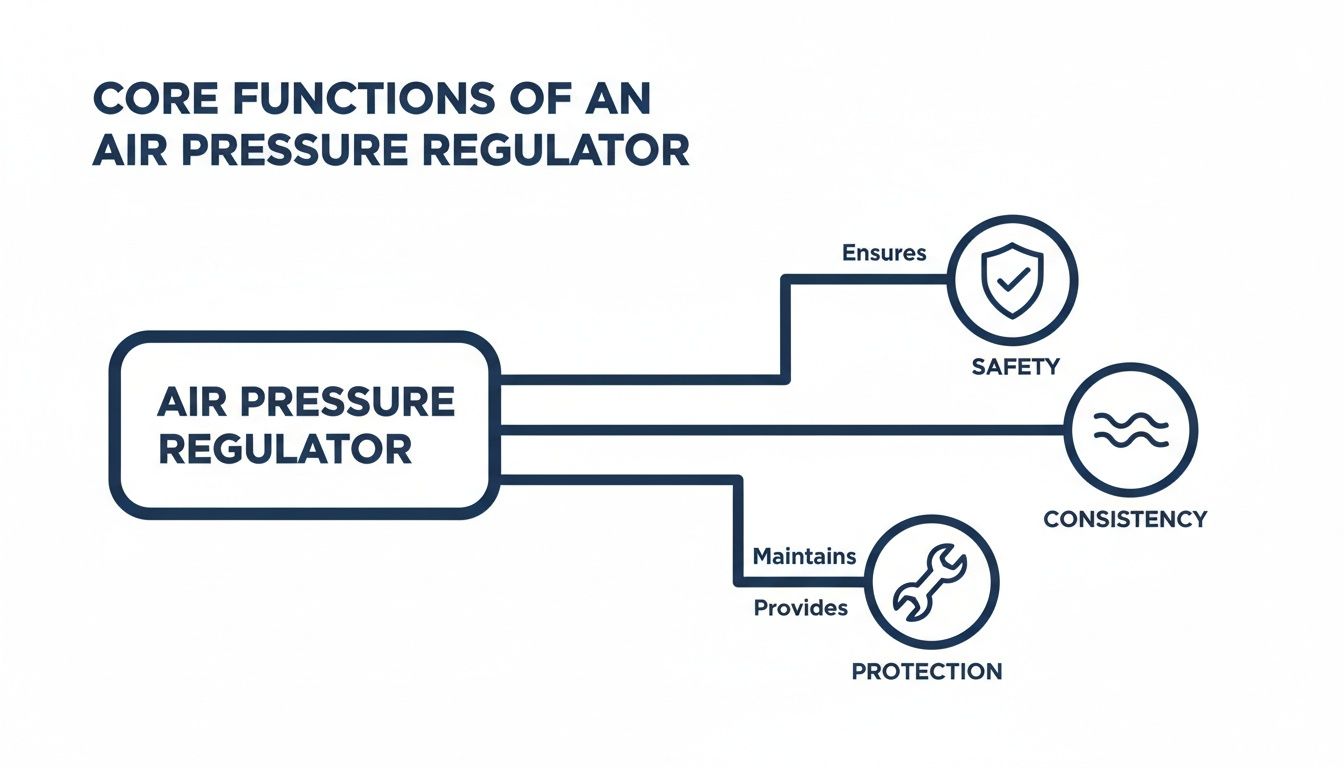
As you can see, this slick mechanical balance is what delivers safety, consistency, and equipment protection on the job site.
Why This Matters for San Luis Obispo County
For pros in San Luis Obispo and surrounding areas like Paso Robles and Arroyo Grande, what happens inside that regulator has a direct impact on your work. It's this delicate balance that ensures your paint sprayer lays down a flawless finish without sputtering, or that your nail gun drives with consistent torque every single time.
But it also means that contaminants like dirt or moisture can easily throw this balance off. Keeping your air lines clean is non-negotiable. To learn more, check out our guide on the importance of a 0.22-micron filter to protect these sensitive components.
A good regulator is an invisible partner in quality work. Its ability to self-correct in milliseconds is what separates a professional finish from a frustrating do-over. Understanding how it works helps you appreciate its importance and diagnose problems much faster.
When you need reliable parts or service in Atascadero, Grover Beach, Morro Bay, or Pismo Beach, knowing how these devices tick helps you communicate exactly what you need. Our team at Contractor's Maintenance Service is here with the quality regulators and expert advice you need to keep that internal balancing act working perfectly.
Choosing The Right Air Pressure Regulator For Your Tools
Picking the right air pressure regulator isn’t a one-size-fits-all deal. It's a make-or-break decision that directly affects how well your tools perform, how long they last, and the quality of your finished work. The beast of a regulator you’d need for a framing nailer on a job site is miles apart from the delicate, precision unit required for a glass-smooth automotive paint job. The key is to match the regulator’s specs to the specific demands of your tool.
This all starts with getting a handle on three core specifications that dictate how a regulator will perform. Nail these, and you’re on your way to getting professional, repeatable results every time you pull the trigger.
H3: Decoding The Essential Specifications
Before you can choose a regulator, you need to speak its language. It’s about looking past the price tag and digging into the numbers that really matter for performance.
Pressure Range (PSI): This is the spec everyone knows—Pounds per Square Inch. It tells you the range of output pressure the regulator can reliably deliver. You need to pick a regulator whose adjustable range comfortably covers the recommended operating pressure for your tool.
Flow Rate (CFM): Measured in Cubic Feet per Minute, this number tells you how much air volume the regulator can push through at a set pressure. A tool can be getting the right PSI, but if it's starved for air volume, it will bog down and underperform. High-demand tools like sanders or impact wrenches need a regulator with a high CFM rating to keep up.
Port Size: This is the thread size of the inlet and outlet, usually measured in inches like 1/4", 3/8", or 1/2". The port size has to match your air hoses and fittings. If it doesn't, you create a bottleneck that chokes the airflow. Using a regulator with ports that are too small is like trying to breathe through a coffee straw—it just won’t work.
When you're choosing, it's vital to consider the unique demands of your specific pneumatic tools like a portable saw to guarantee you're getting the best performance and longevity out of your gear.
H3: Matching The Regulator To The Application
Now that we have the core specs down, let's see how they play out in the real world. A commercial painter and a mechanic live in different worlds, and their regulators should, too. A mismatch is a recipe for frustration and rework.
The right air pressure regulator acts as a translator, converting the raw power of your compressor into the precise language your tool understands. A mismatch creates miscommunication, leading to poor performance and frustrating rework.
Thinking about which regulator to pair with your equipment? A good way to visualize the requirements is to break it down by the tool itself.
Here’s a quick guide to help you match the right regulator specs to your specific application.
Regulator Selection Guide by Tool Type
Tool/Application | Recommended Pressure Range (PSI) | Required Flow Rate (CFM) | Key Feature to Look For |
|---|---|---|---|
Airless Paint Sprayer | 100 - 250 | 5 - 15 | High precision, fine adjustment knob |
Pneumatic Nail Gun | 70 - 120 | 2 - 5 | Durability, quick recovery |
Impact Wrench | 90 - 110 | 4 - 8 | High flow, robust construction |
Orbital Sander | 90 - 100 | 8 - 15 | High CFM, integrated filter/lubricator |
This table gives you a solid starting point, but always double-check the manufacturer's specs for your specific tool to dial in the perfect match.
For painters, especially, precision is everything. Stable 100-250 PSI regulation is non-negotiable for laying down even coats on large surfaces, and getting it right can slash material waste by 10-15%. The technology behind this has come a long way. The introduction of microprocessor-driven sensors, a trend that started back in the 1980s, has massively improved stability. It helped drop regulator failure rates from over 12% to under 3% by the year 2000.
Of course, the regulator is only half the equation. Understanding your compressor's needs is just as important. For a deep dive, check out our guide on choosing a compressor for painting.
H3: Your Local Resource In San Luis Obispo County
For pros working in San Luis Obispo and nearby towns like Paso Robles, Atascadero, and Arroyo Grande, getting the right gear is what keeps you in business. Whether you’re running a high-volume painting crew in Grover Beach, a construction project in Santa Maria, or an auto shop in Pismo Beach, having access to the right parts and solid advice makes all the difference.
At Contractor's Maintenance Service, we stock a wide range of air pressure regulator models. We can help you pick the perfect unit for your tools and workflow, making sure you get peak performance on every single job.
Proper Installation and Adjustment Techniques
Even the best air pressure regulator on the market is useless if it’s not installed and adjusted correctly. Getting this right is the bedrock of a safe, reliable pneumatic system. It’s a pretty straightforward job, but skipping even one small detail can lead to leaky fittings, poor tool performance, or even damaged equipment.
Before you even think about picking up a wrench, your first priority is safety. Always, always make sure the entire air system is completely depressurized. That means shutting off the compressor and then opening a valve downstream to bleed out any trapped air. A pressurized system can turn a simple fitting into a dangerous projectile, so never take this step for granted.

The Step-By-Step Installation Process
With the system safely depressurized, it's time to get the regulator installed. The goal here is a secure, leak-free connection that’s oriented the right way.
Check Airflow Direction: Take a close look at the body of the regulator. You’ll see an arrow stamped or cast into the metal. This arrow must point in the direction of the airflow—from the compressor (inlet) toward your tool (outlet). Putting it on backward means it simply won’t work.
Apply Thread Sealant: On the male threads of your fittings, use a good thread sealant like PTFE tape or a liquid pipe sealant. This is what creates that essential leak-proof seal. If you’re using tape, wrap it clockwise 2-3 times. This keeps it from bunching up or unraveling as you tighten the fitting.
Tighten Fittings Correctly: Start by hand-threading the fittings into the regulator’s ports to make sure you don’t cross-thread them. Then, grab a wrench and tighten them until they're snug. Be careful not to go overboard here—overtightening can crack the regulator's housing, a common and expensive mistake.
Connect Hoses and Gauges: Now, attach the inlet hose coming from your air supply and the outlet hose that runs to your tool. If your regulator has a port for a pressure gauge (most do), go ahead and install it. You’ll need it to monitor and set your pressure accurately.
For professionals working in San Luis Obispo and nearby areas like Paso Robles and Atascadero, getting this setup right the first time is key to staying productive on the job site.
Dialing in the Perfect Pressure
With the regulator installed securely, the last step is to adjust the output pressure. This is where a lot of people make a critical mistake that kills their tool's performance. The trick is to set the pressure while the system is under a dynamic load, not a static one.
The biggest mistake in adjustment is setting the pressure when the tool is off. The reading on the gauge will show a higher 'static' pressure. The moment you pull the trigger, the pressure will drop. True working pressure must be set while the tool is running.
This "pressure drop" is completely normal, but if you don't account for it, your tool will be starved for air and feel underpowered.
Here’s how to do it the right way:
Initial Setting: First, turn the adjustment knob counter-clockwise until it feels loose. This closes the regulator so no air can pass through just yet.
Pressurize the System: Turn your compressor on and let the tank fill up.
Set Dynamic Pressure: Connect your air tool and pull the trigger to get it running. While it’s going, slowly turn the regulator knob clockwise. Keep your eye on the gauge and stop once it hits the PSI recommended by the tool’s manufacturer.
This method ensures your tool gets the exact pressure it needs while it's working, giving you consistent, powerful performance every time. For contractors in Arroyo Grande, Grover Beach, Santa Maria, and Pismo Beach, this simple technique is a game-changer for avoiding rework and getting the job done right.
Troubleshooting Common Air Pressure Regulator Issues
When your pneumatic system starts acting up, the air pressure regulator is often the first and best place to look. Even the most bulletproof regulators can run into trouble from simple wear and tear, debris, or damage. Running a few quick checks can save you a ton of time and money, stopping a small hiccup from turning into a major operational headache.
The key to smart troubleshooting is to first figure out exactly what's happening. Do you hear a faint hissing sound? Is the pressure gauge slowly climbing even when your tools are idle? Or does your nail gun or sprayer feel sluggish and underpowered, even though the gauge looks fine? Each of these signs points to a different problem inside the regulator.

Identifying and Fixing Common Failures
Let’s walk through the most common problems you'll see with air pressure regulators and how to fix them. Most issues boil down to one of three things.
Pressure Creep: This is when the outlet pressure slowly drifts higher than what you set it to, but only when there's no air flowing. The culprit is almost always a worn or damaged poppet valve or seat. Even a tiny piece of grit or a failing seal can keep the valve from closing all the way, letting high-pressure air sneak past.
Sudden Pressure Drops: If your tool fires for a second and then loses its punch, or the pressure just tanks under load, you're likely looking at a stuck or damaged diaphragm. The diaphragm is the flexible part that senses downstream pressure; if it can't move freely, it can't open the valve to deliver more air when your tool demands it.
Persistent Air Leaks: A constant hissing is the dead giveaway here. Leaks often come from the vent hole on the regulator body, which usually means a ruptured diaphragm. If you hear the hiss coming from the adjustment knob, the O-rings or seals inside the control mechanism have probably worn out.
Repair, Rebuild, or Replace
Once you’ve pinpointed the problem, you have a decision to make. What you do next really depends on how bad the issue is and how old the regulator is.
Sometimes, a good cleaning is all it takes to fix issues caused by debris. You can disassemble the unit and carefully wipe down the valve seat and diaphragm with a clean cloth to get it working properly again. If parts are obviously worn or damaged, a rebuild kit is a great, cost-effective option. These kits usually come with a new diaphragm, seals, and springs to bring an old regulator back to life.
However, if the regulator body is cracked, the threads are stripped, or a rebuild doesn’t solve the problem, it’s time to replace the whole unit. Trying to make a faulty regulator work just isn't worth the risk of inconsistent performance and potential damage to your expensive pneumatic tools.
The financial hit from these failures is no joke. Facilities managers report that regulator malfunctions account for 15-20% of unplanned downtime in pneumatic systems, leading to huge losses across the industry. The good news? Proactive maintenance can slash these incidents by up to 40%. You can discover more insights about industrial efficiency efforts and how to stay ahead of the curve.
Your Local Partner in San Luis Obispo County
For professionals in San Luis Obispo and the surrounding areas, including Paso Robles, Atascadero, and Arroyo Grande, downtime simply isn't an option. At Contractor's Maintenance Service, we deliver the expert diagnostics and high-quality parts you need to get your systems running flawlessly. Whether you need a rebuild kit for your current air pressure regulator or a brand-new unit, our team is here to help contractors in Grover Beach, Morro Bay, and Pismo Beach keep their jobs moving forward.
Your San Luis Obispo Partner for Regulator Service and Repair
Knowing your way around a faulty air pressure regulator is one thing, but having a trusted local expert in your corner is a total game-changer. When downtime is not an option, you need fast, no-nonsense access to quality parts and straight-up professional advice. That's where Contractor's Maintenance Service becomes your go-to partner on the Central Coast. We don't just sell parts; we provide complete, hands-on solutions to keep your pneumatic systems firing on all cylinders.
Our team is here to support the hardworking pros who build and maintain our communities. We’re proud to serve San Luis Obispo and the surrounding areas, delivering the critical support you need to keep your projects moving forward.
Authorized Service for Leading Brands
As an authorized service center for top-tier brands like Graco and Wagner/Titan, we have the factory training and genuine parts to get your equipment serviced the right way. Whether you need a precision air pressure regulator for a paint sprayer, a high-flow unit for your pneumatic tools, or a complete rebuild kit, our shelves are stocked. This direct relationship also means we handle warranty claims and perform repairs that meet the manufacturer’s exact standards.
That level of expertise ensures that when you bring your gear to us, you’re getting a real solution that protects your investment and gets it back to peak performance. We know the specific demands of professional-grade equipment and the costly headaches that come from using the wrong parts.
At Contractor's Maintenance Service, our job is to solve problems, not just sell products. We aim to be the go-to resource for any contractor who counts on their equipment to get the job done right—offering diagnostics, parts, and repairs all under one roof.
To keep your equipment running longer and stronger, sticking to a maintenance schedule is non-negotiable. A great way to stay on top of things is by using a solid equipment preventive maintenance checklist to catch potential issues before they become full-blown failures.
Serving the Entire San Luis Obispo County
Our commitment stretches across the entire region. We are the trusted local supplier and service center for contractors and businesses in:
Paso Robles
Atascadero
Arroyo Grande
Grover Beach
Pismo Beach
Morro Bay
Cambria
Santa Maria
Nipomo
No matter where your job site is in San Luis Obispo County, our shop is your central hub for reliable parts and expert service. When an air pressure regulator goes down, you don't have time to wait for parts to ship from halfway across the country. Just stop by our counter for immediate help, hands-on advice, and the quality components you need to get back to work—fast. This approach is just one part of our bigger mission to offer comprehensive industrial repair solutions for your business, covering everything from pneumatic tools to hydraulic systems.
Your Top Questions About Air Pressure Regulators, Answered
Even after you get the hang of how an air pressure regulator works, plenty of practical questions pop up on the job. Let's tackle some of the most common ones we hear from pros trying to keep their pneumatic systems running like a top.
How Often Should I Replace My Air Pressure Regulator?
There's no single "replace by" date on these things. A regulator's lifespan really comes down to its daily life—what it's doing and where it's doing it.
If your regulator lives in a clean, indoor shop, giving it a good inspection once a year is usually enough. But if it’s out on a dusty, damp construction site, you’ll want to check it every six months.
Keep an eye out for these tell-tale signs that it's time for a replacement:
Visible Corrosion: If you see rust or pitting on the body, its structural integrity is at risk.
A Stubborn Knob: Is the adjustment knob getting stiff or impossible to turn? That’s a good sign the internal parts are giving up.
Leaks That Won't Quit: When you’ve already tried a rebuild kit and air is still escaping, the main housing is likely damaged beyond repair.
A rebuild kit can be a great fix for minor issues, but if performance problems stick around, installing a brand new air pressure regulator is your safest and most reliable move.
What Exactly Is a Filter Regulator Lubricator (FRL) Unit?
Think of an FRL as a complete, all-in-one air treatment station for your tools, packed into a single unit. Each part has a very specific and important job to do before that compressed air ever reaches your tool.
First up is the "Filter," which is your first line of defense. It strips out moisture, oil, and any solid junk from the air stream. Next, the "Regulator" takes over to dial in and control the pressure, making sure your tool gets a steady, correct PSI. Finally, the "Lubricator" adds a very fine mist of oil into the air, which is absolutely vital for lubricating the moving parts inside tools like air ratchets and impact wrenches.
Here’s a critical pro tip: NEVER use a lubricator in your setup for any kind of painting or spraying. The oil will contaminate your paint and completely ruin the finish. For spray guns, you'll want a filter-regulator combo, no lubricator.
Can I Get Away with a Cheap Regulator for My Pro Paint Sprayer?
Honestly, trying to save a few bucks by using a cheap, generic regulator on a professional paint sprayer is a recipe for frustration. High-end sprayers from brands like Graco and Titan are engineered to perform with incredibly stable, consistent air pressure. It's how they atomize paint perfectly to lay down that flawless, glass-smooth finish.
A low-quality regulator just can't keep up. It's prone to pressure spikes and drops, and every little fluctuation shows up instantly in your spray pattern. These inconsistencies are what cause common headaches like "tailing"—where you get heavy edges on your pattern—and an uneven mil build.
Investing in a quality air pressure regulator built for spraying isn't just an expense; it's insurance against shoddy results and the time and money wasted on rework.
For expert advice and access to professional-grade regulators and parts on the Central Coast, trust Contractor's Maintenance Service. Visit us online to explore our full range of solutions. https://www.contractorsmaintenanceservice.com
Comments