


Predictive Maintenance vs Preventive Maintenance Showdown
The real difference between predictive maintenance vs preventive maintenance is all about timing and triggers. Think of preventive maintenance as a scheduled, time-based strategy. Predictive maintenance, on the other hand, is a data-driven, condition-based approach.
It’s like changing your car’s oil. With a preventive mindset, you change it every 5,000 miles, no questions asked. With a predictive approach, you’d only change it when sensors show the oil is starting to lose its viscosity.
Choosing Your Maintenance Philosophy
For any contractor or industrial business on California's Central Coast, picking the right maintenance philosophy is a huge deal. Whether you're running equipment in San Luis Obispo, Paso Robles, Santa Maria, Arroyo Grande, Atascadero, or nearby areas, your uptime is your bottom line.
A critical asset going down unexpectedly doesn’t just stop one task. It can throw entire projects off schedule, creating expensive delays and unhappy clients. The right approach—or even a smart mix of both—can make all the difference.
A solid maintenance plan delivers real, measurable results:
Significant cost savings by cutting out unnecessary parts and labor.
Drastically reduced downtime by catching failures before they happen.
Longer equipment lifespan through optimized care and perfectly timed repairs.
This guide will get into the nuts and bolts of each strategy to help you figure out what makes sense for your operation. While both are designed to prevent failures, they get there in fundamentally different ways. It’s also smart to understand how they fit within the broader context of general maintenance strategies to build a complete program.
Quick Guide to Maintenance Strategies
To get a handle on the core differences, let's look at how each philosophy works in practice. Preventive maintenance is all about sticking to a strict calendar or usage schedule, ticking off tasks at set intervals.
Predictive maintenance is completely different. It uses real-time data from sensors and other diagnostic tools to forecast when a failure is about to happen, letting you step in at the most optimal moment. If you want to see how these compare to other methods, check out our guide on preventive maintenance vs. corrective maintenance.
The fundamental shift is from scheduled guesswork to data-driven precision. Preventive maintenance assumes failure might happen, while predictive maintenance knows when it's about to happen.
This table offers a clear, at-a-glance comparison of these two core maintenance philosophies, helping you see where each one shines.
Key Aspect | Preventive Maintenance (Time-Based) | Predictive Maintenance (Condition-Based) |
|---|---|---|
Trigger | Fixed schedule (e.g., every 500 hours or 6 months) | Real-time asset condition (e.g., vibration, temperature) |
Approach | Proactive but scheduled; "just-in-case" | Proactive and data-driven; "just-in-time" |
Cost Structure | Predictable, recurring costs for parts and labor | Higher initial investment, lower long-term operational costs |
Typical Use Case | Non-critical equipment, assets with predictable wear | High-value, critical machinery where downtime is costly |
Ultimately, understanding these differences is the first step toward building a maintenance program that not only prevents failures but also drives efficiency and profitability for your business.
A Head-to-Head Maintenance Strategy Comparison
When you’re weighing predictive maintenance vs preventive maintenance, you have to look past the simple definitions and get into how each one actually performs in the real world. For businesses here in San Luis Obispo and surrounding communities like Paso Robles, Morro Bay, and Santa Maria, this choice hits everything from daily operations to your bottom line.
Let's break down the practical trade-offs. Each strategy plays by a different set of rules and demands completely different resources. Getting a handle on these differences is the first real step toward building a maintenance program that actually protects your equipment and keeps projects moving.
Data Requirements and Collection
Preventive maintenance runs on pretty simple data. It’s all based on manufacturer recommendations, historical failure rates, and basic usage logs. Think of a Multiquip compactor: the schedule might just be to check the engine oil every 50 hours and swap the air filter every 200 hours. The data is static, easy to track with a calendar or a basic spreadsheet.
Predictive maintenance, on the other hand, is hungry for a constant stream of real-time, dynamic data. It relies on sensors monitoring specific conditions like vibration, temperature, oil viscosity, and even acoustic signatures. This continuous flow of information lets the system spot subtle changes that signal a coming failure, which means you need more advanced tools to collect and analyze it all.
Failure Detection Methods
The way each approach spots potential failures highlights the core philosophical divide between them. Preventive maintenance doesn’t really detect failures at all; it just tries to preempt them based on averages. It works on the assumption that a part is getting old just because a certain amount of time has passed or it’s hit a usage milestone.
It’s a reliable method, but often wasteful. In contrast, predictive maintenance uses condition monitoring to identify the absolute earliest signs that a component is starting to degrade. If a bearing inside a Graco paint sprayer starts to wear, sensors will pick up on the increased vibration frequencies long before the sprayer ever quits, letting you schedule a just-in-time repair.
The most significant differentiator is the shift from scheduled guesswork to data-driven precision. Preventive maintenance acts based on what might happen on a generalized timeline, while predictive maintenance acts based on what is happening to a specific asset right now.
This evidence-based method is just far more precise. It ensures you’re only performing maintenance when it’s truly needed, getting the maximum possible life out of every single component.
Cost Structures and Investment
The financial models here couldn't be more different. Preventive maintenance involves predictable, recurring operational costs. You budget for a certain number of filters, belts, and labor hours every year. The initial investment is low, but these costs add up over time and often include replacing parts that were still perfectly fine.
Predictive maintenance requires a significant upfront capital investment. You’re paying for sensors, data acquisition hardware, analytics software, and training your team. But the long-term ROI is often massive, thanks to lower labor costs, a smarter spare parts inventory, and the near-elimination of catastrophic, project-stopping failures. For a contractor in Arroyo Grande, Atascadero, or Nipomo, avoiding just one major equipment breakdown can pay for the entire system.
Implementation Complexity
Getting a preventive maintenance program off the ground is straightforward. You can build a solid schedule using manufacturer manuals and your own operational experience. It's a process-focused task that a maintenance manager can roll out with minimal disruption.
Implementing a predictive maintenance program is a much bigger project. It involves:
Asset Identification: Pinpointing which critical pieces of equipment will give you the best return on monitoring.
Sensor Selection: Choosing the right sensors for specific failure modes, like thermal imagers for overheating or vibration analyzers for mechanical wear.
System Integration: Connecting those sensors to a central platform that can collect, process, and analyze the data.
Threshold Setting: Establishing baseline performance metrics and defining the alert thresholds that will trigger a maintenance work order.
Because of this complexity, a gradual rollout is usually the best approach, starting with your most critical assets. The fundamental distinction is clear: Preventive maintenance follows a fixed schedule, while predictive maintenance uses real-time sensors monitoring vibration, temperature, and oil quality to predict failures before they happen. Discover more insights about these maintenance trends and challenges.
Analyzing the Financial Impact and Long-Term ROI
When you're weighing predictive maintenance vs preventive maintenance, the conversation always finds its way back to the numbers. Both strategies are designed to head off expensive failures, but they operate on completely different financial models and deliver a return on investment (ROI) in ways that are worlds apart.
For any contractor in San Luis Obispo County—including Paso Robles, Santa Maria, and the Five Cities area—getting a firm grip on these financial differences is key to making a smart, sustainable choice.
Preventive maintenance is pretty straightforward financially. It’s all about predictable, recurring costs. You budget for a specific number of labor hours, filters, fluids, and wear parts over the course of the year. This gives you budget stability because the expenses are consistent and easy to forecast.
But that predictability can sometimes hide costly inefficiencies. You might find yourself replacing parts that still have 50% of their useful life left, just because the calendar told you it was time. While you’re successfully dodging catastrophic failures, you’re almost certainly over-maintaining some of your equipment, creating a slow but steady drain on your budget.
The Upfront Costs vs Long-Term Savings
Predictive maintenance completely flips that financial model. It requires a much larger upfront capital investment in sensors, data acquisition hardware, and the software needed to analyze it all. You’ll also have costs tied to training your team to understand the data and act on what it's telling them.
That initial price tag can feel steep for businesses in Atascadero, Grover Beach, or Arroyo Grande. However, the long-term ROI is where this strategy really starts to pay off. By only performing maintenance when it's genuinely needed, you cut your spending on unnecessary parts and labor. You also extend the life of your critical equipment, pushing back major capital investments for replacements.
The core financial trade-off is simple: preventive maintenance offers low initial costs but higher lifetime operational expenses. Predictive maintenance demands a larger upfront investment in exchange for dramatically lower long-term costs and maximized asset value.
This shift turns maintenance from a simple operating cost into a strategic investment in reliability and efficiency.
Quantifying the Return on Investment
The ROI for predictive maintenance isn't just a theory; it’s backed by solid data. For a painting contractor, this means keeping high-value Graco sprayers running without a single hiccup during the busy season. For a municipal works department, it means knowing that critical pumps and generators are always ready to go.
The numbers consistently point to powerful financial gains. Research from the U.S. Department of Energy shows predictive maintenance can deliver 30-40% in savings over a reactive approach and a significant 8-12% advantage over a well-managed preventive program.
While every dollar spent on preventive maintenance can yield an impressive 545% ROI, predictive maintenance takes it a step further by optimizing spare parts inventory by 15-20%, wiping out the high costs of overstocking and last-minute rush orders. You can dig deeper into the numbers by exploring more predictive and preventive maintenance statistics.
For a mid-sized construction company here on the Central Coast, that could easily translate to tens of thousands of dollars in annual savings—money that goes straight to the bottom line. These savings come from three main areas:
Reduced Maintenance Costs: A 25-35% drop in overall maintenance spending by cutting out unnecessary tasks.
Minimized Unplanned Downtime: Stopping catastrophic failures that can bring an entire project to a grinding halt.
Optimized Parts Inventory: Carrying fewer spare parts because you know exactly when a component is nearing the end of its life.
In the end, while the predictable budget of preventive maintenance is appealing, a close look at the long-term ROI often shows that predictive maintenance is the smarter financial play for your most critical, high-value assets. It transforms your maintenance program from a necessary expense into a powerful engine for profitability.
When to Choose Predictive or Preventive Maintenance
The whole predictive maintenance vs. preventive maintenance debate isn't about finding a single "best" strategy. It's about picking the right tool for the right job—or in this case, the right machine at the right time. For businesses here in San Luis Obispo and up and down the Central Coast, from Paso Robles to Santa Maria, forcing a one-size-fits-all approach is a fast track to wasting money.
The decision really boils down to a few practical questions. How critical is this equipment to our operation? What’s the real cost if it fails without warning? What can we realistically budget for maintenance? Answering these honestly will light up the best path forward for every asset in your fleet.
Choosing Preventive Maintenance for Reliability and Simplicity
Preventive maintenance is the workhorse strategy for a huge portion of your equipment. It’s the perfect fit for assets that are important but not mission-critical, have fairly predictable wear and tear, and where the cost of a surprise failure won't break the bank.
Think about the support equipment in your shop or on a job site in Paso Robles, Cambria, or Los Osos—things like a portable generator, a backup air compressor, or general-use power tools. You need them to work, but if one goes down, you likely have another one handy or can get a replacement without shutting down the entire project.
Preventive maintenance is the smart call when:
Asset Criticality is Low: The equipment isn't essential for your core operations. Its failure won't cause a major production stoppage.
Failure Modes are Predictable: The parts that wear out do so on a pretty consistent schedule. Things like belts, filters, and fluids have reliable service timelines recommended by the manufacturer.
The Cost of Failure is Minimal: Unplanned downtime might be an inconvenience and cost a little, but it won’t trigger a catastrophic financial loss.
Budget is a Primary Constraint: You need a predictable, low-cost maintenance plan without the upfront expense of advanced monitoring technology.
For these machines, a simple, calendar-based schedule is both cost-effective and more than enough to keep them reliable without overcomplicating things.
When Predictive Maintenance Becomes Non-Negotiable
Predictive maintenance is for your MVPs—the high-value, mission-critical machinery where unplanned downtime is a complete disaster. This is the equipment that directly makes you money, and if it fails, it could threaten project deadlines, safety, and your bottom line.
Imagine a large, industrial-grade Graco paint sprayer on a major commercial project in Santa Maria, or the primary Multiquip compactor on a tight construction schedule in Pismo Beach. If either of those machines stops, work grinds to a halt. You’re left paying for idle labor and facing potential contractual penalties.
Predictive maintenance is an investment in operational certainty. You choose it when the cost of unplanned downtime far exceeds the cost of implementing a condition-monitoring solution.
This data-first approach is essential when:
Asset Criticality is High: The machine is the linchpin of your operation. A failure would mean serious production losses or safety risks.
Failure Modes are Complex: The equipment can fail in dozens of ways that a simple time-based schedule just can't predict.
The Cost of Failure is Severe: Downtime translates into thousands of dollars in lost revenue, idle crews, and damage to your company's reputation.
Maximizing Asset Life is a Goal: You need to squeeze every ounce of value from a major capital investment, and that means replacing parts only when they actually need it.
The Power of a Hybrid Maintenance Model
For most contractors and industrial businesses in Arroyo Grande, Atascadero, and across the Central Coast, the best solution isn't an either/or choice. It's a hybrid model that strategically blends the strengths of both predictive and preventive maintenance.
This means you apply a robust predictive program to your most critical, high-dollar assets while sticking with a cost-effective preventive schedule for everything else. This tailored strategy focuses your resources where they deliver the biggest financial impact.
You protect your crown-jewel equipment with advanced monitoring while keeping the rest of your fleet dependable with simple, scheduled upkeep. It’s a balanced approach that gives you the best of both worlds: maximized uptime for critical gear and controlled costs across your entire operation.
Implementing Your Chosen Maintenance Program
Deciding between predictive and preventive maintenance is one thing; putting that plan into action is where the real work begins. The path forward looks completely different for each strategy—one is all about schedules and process, while the other is driven by technology and data.
For businesses here in San Luis Obispo and up and down the Central Coast, the goal is always a smooth transition that delivers value fast, without bringing current operations to a halt.
Building a Preventive Maintenance Schedule
Getting a preventive maintenance program off the ground is a pretty straightforward, process-driven effort. The entire focus is on creating a solid, repeatable schedule that your technicians can follow to the letter, every time.
It really boils down to four core steps:
Inventory Your Assets: First, you need a complete list of every piece of equipment that needs attention, from your primary machinery down to essential support tools.
Gather Documentation: Pull together the manufacturer manuals and OEM guidelines for each asset. This gives you the baseline for service intervals.
Review Operational Data: Look at your own history. Analyze past work orders and maintenance logs to tweak the manufacturer's advice based on your real-world usage and environment.
Create the Schedule: Put it all together in a clear, accessible maintenance calendar. For a deeper dive, check out our guide on how to build a preventive maintenance schedule template.
The principles here are universal. Whether you're maintaining industrial equipment or organizing household chores, sticking to a plan is key. Thinking about how simple tools like weekly schedule templates keep routines on track offers a great parallel for how effective organization works.
Launching a Predictive Maintenance Program
Rolling out a predictive maintenance program, on the other hand, is a much more involved, technology-heavy project. It demands a methodical approach to make sure the data you're collecting is accurate, relevant, and ultimately, actionable.
This decision tree gives you a great visual for how to weigh the key factors—asset criticality, failure impact, and budget—that point you toward the right strategy.
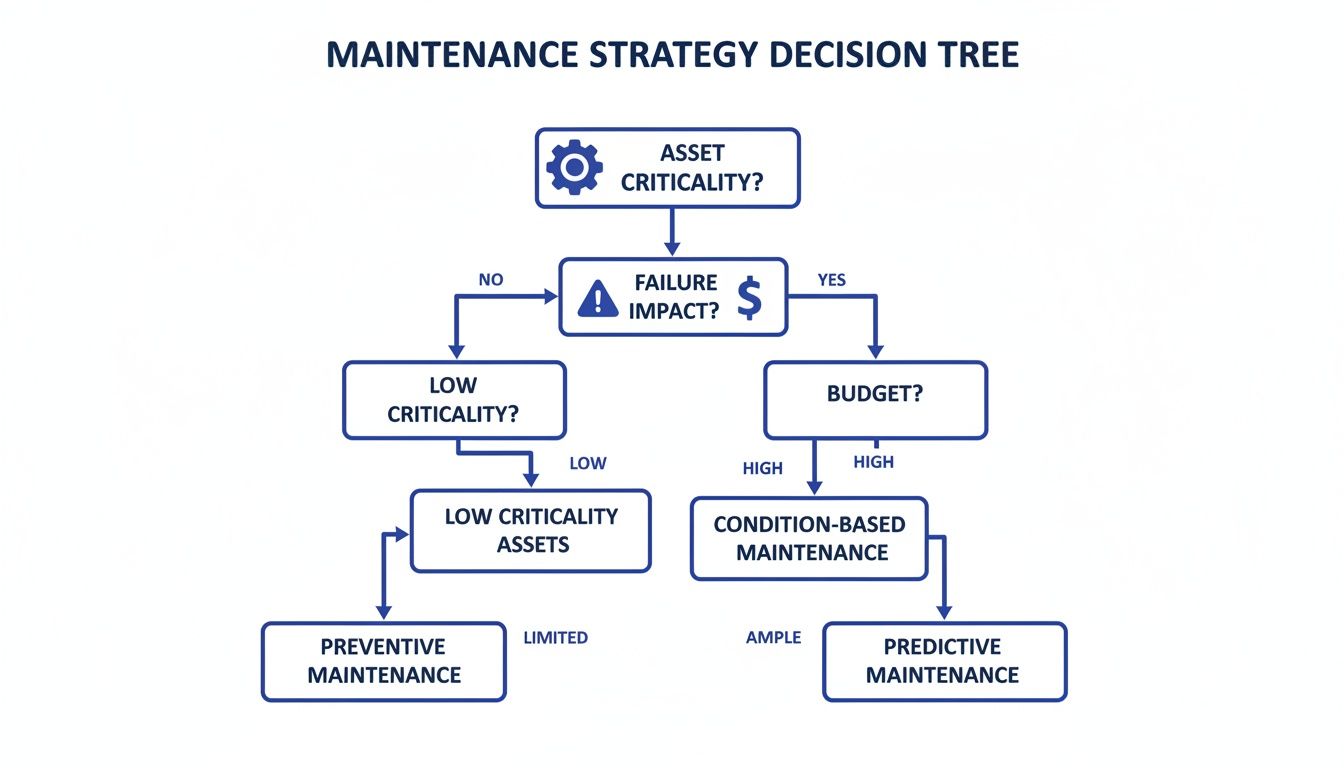
As you can see, the more important the asset and the higher the cost of failure, the stronger the argument becomes for a data-driven, predictive approach. The process usually unfolds in a few distinct stages:
Identify Critical Assets: Don't try to boil the ocean. Start small by focusing on the high-value equipment where unplanned downtime would be an absolute catastrophe.
Select and Install Sensors: Choose the right condition-monitoring sensors (like vibration, thermal, or acoustic) to detect the specific failure modes you're worried about for each asset.
Establish Data Baselines: Run the equipment under normal operating conditions to collect performance data. This creates your baseline—the benchmark that all future data gets measured against.
Set Action Thresholds: Define the specific data points or trends that will automatically trigger a maintenance alert. For example, a 15% spike in vibration could generate a work order.
A successful PdM program lives and dies by its data integrity. The quality of your implementation, from sensor placement to the accuracy of your baseline, will directly determine how well you can get ahead of failures.
Your Local Implementation Partner
For companies in San Luis Obispo, Arroyo Grande, Atascadero, Paso Robles, and Santa Maria, you don’t have to go it alone. Whether you’re simply looking to refine an existing preventive schedule or you're ready to install your first set of predictive sensors, having an expert partner makes all the difference.
Our technicians at Contractor's Maintenance Service can help guide diagnostics, support sensor installation, and manage your ongoing maintenance program to ensure a smooth, successful transition.
Your Expert Maintenance Partner on The Central Coast
Making the right call in the predictive maintenance vs preventive maintenance debate is one thing—putting it into practice is another. For contractors and industrial businesses across the Central Coast, from busy job sites in San Luis Obispo and Paso Robles to the agricultural operations in Santa Maria, having a partner who can turn strategy into real-world results is everything. That’s where Contractor's Maintenance Service comes in.
We get it. Downtime isn’t just an inconvenience; it’s a direct hit to your bottom line. We proudly serve the entire San Luis Obispo County area, including Atascadero, Arroyo Grande, Nipomo, Morro Bay, and all surrounding communities. Our team has built its reputation on delivering practical, effective maintenance solutions that keep your most important equipment running at peak performance. We're more than just a parts supplier—we are your hands-on diagnostics and repair specialists.
Specialized Expertise for Leading Brands
We have a deep, working knowledge of the equipment you depend on every single day, which gives us a serious advantage. As an authorized service center and parts provider for industry-leading brands, we know their common failure points inside and out.
Our expertise includes:
Graco and Wagner/Titan: We keep your airless paint sprayers and coating equipment running smoothly to prevent expensive project delays.
Honda Engines: As small engine repair specialists, we make sure the heart of your compactors and generators is always reliable.
Multiquip Equipment: We provide the diagnostics and repairs needed to maximize the uptime of your essential construction machinery.
This focused knowledge means we can effectively support whichever maintenance strategy you choose. Whether you're setting up a straightforward preventive schedule or integrating predictive sensors, we have the experience to make sure it's done right.
At Contractor's Maintenance Service, our job is to maximize your equipment’s reliability and operational uptime. We do this by combining expert diagnostics, quick turnarounds, and custom solutions to build a maintenance program that protects your investment and your profit.
Your Local Partner from Paso Robles to Arroyo Grande
For businesses in Paso Robles, Atascadero, Arroyo Grande, and all over San Luis Obispo County, we offer a partnership built on trust and a real commitment to solving your toughest equipment challenges. Our shop handles everything from routine service to complex diagnostics and even custom fabrication of hydraulic hoses and hard-to-find fittings. You can explore our comprehensive industrial repair solutions for your business to see what we can do for you.
Whether you need a quick fix to get back on track or a full consultation to build out a solid maintenance program, our team is ready to help. Contact us today to talk about how we can keep your operations moving forward, no interruptions.
Common Questions Answered
When you're weighing predictive maintenance vs preventive maintenance, a lot of questions come up. Here are the answers to the ones we hear most often from contractors and facility managers around San Luis Obispo.
What's the Real Difference Between Predictive and Preventive Maintenance?
The easiest way to put it is this: preventive maintenance is all about the calendar, while predictive maintenance is all about the machine's actual condition.
Preventive is time-based. Think of it like changing the oil in your truck every 5,000 miles, whether it really needs it or not. Predictive maintenance, on the other hand, uses sensors to listen for early signs of trouble—like a bearing starting to vibrate more than usual—so you only step in when a real problem is developing.
Do I Have to Pick Just One?
Not at all. In fact, you shouldn't. The smartest and most cost-effective play for most businesses is a hybrid approach.
Use high-tech predictive monitoring on your most critical, expensive equipment—the machines you can't afford to have go down unexpectedly. For everything else that’s less critical, stick with a simple, low-cost preventive schedule. This way, you get the best of both worlds.
A hybrid strategy lets you focus your biggest maintenance investments where they will deliver the greatest return. It's about applying the right level of oversight to the right machine, optimizing both reliability and your budget.
How Do I Even Get Started with Predictive Maintenance?
Jumping into a predictive maintenance program doesn't have to be a massive, expensive project. If you're running a business in Paso Robles, Santa Maria, or anywhere in SLO County, the best way to start is small and targeted.
Just follow these three steps:
Identify Your Most Critical Assets: Pick one or two machines where an unexpected failure would hit you the hardest, either financially or operationally.
Consult with an Expert: Bring in a specialist who knows that type of equipment. They can pinpoint its common failure points and recommend the right sensors and software to keep an eye on them.
Launch a Pilot Program: Roll out the system on just those few assets first. This lets you prove the value and get comfortable with the data before you go all-in.
Is Predictive Maintenance Too Expensive for a Smaller Business?
It’s true there’s an upfront cost for the sensors and software, but the long-term ROI usually makes predictive maintenance a no-brainer, even for smaller shops in Arroyo Grande, Atascadero, or Templeton.
Think about it this way: if the system prevents just one major, unexpected breakdown on a key piece of equipment, it has likely already paid for itself. By starting with a small pilot program on your most important machine, you can keep the initial investment manageable and see the financial payoff quickly.
Ready to build a maintenance strategy that maximizes uptime and protects your bottom line? The team at Contractor's Maintenance Service has the expertise to help you implement the right program for your equipment. Visit us at https://www.contractorsmaintenanceservice.com to get started.
Comments