


Finding the Best Pressure Washer for Commercial Use
Picking the best pressure washer for commercial use isn't about finding a single "top" model. It's about matching the machine to your trade. A painting contractor stripping old layers of paint needs brute force, while a fleet manager cleaning a dozen trucks needs speed and efficiency. The "best" choice is always the one that fits the job.
How to Choose the Right Commercial Pressure Washer
When you're running a business, choosing the right commercial pressure washer is a big decision that hits your bottom line. It affects your crew's efficiency, the quality of your work, and how much money you make. Unlike the residential units you'd find at a big-box store for weekend projects, commercial machines are built to be workhorses. They're designed for the daily grind with beefier components, more power, and features that professionals in San Luis Obispo and beyond rely on to get paid.
This guide will break down the four key things every pro needs to think about before buying:
PSI (Pounds per Square Inch): This is the raw power. It’s the force that knocks grime loose.
GPM (Gallons Per Minute): This is the rinsing muscle. It’s the water flow that washes all that broken-up debris away.
Hot vs. Cold Water: This is the game-changer for tackling grease, oil, and tough, caked-on messes.
Gas vs. Electric Power: This choice comes down to portability and raw power versus indoor-safe operation.
Matching the Machine to the Mission
There’s a reason the pressure washer market is booming. These tools are incredibly valuable for businesses of all stripes. The global market was valued at USD 1.4 billion and is only expected to grow. What separates the true commercial-grade machines is their ability to handle constant, heavy use. Most professional models fall in the 3000-4000 PSI range, giving them enough punch to handle anything from prepping a surface for paint to degreasing heavy machinery.
This simple decision tree helps visualize how to line up your main cleaning jobs—whether it's heavy-duty stripping, covering large areas quickly, or cutting through oily grime—with the right machine.
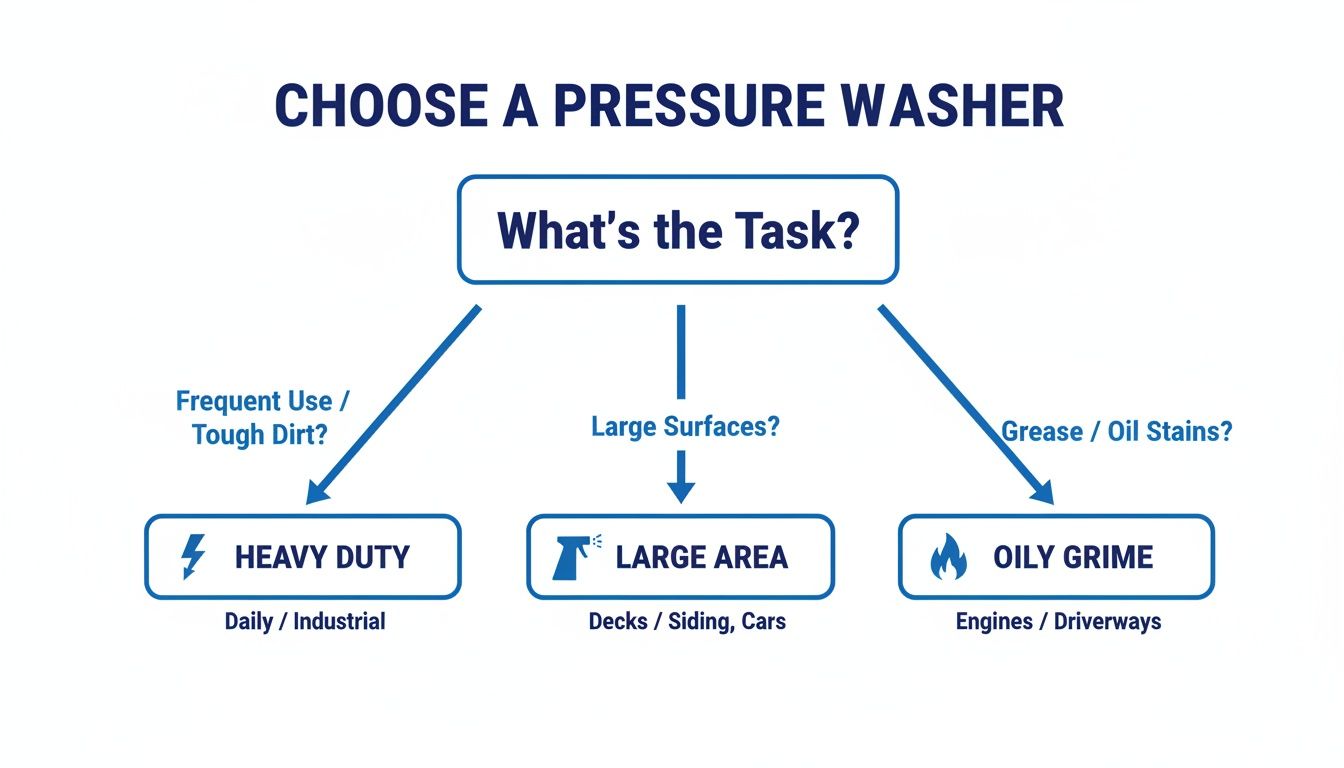
The main takeaway here is pretty simple: let your biggest cleaning headache guide your choice. Start with the problem, and you'll find the right solution.
Thinking Beyond the Pressure Washer
As you think about all your cleaning needs, remember that a pressure washer is just one tool in the toolbox. For certain jobs, especially indoors or on specific surfaces, you might need to look at other commercial deep cleaning machines, such as the Bissell Biggreen. Having a complete cleaning arsenal means you’re ready for any challenge that comes your way.
Key Takeaway: The "best" commercial pressure washer isn't a specific brand or model. It's the right combination of PSI, GPM, water temperature, and power source that perfectly matches what your business does day in and day out.
Getting these fundamentals down is the first step to making a smart investment. In the next few sections, we'll dig deeper into each of these specs to help you choose the perfect machine for your business, whether you're working in Paso Robles, Atascadero, Arroyo Grande, Pismo Beach, or Santa Maria.
Understanding PSI and GPM for Maximum Cleaning Power
When you're looking at commercial pressure washers, two numbers matter more than anything else: PSI and GPM. Get these right, and you've got the key to efficient, profitable work. Misunderstand them, and you’ll end up with a machine that either takes forever to clean or just doesn't have the muscle for the job.
Think of it like carving a statue. PSI (Pounds per Square Inch) is the sharp, focused tip of the chisel. It’s the raw force that breaks up stubborn dirt, strips peeling paint, and blasts away caked-on grime. High PSI is what gives you the power to make a real impact on a tough surface.
Then you have GPM (Gallons Per Minute). That’s the big wave that follows, washing away all the debris you just broke loose. It’s your rinsing power. A high GPM means you can clear large areas quickly, pushing all that dirt away with a powerful flow of water.

Striking the Right Balance
The real secret isn't just chasing the highest numbers—it's about finding the right balance for the work you do. A machine with sky-high PSI but low GPM is like having a razor-sharp chisel but only being able to flick away one tiny chip at a time. It's precise, but painfully slow for big jobs.
On the flip side, a unit with high GPM but just moderate PSI is like a powerful fire hose. It moves a massive amount of water to rinse surfaces in a hurry, but it might not have the focused punch to break up the toughest messes. Getting this interplay right is what separates the pros from the rookies.
PSI and GPM in Real-World Scenarios
Let's break down how this plays out for professionals working around San Luis Obispo County. The right combo of PSI and GPM can make or break your day, whether you're in Paso Robles, Atascadero, Arroyo Grande, Pismo Beach, or Santa Maria.
For the Graffiti Removal Expert: Here, high PSI is king. A contractor cleaning a wall in downtown San Luis Obispo needs serious force—often 3500+ PSI—to strip spray paint from brick or concrete. GPM is secondary because the focus is on a small, stubborn area.
For the Mobile Fleet Washer: A business cleaning delivery vans in Santa Maria needs high GPM. The goal is to soap up and rinse large vehicles fast. A machine pushing 4-5 GPM will wash a truck in a fraction of the time, even with a moderate PSI of around 2000-2500.
For the General Contractor: Someone cleaning a big concrete patio in Arroyo Grande needs a balanced machine. A unit with around 3000 PSI and 3.5 GPM has enough force to lift stains and enough flow to rinse the whole area efficiently without taking all day.
A simple way to compare the overall cleaning performance of two machines is to multiply these numbers. A unit with 3000 PSI x 4 GPM gives you a "Cleaning Power" score of 12,000. This single figure is a great gut check for how much work a pressure washer can really do.
The Growing Demand for Commercial Power
The push for efficiency is why businesses are investing in more powerful equipment. In fact, commercial applications are set to lead the pressure washer market, with an expected growth rate of 5.2% from 2025 to 2030. These powerful tools can cut cleaning times by up to 70% compared to manual scrubbing, which is a massive savings in labor costs. This trend is obvious in North America, where demand from sectors like automotive fleets—needing 2,000+ PSI washers for public transit buses—shows just how critical it is to match the specs to the job.
Of course, to get the most out of your machine, you also have to know how nozzles change the game. To really dial in your cleaning power, check out these expert tips on PSI and nozzle choices to match the tool perfectly to the task. This is the kind of knowledge that helps you see past marketing hype and choose a machine based on the real physics of getting things clean.
Gas vs. Electric and Hot vs. Cold Water Decisions
Once you've wrapped your head around PSI and GPM, the next big decisions are about the machine's heart and soul: its power source and its water temperature. These two choices—gas versus electric and hot versus cold—are what truly define what your pressure washer can do, where you can use it, and how well it will tackle different kinds of dirt and grime. Getting this right is a non-negotiable for any pro looking for the best pressure washer for commercial use.
To make sense of these options, it helps to see them side-by-side. Your worksite and cleaning needs will point you directly to the right combination.
Choosing Your Commercial Pressure Washer Type
Washer Type | Primary Benefits | Ideal Use Cases | Key Limitations |
|---|---|---|---|
Gas-Powered | Maximum power, total portability, and cordless freedom. | Outdoor job sites, construction, agriculture, mobile contract cleaning. | Loud, produces exhaust fumes, not suitable for indoor use. |
Electric-Powered | Quiet, zero emissions, lighter weight, and lower maintenance. | Indoor cleaning (warehouses, food processing), noise-sensitive areas. | Limited by cord length, generally less powerful than gas models. |
Hot Water | Cuts through grease, oil, and grime, drastically reducing cleaning time. | Heavy equipment cleaning, automotive shops, restaurant vent hoods. | Higher initial cost, more complex maintenance. |
Cold Water | Versatile for general cleaning, more affordable, and simpler to maintain. | Removing dirt, mud, and loose paint from siding, concrete, vehicles. | Ineffective on grease and oil-based stains. |
This table gives you a quick snapshot, but let's dig into the "why" behind each choice. Understanding the trade-offs is what separates a good investment from a frustrating one.
The Power Source Debate: Gas vs. Electric
First up, how will you power your machine? This isn't about which is "better" in a vacuum. It's all about matching the engine to your typical job site.
Gas-powered pressure washers are the undisputed champs of raw power and go-anywhere freedom. With no cord to tie you down, they’re the go-to for mobile contractors. If your work takes you all over San Luis Obispo County—from a vineyard in Paso Robles to a new construction site in Atascadero—a gas engine delivers the muscle and independence you need.
On the other hand, electric-powered pressure washers are the specialists for indoor and noise-sensitive environments. Picture cleaning the inside of a food processing plant, a warehouse, or a hospital. Electric models run quiet and produce zero emissions, making them the only safe and compliant choice for those jobs. They're also typically lighter and ask for less maintenance.
The Temperature Question: Hot Water vs. Cold Water
Next, you need to decide if you need the grease-cutting power of hot water or if a standard cold water unit will do the trick. This choice directly impacts your cleaning speed and effectiveness, especially on stubborn, organic stains.
A cold water pressure washer is the versatile workhorse for most day-to-day cleaning. It’s perfect for blasting away dirt, caked-on mud, and loose paint from surfaces like concrete, siding, and equipment. For a contractor tidying up a job site in Arroyo Grande or a landscaper washing down gear in Santa Maria, a solid cold water unit is often all that’s needed. They are simpler machines, easier to maintain, and friendlier on the wallet.
But the moment you run into grease, oil, or caked-on grime, cold water just isn't enough. It tends to just push the mess around. That’s when a hot water pressure washer becomes absolutely essential.
Think about trying to wash a greasy skillet with cold water—it just doesn't work. The same principle applies here. Hot water acts as a solvent, breaking down the molecular bonds in grease and oil so they can be washed away effortlessly.
For anyone in the restaurant business cleaning vent hoods, or shops servicing heavy equipment and vehicles, a hot water unit can slash cleaning times by more than 50%. While they cost more upfront, the massive savings in labor mean they pay for themselves surprisingly fast.
Ultimately, the best pressure washer for your commercial operation is the one that lines up with these four options. Whether you need a portable gas machine for outdoor jobs or a fume-free electric model for indoor sanitation, our team at Contractor's Maintenance Service helps professionals across San Luis Obispo and its surrounding communities make the right call every time.
Why Commercial-Grade Pumps Are Non-Negotiable
If the engine is the heart of a pressure washer, the pump is its soul. While PSI and GPM get all the attention, it's the pump that truly determines your machine's lifespan, its on-the-job reliability, and ultimately, your bottom line.
For any professional, choosing a machine with a commercial-grade pump isn't an "upgrade"—it's a foundational requirement for keeping your business running.
The market is flooded with pressure washers that look the part, but what's under the hood matters most. You'll primarily find two types of pumps: axial and triplex. Knowing the difference is what separates a smart investment from a costly mistake.
An axial pump is like the engine in a standard passenger car. It's built for occasional, short-term tasks, making it perfect for a homeowner who just needs to clean their patio a couple of times a year. It's cheap and it works for light jobs, but it simply wasn't designed to handle the constant vibration and heavy demands of daily commercial work.
The Professional's Choice: Triplex Pumps
A triplex pump, on the other hand, is the heavy-duty diesel engine in a semi-truck. It was engineered from the ground up for continuous, all-day operation and can run for thousands of hours without breaking a sweat. This is the only pump that has any business being on a true commercial-grade pressure washer.
Here’s why a triplex pump is the absolute standard for any serious contractor:
Longevity: Triplex pumps are designed to run at lower RPMs. This means less heat, less vibration, and a whole lot less wear and tear on the internal parts.
Durability: They are built with superior materials, like tough ceramic plungers and heavy-duty crankshafts, that can take the daily abuse of a job site without failing.
Serviceability: This is a big one. Most axial pumps are sealed units; when they die, you have to replace the whole thing. Triplex pumps are completely serviceable. You can replace individual seals, valves, and plungers, which means you can extend the pump's life indefinitely with the right care.
A contractor in San Luis Obispo or Paso Robles can't afford to have their primary tool fail in the middle of a big job. A triplex pump is your best insurance against that kind of expensive downtime. The ROI isn't just in how long the pump lasts, but in all the uninterrupted work it lets you complete.
The Real Cost of a Cheaper Pump
Going for a machine with a residential-grade axial pump to save a few bucks upfront is a classic rookie mistake. Any money you save will be wiped out fast by constant downtime, frustrating repair headaches, and the need to replace the entire pump—or the whole machine—far sooner than you expected. For a pro, time is money, and a dead machine kills your profits.
A quality triplex pump, however, transforms a pressure washer from a disposable tool into a long-term business asset. It's the difference between a machine that makes it through one season and one that becomes a reliable partner for years. Of course, proper care is everything, and our guide on mastering pressure washer pump maintenance has the essential tips you need to keep that investment running strong.
Whether you're working in Atascadero, Arroyo Grande, Pismo Beach, or Santa Maria, the rule is the same: the pump is the foundation of your machine's performance. Investing in a unit with a durable, serviceable triplex pump is how you ensure you have the reliability to hit your deadlines and keep your business moving forward.
Essential Accessories That Boost Your Efficiency
A powerful machine is just the starting point. The real difference between a good contractor and a great one often comes down to having the right tools to get the job done faster, better, and more profitably. Finding the best pressure washer for commercial use is half the battle; the other half is equipping it with accessories that turn it into a complete, money-making cleaning system.
These tools aren't just nice-to-haves—they're efficiency multipliers. They are what allow you to clean a massive parking lot in a few hours instead of a full day, or safely reach the top of a three-story building without hauling out risky ladders. The right attachments transform your pressure washer into a specialized tool for any challenge you face.
Must-Have Tools for the Professional
For any pro working in San Luis Obispo, Paso Robles, or Atascadero, having the right gear on the truck is non-negotiable. It means you can take on more jobs and finish them with better results, which is the key to growing your business.
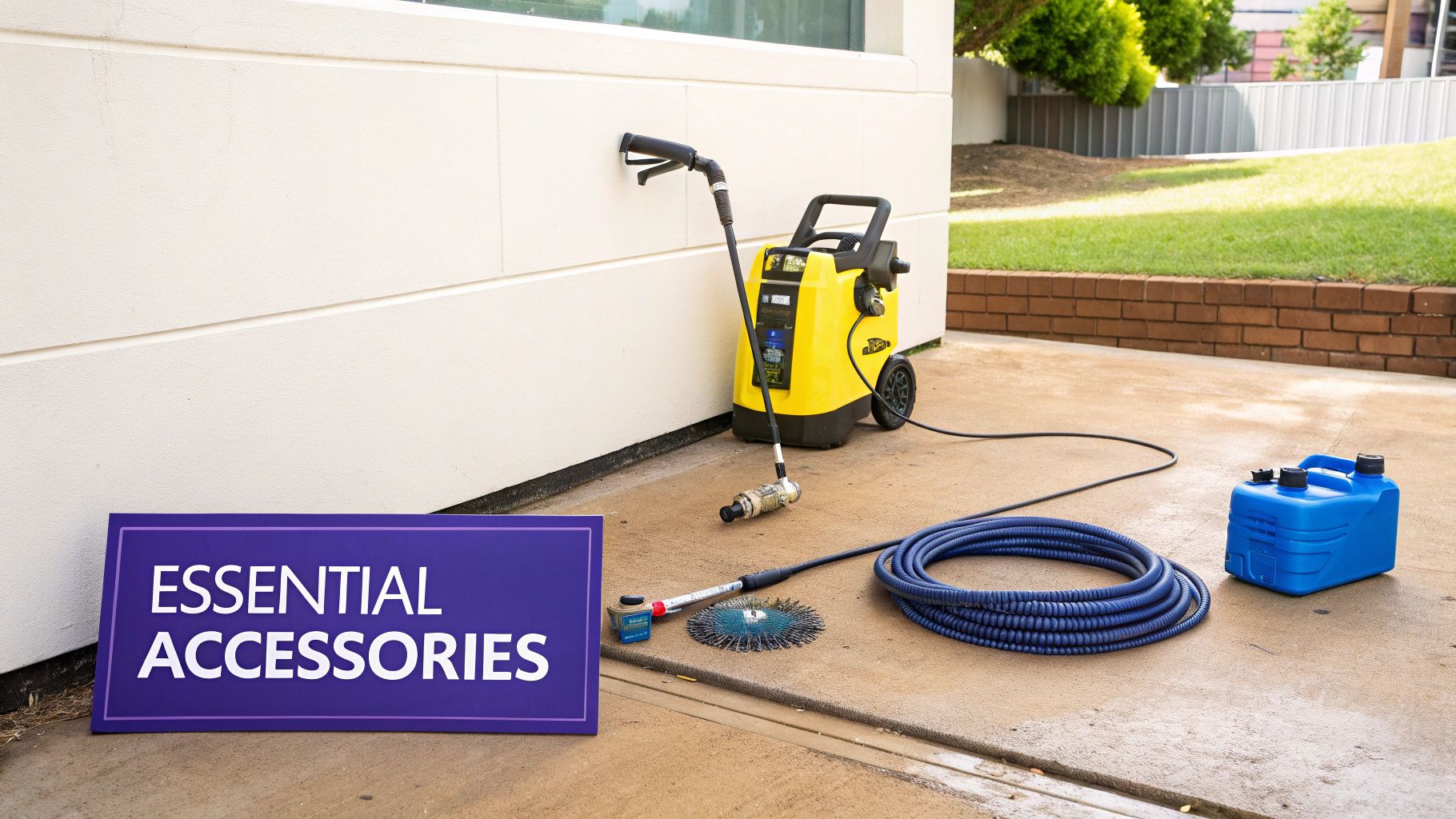
Here are the essential accessories every commercial operator should own:
Surface Cleaners: Think of this as a lawnmower for concrete. A surface cleaner uses a spinning bar with two or more nozzles inside a circular housing to clean large flat areas—driveways, patios, parking garages—up to 10 times faster than a standard wand. More importantly, it delivers a consistent, streak-free finish that’s nearly impossible to achieve with a nozzle alone.
Turbo Nozzles: Also called a rotary nozzle, this little powerhouse combines the immense force of a 0-degree nozzle with the wider coverage of a 25-degree fan spray. It creates a pulsating, cone-shaped jet of water that absolutely obliterates stubborn stains like embedded grime, rust, and graffiti without the risk of leaving behind those tell-tale "zebra stripes."
Extension Wands: Safely cleaning multi-story buildings in areas like Arroyo Grande or Pismo Beach requires reach. Telescoping extension wands, often made of lightweight fiberglass or aluminum, let you clean second or even third-story siding and eaves right from the safety of the ground.
Hoses, Injectors, and the Little Things That Matter
Beyond the main attachments, the supporting gear is just as critical for a smooth-running operation. Investing in quality components here prevents frustrating downtime and headaches on the job.
A durable, non-marking hose is a must. Cheaper hoses are notorious for leaving black scuff marks all over freshly cleaned concrete, forcing you to do the work twice. A quality hose resists kinking, abrasion, and breaking down under the sun. To learn more about picking the right one, check out our detailed guide on what you need to know about high-pressure hoses.
Pro Tip: Always go with a hose that’s longer than you think you’ll need. A 100-foot or 150-foot hose gives you the freedom to move around a property without constantly dragging your heavy pressure washer, saving a surprising amount of time and effort.
Finally, a reliable chemical injector is essential for applying detergents, degreasers, or other cleaning solutions efficiently. Downstream injectors are the go-to for commercial use because they introduce the chemical after the pump, protecting its seals from corrosive damage. This lets you apply soap at low pressure and then switch back to high pressure for rinsing with a simple nozzle change.
From Santa Maria to San Luis Obispo, these accessories are the building blocks of a professional, efficient, and profitable pressure washing business.
Your Local San Luis Obispo Equipment Partner
Picking the right pressure washer is just the first step. For any professional, what really matters is the support you get after the sale. When a machine goes down, every hour of downtime costs you money. That's where having a true local partner changes the game.
At Contractor's Maintenance Service, we're not just another equipment dealer. We're your team on the ground, dedicated to keeping you up and running.
We’re proud to serve commercial contractors, industrial businesses, and municipal departments all across San Luis Obispo County. From Paso Robles to Pismo Beach, we’re here to make sure you have what you need to get the job done right.
Serving the Central Coast
Our team is dedicated to supporting the businesses that keep our communities running. We're the go-to resource for professionals in:
San Luis Obispo
Paso Robles
Atascadero
Arroyo Grande
Pismo Beach
Santa Maria
And other surrounding Central Coast communities
We know the unique challenges that come with working on the Central Coast. Whether you're a painter in Paso or a property manager in Pismo, we have the expertise to help you select the perfect machine and keep it in peak condition for years to come.
We believe that your success is our success. That’s why we focus on being a long-term partner, not just a one-time seller. Our goal is to maximize your uptime and profitability through expert service and genuine support.
Our guys don't just point you to a machine on the floor; we talk through your specific trade and daily demands to find the best pressure washer for commercial use. And once you have it, we’re here for the long haul. We are an authorized service and warranty center for the top-tier brands you depend on, including Honda, Graco, and Multiquip.
More Than Just a Sale
What does that mean for you? It means when your equipment needs attention, you have a local expert ready to get it back to work. From routine tune-ups to complex repairs, our authorized service protects your warranty and guarantees the job is done right with genuine parts.
Need a replacement part fast? Swing by our local counter in San Luis Obispo. Need a specialized component shipped nationwide? We’ve got you covered there, too.
Our deep roots in this community give us a real understanding of what professionals need to succeed. To see more on how we support local businesses, check out our guide to professional pressure washing in San Luis Obispo, CA. We’re here to be the operational backbone for every contractor we serve.
Frequently Asked Questions
Even with the perfect machine on your truck, questions always pop up in the field. Here are some straightforward answers to the most common things we hear from contractors around San Luis Obispo County.
How Often Should I Service My Commercial Pressure Washer?
Think of it like the maintenance schedule for your work truck. Consistent care is what prevents those unexpected, job-stopping breakdowns. If your machine is running daily, a quick weekly check of the oil levels and filters is a must.
For a more serious service, you should be looking at a 3 to 6-month interval. This is when you'll want to change the pump and engine oil and give the whole machine a proper tune-up. A lot of pros just follow the manufacturer's hour meter—for instance, a Honda engine typically needs a look every 500 hours. Sticking to a schedule is always cheaper than dealing with a blown pump mid-job.
Can I Run Bleach Through My Pressure Washer?
Absolutely not. You should never run bleach, chlorine, or other harsh acids directly through your pressure washer's pump. These chemicals are incredibly corrosive and will eat through the internal seals and metal components in no time, causing permanent damage.
The right way to do it is with a downstream chemical injector. This simple attachment pulls the chemical into the water stream after it has already left the high-pressure pump, completely protecting your machine. When you're finished, always remember to run clean water through the system for a few minutes to flush everything out.
A downstream injector isn't just a suggestion; it's non-negotiable if you want your equipment to last. It keeps aggressive cleaners away from the most delicate and expensive parts of your pump, saving you from a costly repair that was 100% avoidable.
What's Better for Tough Stains: High PSI or Hot Water?
This is a classic question, and the answer really depends on what you're trying to clean. They solve different problems entirely. Think of one as a chisel and the other as a solvent.
High PSI is all about brute force. It's designed to physically blast away caked-on materials that have a strong bond to the surface, like dried mud, stubborn scale, or paint that's starting to peel.
Hot Water is the key to breaking down anything oil-based. It works by melting and dissolving grease, oil, and heavy grime. Cold water will just smear that kind of mess around, but heat breaks it apart on a molecular level so you can actually rinse it away.
So, if you're cleaning oily stains off a shop floor in Atascadero, you need hot water. But if you’re stripping old paint from a commercial building in Paso Robles, high PSI is what will get the job done.
What Are the Warning Signs of a Failing Pump?
Your pump will almost always give you a heads-up before it completely gives out. Learning to spot these signs can be the difference between a minor fix and a major overhaul. Keep an eye out for:
A noticeable drop in pressure that changing the nozzle doesn't fix.
The water flow "pulsing" or surging instead of spraying in a smooth, steady stream.
Visible water dripping or leaking from the pump seals.
The pump oil looking milky or cloudy, which is a dead giveaway that water has gotten inside.
If you see any of these signs, shut the machine down immediately. Trying to push through the job can quickly turn a simple seal replacement into a full pump rebuild. The smartest move you can make is to bring it in for service early.
At Contractor's Maintenance Service, we don't just sell you a box and send you on your way. We're here to provide the expert advice, authorized service, and genuine parts that keep professionals across San Luis Obispo County working. Whether you've got a question or need a repair, we have your back. Find the parts and support you need at https://www.contractorsmaintenanceservice.com.
Comments