


A Guide To Spare Parts Inventory Management
You're in the middle of a big job, the crew is working hard, and then it happens: your airless sprayer grinds to a halt. The culprit? A fifty-dollar seal that's on backorder. Suddenly, that small part isn't just an inconvenience—it's a direct hit to your bottom line.
This is where smart spare parts inventory management comes in. It's the critical line of defense that turns a potential disaster into a minor hiccup, transforming your inventory from a necessary cost into a powerful competitive advantage.
The True Cost Of Poor Parts Management

Many contractors see spare parts as a tedious chore—just a bunch of components collecting dust and tying up cash in the stockroom. But the real cost isn't the part sitting on your shelf; it's the part that isn't there when you need it most. That single missing component can trigger a cascade of expensive problems that go far beyond its price tag.
Picture this: your painting crew is in Paso Robles, scheduled for a three-day exterior job. On day one, a critical pump seal on the main Wagner sprayer fails. Without a spare on hand, the whole crew is idle. That's four painters on the clock with nothing to do, deadlines slipping away, and a client who's starting to get impatient. Every hour of delay is a direct hit to your labor costs and can do real damage to your professional reputation.
The Ripple Effect of a Single Missing Part
The financial fallout from poor parts management is rarely a single event. It creates a ripple effect that touches every corner of your operation, from the job site right back to the office. The consequences are often hidden but always substantial.
Wasted Labor: Your techs might spend hours diagnosing an issue, only to discover they don't have the part to fix it. That idle time is pure financial loss.
Project Delays: Downtime throws project timelines off schedule, which can trigger penalty clauses, create scheduling conflicts with other jobs, and leave you with unhappy clients.
Premium Shipping Costs: When a machine is down, you're forced to pay for expedited shipping. That $50 part quickly becomes a $150 emergency expense.
Reputation Damage: If you're consistently missing deadlines because of equipment failures, you'll erode client trust and find it harder to win future bids.
Your Local Partner on the Central Coast
Inventory mismanagement can lead to staggering costs. In fact, poor stock control can result in 20-30% excess inventory tying up your capital, a common pitfall we help you avoid by stocking curated best-sellers for Wagner and Titan sprayers. For a deeper dive, check out this analysis on the automotive spare parts market.
A proactive approach to spare parts inventory management is your best defense against unplanned downtime. It’s not about stocking everything; it's about stocking the right things.
For contractors in San Luis Obispo, Atascadero, Santa Maria, Arroyo Grande, Morro Bay, and the surrounding Central Coast areas, having a local partner is a game-changer. Instead of waiting days for a part to ship from across the country, you have an expert resource right in your backyard.
Contractor's Maintenance Service offers more than just parts. We provide the strategic support you need to build an inventory system that stops these costly failures before they happen, keeping your operations seamless and profitable.
Before you can get a handle on your spare parts, you have to know exactly what you’re working with. A solid inventory isn't built on guesswork; it’s built on a clear, comprehensive audit of your equipment and the components that keep it humming. This first step is the most critical one in moving from putting out fires to actually controlling your operations.
Think about all the equipment in your fleet, from the Graco paint sprayers on a job in Arroyo Grande to the Multiquip compactors prepping a site over in Atascadero. Every machine has its own unique list of parts, and not all of them are created equal. The goal here is to create a master list of your assets and the spares they rely on.
This means physically walking through your shop, inspecting your gear, and digging through your current parts storage—whether that's a dedicated stockroom or just a few shelves in a service truck. You need to document everything. This baseline will inform every single decision you make from here on out.
Starting Your Equipment and Parts Audit
A full-blown audit can feel like a massive undertaking, but you don't have to boil the ocean. Start small and build momentum by focusing on your most-used or most critical pieces of equipment first.
Here's a simple checklist to get you rolling:
List All Major Equipment: Get everything down on paper. Document each machine by name, model, and serial number (e.g., Honda GX390 engine, Wagner Control Pro 190 sprayer).
Identify Critical Components: For each machine, figure out which parts are most likely to fail or bring a job to a screeching halt. Your best resources here are the manufacturer's manuals and your own repair history.
Count Existing Spares: Go through what you already have. Record part numbers and quantities for everything on hand.
Assess Part Condition: Make a note of any parts that look old, damaged, or possibly obsolete. An unusable part taking up space is worse than having no part at all.
For a deeper dive into the strategy behind this, understanding the different essential inventory management methods can give you a solid framework for your efforts.
Differentiating Between Value and Importance
Once you have a complete list of what you own, the real work begins: classifying those parts. This is where a lot of contractors get tripped up, often treating a $5 fitting with the same urgency as a $500 engine control module. The two most practical ways to sort this out are ABC analysis and criticality analysis. These methods help you focus your energy—and your money—where it counts.
ABC analysis is all about the money. It sorts your parts based on their annual consumption value:
Category A: The big-ticket items. These are your high-value parts that make up a small portion of your total inventory but account for the lion's share of your spending (think a complete pump assembly for a Graco sprayer).
Category B: The middle-of-the-road parts.
Category C: The small stuff. These are your low-value, high-quantity parts like seals, O-rings, and filters.
Criticality analysis, on the other hand, ignores the price tag completely. It’s all about operational impact. You classify a part based on one simple question: "What happens if this fails and we don't have a spare?"
Take a low-cost hydraulic fitting on a compactor, for example. In an ABC analysis, it’s a Category C part. But if its failure can shut down the entire paving operation for a day, it’s a high-criticality item. Conversely, an expensive but rarely used engine might be Category A by value, but if you have backup equipment, its failure might have less immediate impact.
The sweet spot is combining these two approaches. This gives you a powerful matrix for making smart decisions about what to stock. For our clients here in San Luis Obispo and the surrounding areas, we often find that zeroing in on high-criticality, low-cost parts delivers the biggest and fastest return by preventing the most common—and annoying—sources of downtime.
ABC Vs Criticality Analysis For Spare Parts
Trying to decide where to start? This table breaks down how each method works and which might be a better fit for your immediate needs.
Aspect | ABC Analysis | Criticality Analysis | CMS Recommendation |
|---|---|---|---|
Focus | Financial Value (Annual Spend) | Operational Impact (Downtime Cost) | Blend both. Prioritize high-impact parts first, regardless of cost, to stabilize operations. |
Example | An expensive, rarely used engine. | A critical, low-cost hydraulic hose. | Always stock the hose. Consider on-demand ordering for the engine to free up cash. |
Benefit | Helps control capital tied up in inventory. | Minimizes costly, unexpected project delays. | Creates a resilient inventory that balances cost against uptime. |
Best For | Optimizing your budget and reducing carrying costs. | Ensuring job site continuity and preventing catastrophic failures. | A practical, real-world strategy that protects both your schedule and your bottom line. |
Ultimately, a smart inventory strategy uses both lenses to decide what earns a spot on your shelf.
Our team at Contractor's Maintenance Service can help you run this analysis, pinpointing the essential spares you absolutely need for your specific fleet. You can even browse our catalog of industrial equipment parts to see what we keep in stock to support local contractors.
How To Forecast Demand And Set Reorder Points
Once you've audited your parts room and figured out what's critical, the next move is to shift from a reactive to a proactive mindset. Running out of a vital part is just as bad as having thousands of dollars in components gathering dust. The goal is to hit that sweet spot by predicting what you'll need and when.
Forecasting isn't about gazing into a crystal ball or buying fancy software. It starts with the data you already have. Dive into your maintenance logs and purchase orders from the last 12-24 months. This history is a goldmine for spotting consumption patterns.
Let's say you're managing a fleet of Honda-powered equipment for a public works department in San Luis Obispo. A quick look at your records would likely show a surge in air filter and spark plug orders every spring, right as the mowers and trimmers get prepped for landscaping season. That's a predictable pattern, and it’s the bedrock of your demand forecast.
Calculating Your Safety Stock
With a handle on your typical usage, it's time to build in a buffer for the unexpected. This is your safety stock—a small, strategic reserve that shields you from sudden equipment failures or supplier delays. Think of it as your insurance policy against downtime.
To figure it out, you just need two numbers:
Maximum Daily Usage: The most you've ever used of a specific part in a single day.
Maximum Lead Time: The longest you've ever had to wait for that part to show up after ordering.
Imagine the most spark plugs you’ve burned through in a day is five, and the longest you've waited for a supplier shipment is ten days. A straightforward safety stock calculation would be . This simple formula ensures you have enough inventory to weather the absolute worst-case scenario.
This flow chart nails the process of building a solid inventory foundation. It all starts with the audit and classification work you need to do before making smart stocking decisions.
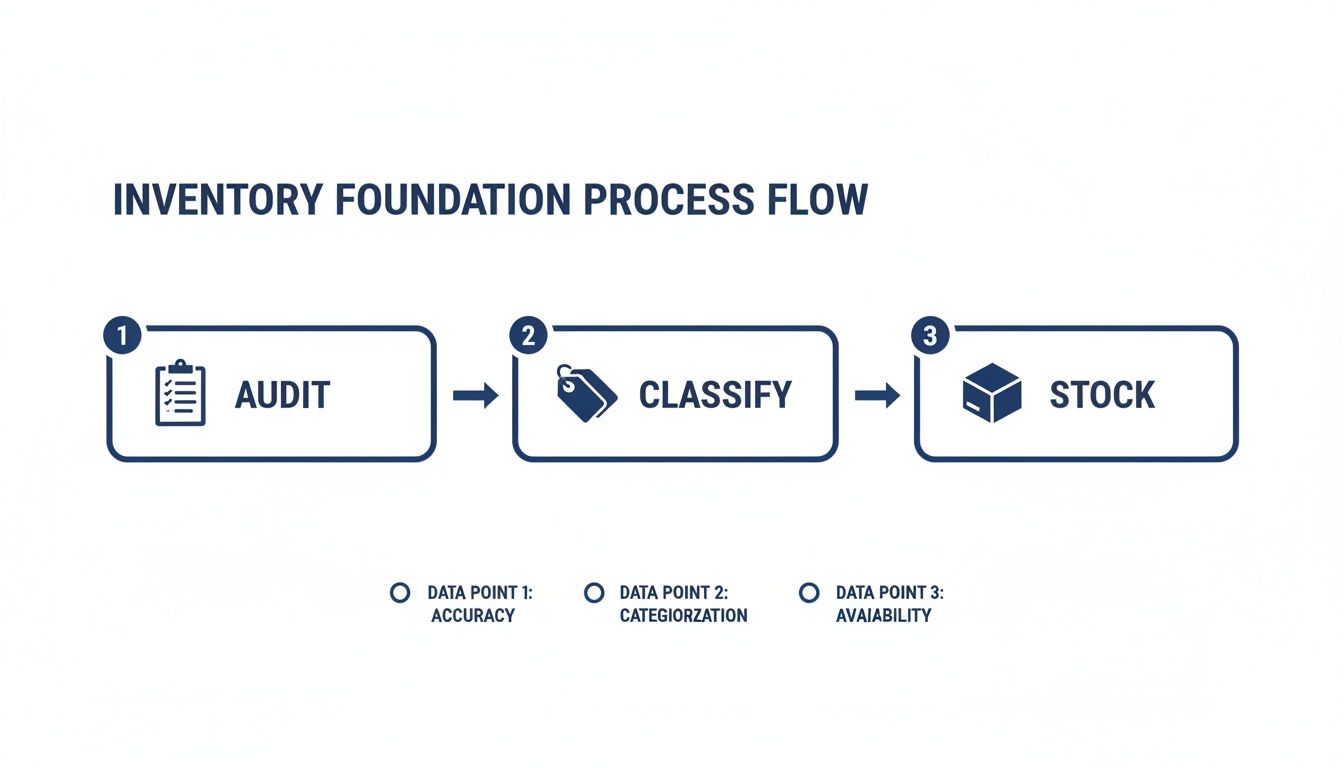
This visual really drives home the point: a methodical approach—audit, classify, then stock—is the only way to guarantee you have the parts you need, right when you need them.
Setting Smart Reorder Points
While your safety stock is there for emergencies, your reorder point (ROP) is what keeps the whole system running like clockwork. It’s the specific inventory level that automatically triggers a new purchase order. This ensures fresh parts arrive just as you start tapping into your safety supply. Learning how to properly calculate the reorder point is a cornerstone of inventory management that saves you from costly stockouts.
The formula is pretty simple: .
Let's stick with our spark plug example. If you typically use two plugs a day, the average lead time is five days, and your safety stock is 10 plugs, your ROP is . The moment your spark plug count hits 20, it's time to place a new order. You can see how this ties into a bigger maintenance picture in our guide comparing predictive vs. preventive maintenance.
This proactive approach puts an end to last-minute scrambles and expensive rush shipping fees. It turns inventory management from a guessing game into a predictable, data-driven process that protects both your operations and your budget.
For a commercial painter dealing with an unexpected equipment breakdown, this kind of system is a lifesaver. Predictive analytics can forecast part demand with 85-90% accuracy, which helps cut excess inventory costs by 20-40% and seriously boosts uptime.
For the businesses we work with in San Luis Obispo and nearby areas like Paso Robles, Atascadero, Santa Maria, Arroyo Grande, and Morro Bay, having Contractor’s Maintenance Service as your local partner makes all of this much easier. We know the lead times for critical components and can help you build a forecast based on the real-world demands of operating here on the Central Coast.
Optimizing Storage And Supplier Relationships
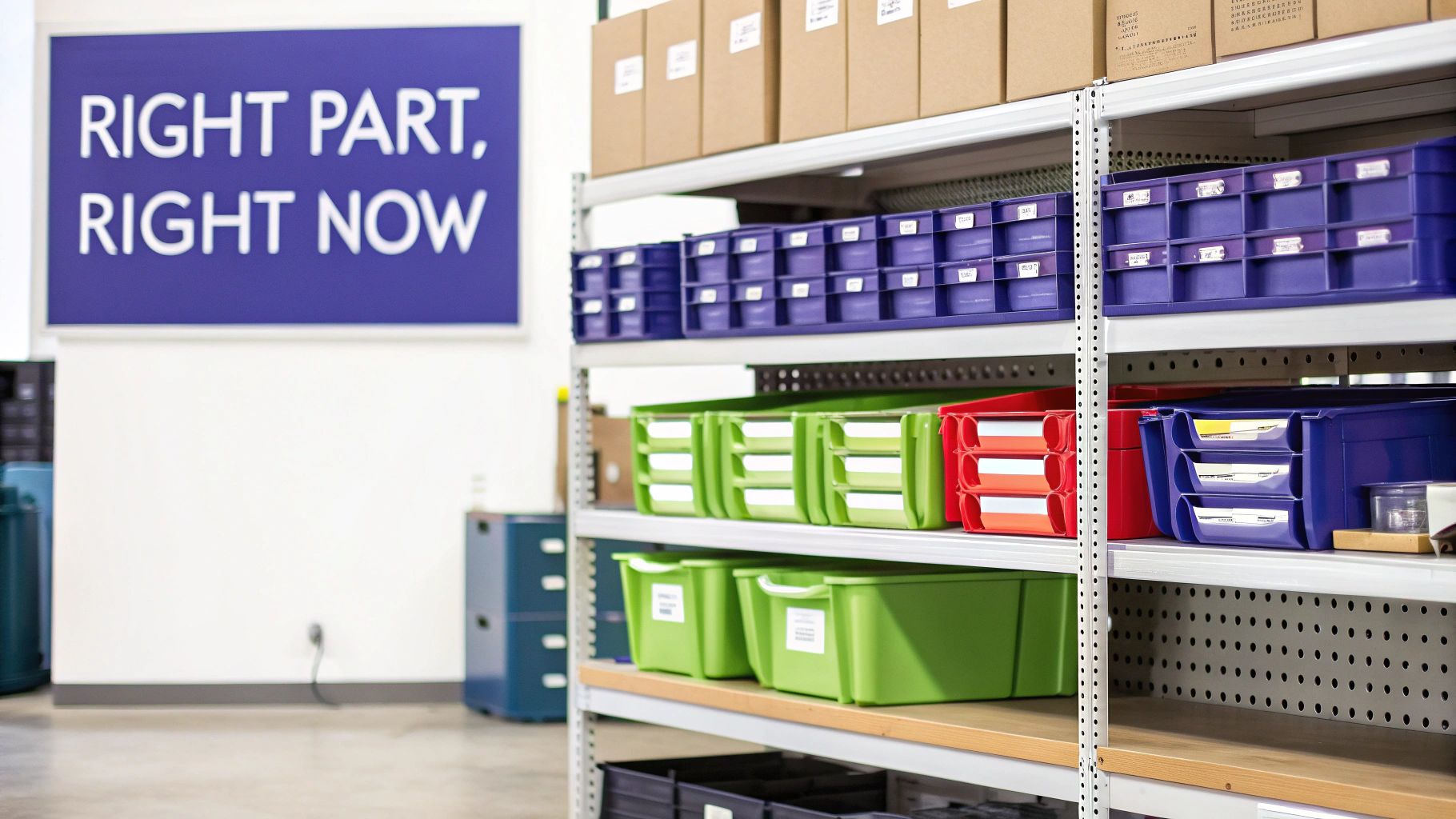
Great spare parts management is about more than just numbers on a spreadsheet. Even the most accurate forecast or perfect reorder point falls apart if your technician can't find the part they need, or if the component you just received is a cheap knock-off.
A messy stockroom or a shaky supplier relationship will quietly sabotage your entire operation. Let's get into the two physical-world factors that make or break your system: how you store your parts and who you buy them from.
Creating A Smart and Accessible Storage System
The way you physically organize your parts—whether in a stockroom, a van, or a job box—is where efficiency is won or lost. Every minute a tech spends digging through unlabeled bins is pure lost productivity, and that hits your bottom line directly. The goal here is simple: create a system where anyone on your team can walk up, grab the right part, and get back to work in seconds.
A clean, logical, and clearly labeled storage area isn't a "nice-to-have"; it's non-negotiable. It protects your inventory from damage, eliminates guesswork, and speeds up repairs like nothing else. This isn’t about needing a giant warehouse, either. It’s about being smart with the space you've got.
Here are a few practical tips we've seen work time and again:
Embrace "First In, First Out" (FIFO): This is absolutely critical for parts with a shelf life, like O-rings, seals, gaskets, or certain fluids. Always store the older stock in the front so it gets used before it expires or degrades.
Use Clear, Labeled Bins: Invest in sturdy bins, preferably transparent or with an open front. Label every single one with the part number, a simple description, and maybe even the machine it's for (e.g., "Graco Ultra 395 Pump Seal Kit, #244194").
Level Up with QR Codes: For a more modern setup, slap a QR code on each bin. A quick phone scan can link directly to the part's full specs in your system, show current stock levels, or even open a reorder page on a supplier's website.
Protect Your Sensitive Components: Electrical parts, sensors, and circuit boards are magnets for dust and static. Keep them stored in anti-static bags in a clean, dry area, far away from moisture and shop grime.
An organized stockroom is a direct reflection of an organized operation. It builds discipline, reduces waste, and empowers your team to work more effectively, whether they're in the shop or out on a job in Morro Bay.
The Critical Role of Your Parts Supplier
Where you buy your parts is every bit as important as how you track them. It’s easy to get tempted by the promise of saving a few bucks from a generic online seller, but that path is often paved with hidden costs—wrong parts, poor quality, and zero support when you need it most.
Building a solid relationship with a reliable, authorized supplier isn't just a transaction; it's a strategic partnership. This is about having an expert in your corner.
An authorized service center like Contractor's Maintenance Service offers a level of support that faceless online retailers can't touch. We're not just shipping you a box with a part number on it.
Guaranteed OEM Parts: We only deal in genuine OEM (Original Equipment Manufacturer) parts. That means you get a perfect fit, the performance you expect, and your machine's warranty stays intact.
Expert Technical Support: Not 100% sure which part you need? Our team has hands-on experience to help you troubleshoot the problem and pinpoint the exact component you need the first time. For a deeper dive, check out our guide to sourcing Graco sprayer components.
Warranty Handling: If a part fails prematurely, we handle the warranty claim for you. No administrative headaches, no waiting on hold—we just get a replacement in your hands faster.
Local Availability: For contractors and public works departments across the Central Coast—from San Luis Obispo and Arroyo Grande to Paso Robles and Santa Maria—having a local partner means getting a critical part the same day. That immediate access can turn a multi-day shutdown into a simple, hours-long repair.
When you choose the right supplier, procurement stops being a cost center and starts becoming a powerful tool for keeping your operations running smoothly.
Using Technology And Kpis To Measure Success
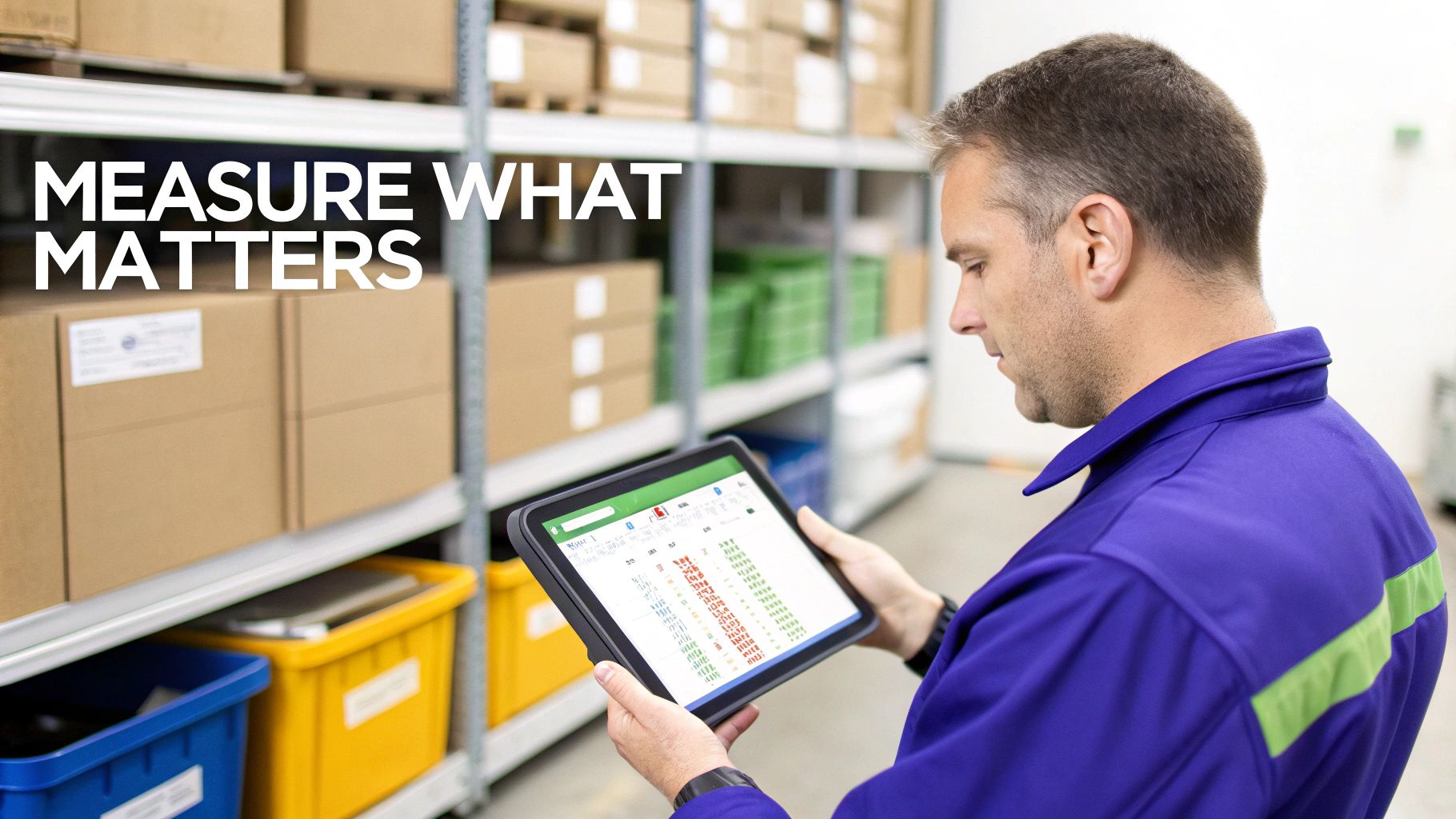
Let's be honest: spreadsheets and gut feelings will only take you so far with spare parts. If you really want to get a handle on your stockroom, you have to measure what matters. That's where technology and the right performance metrics come in. The goal isn't to make things more complicated—it's to simplify the entire process.
A Computerized Maintenance Management System (CMMS) or an Enterprise Resource Planning (ERP) system is the central brain of your operation. These platforms bring all your inventory data together, automate reorder points, and give everyone on your team a single, reliable source of information.
Imagine this: instead of a tech out in Atascadero calling the shop to ask if a part is in stock, they just check their phone. Instead of someone spending hours tallying part usage at the end of the month, the system does it automatically. That’s how you move from reactive chaos to proactive control.
Key Performance Indicators You Should Be Tracking
Your software gives you the data, but Key Performance Indicators (KPIs) tell you the story behind the numbers. Focusing on a few core metrics is the best way to see how healthy your inventory system really is and pinpoint exactly where you need to improve. Don't get overwhelmed; just start with these three.
Every contractor and maintenance manager should be watching these metrics:
Inventory Turnover Rate: This tells you how many times you sell through your entire inventory over a specific period. A higher number is usually a good sign, meaning your cash isn't just sitting on a shelf in slow-moving parts.
Stockout Frequency: How often do you need a part that isn’t there? A high stockout rate is a major red flag. It points to problems with your forecasting, safety stock levels, or even your suppliers.
Carrying Costs: This is the total cost of just having inventory—storage space, insurance, and the risk of parts becoming obsolete. Tracking this shows you the true price of keeping those parts on hand.
These numbers give you a clear, objective look at what’s working and what’s not. If your turnover is low, you might be overstocking. If stockouts are a regular headache, it's time to revisit those reorder points.
Technology is a powerful ally, but it’s most effective when paired with a solid strategy. The goal is to use data to make smarter, faster decisions that directly impact your profitability and operational uptime.
Using Technology for a Competitive Edge
Modern systems do more than just count parts; they deliver insights you can actually use. A good CMMS, for example, can automatically generate reports showing which parts are flying off the shelves, helping you fine-tune your ABC and criticality analyses over time. It can also flag parts that haven't moved in a year, letting you know it might be time to clear out obsolete stock.
This data-driven approach is a game-changer. In asset-heavy industries like construction, intelligent inventory buffering is replacing static safety stocks with dynamic, usage-based models. This shift can lead to 20-30% reductions in lifecycle costs while pushing parts availability up to 98%. For a deeper dive into these trends, check out the latest research on the spare parts management market.
Local Support for Your Systems
Getting these systems up and running can feel like a huge task, which is why having local support makes all the difference. At Contractor's Maintenance Service, we work with businesses across San Luis Obispo and nearby communities like Paso Robles, Santa Maria, and Morro Bay to help them make sense of their data.
We can help you figure out the right KPIs to track for your specific fleet and goals. By combining your internal data with our on-the-ground knowledge of local supplier lead times and demand patterns, we can help you build a truly optimized spare parts inventory system that saves you time, money, and a lot of headaches.
Your Partner In Performance On The Central Coast
Setting up a solid spare parts inventory system is one thing, but keeping it running smoothly is a whole different ballgame. It's a constant process of tweaking and adapting. While this guide gives you the playbook, having a local partner to help you execute that strategy is what really drives results.
That’s where we come in. At Contractor's Maintenance Service, we're more than just a parts supplier for businesses on the Central Coast—we’re your boots-on-the-ground support team, dedicated to keeping your equipment humming.
Local Expertise You Can Count On
We’re proud to work with contractors and public works departments right here in our community. Our team is always on the move, serving clients throughout:
San Luis Obispo
Paso Robles
Atascadero
Santa Maria
Arroyo Grande
Morro Bay
Pismo Beach
Grover Beach
Nipomo
And the surrounding Central Coast areas.
Being local means we get the unique challenges you face every day. Forget waiting on parts to cross the country. With us, you get the critical components and hands-on advice you need, right when you need them.
Whether you’re trying to prevent a shutdown with a single critical part, need an expert to diagnose a tricky issue, or want a hand optimizing your stockroom, our team is here to help you get the job done right.
We stock genuine OEM parts and have the technical know-how to protect your investments. Our mission is simple: help you cut downtime, get a handle on costs, and make every job more profitable. Let's build a spare parts inventory management system that gives you a real edge.
Frequently Asked Questions
When you're trying to get a handle on spare parts, a few questions always seem to pop up. Here are some of the most common ones we hear from contractors and maintenance managers right here on the Central Coast, along with our straightforward, field-tested answers.
What Is The Biggest Mistake In Managing Spare Parts Inventory
Hands down, the biggest mistake is fixating on a part's purchase price while ignoring its total cost of ownership. It's a classic case of tunnel vision. This overlooks the huge, hidden costs of downtime, wasted labor, and project delays that happen when a critical part isn't on the shelf.
Think about it: a cheap aftermarket part that fails constantly will cost you far more in lost revenue and angry clients than a genuine OEM component. Smart inventory management is about prioritizing parts based on their impact on your operations, not just their price tag.
How Can A Small Business Manage Inventory Without Expensive Software
You can get surprisingly far with a simple, disciplined spreadsheet. Seriously. Start with essential columns: Part Number, Description, Equipment it belongs to, Location, Quantity on Hand, Reorder Point, and Supplier. The secret sauce isn't the technology; it's consistency. You have to track every single part that comes in and goes out.
This manual system does more than just track parts—it builds the data and the habits you'll need if you ever decide to upgrade to a CMMS. For local businesses in San Luis Obispo, Paso Robles, and Santa Maria, our team can even help you build a "starter list" of critical spares for your specific machinery, making the whole process feel less overwhelming from day one.
A well-maintained spreadsheet is more powerful than expensive software that isn't used correctly. Simplicity and consistency are your best tools when starting out.
Should I Stock OEM Parts Or Are Aftermarket Parts Good Enough
This is a big one. While some aftermarket parts might be okay for non-critical uses, stocking OEM (Original Equipment Manufacturer) parts is always the safest bet for your core components. OEM parts are the only way to guarantee the correct fit, performance, and safety specs your equipment was designed with.
Using non-OEM parts can void warranties and cause premature failures on crucial gear like your Graco sprayers or Honda engines. For any part that can bring a job to a screeching halt, we always recommend investing in OEM. It's about reliability and protecting your equipment. For contractors in Atascadero or Arroyo Grande, this simple choice can be the difference between a profitable day and a costly one.
Ready to build a smarter spare parts inventory management system that prevents downtime and protects your bottom line? Contractor's Maintenance Service provides the expert advice and genuine OEM parts you need. Visit us online or at our San Luis Obispo shop to get started.
Find the right parts now at https://www.contractorsmaintenanceservice.com.
The modular approach to agent capabilities is often what separates a flexible system from a rigid one. Having clearly defined modules for research, collection, and social media interaction means you can assemble exactly the behavior you need. The TOML examples provided are especially useful for understanding how to combine these modules effectively. I recommend reviewing the configuration details on OpenFang's module reference before building your own setup.